



Vol. 1 T-Rex vs. Triceratops: A History of Their Fated Rivalry
It's been a long time since my last "Secret Dinosaur Museum" entry, but I'm back with a fresh start (though my writing style remains the same) with the [New Secret Dinosaur Museum], featuring our dinosaurs that miraculously escaped the earthquake damage. For the first installment, I'd like to look back at the history of the "T-Rex vs. Triceratops" conflict, which is the highlight of the "Dinosaur Expo 2011" currently being held at the National Museum of Nature and Science in Ueno.
Given that they were unearthed from the same geological stratum and T-Rex bite marks were found on Triceratops frills, there's no doubt about the conflict between the two. The fact that this rivalry still excites us 70 million years later truly deserves the title "Greatest Battle in Earth's History." (While Allosaurus vs. Stegosaurus is a contender, Stegosaurus doesn't seem as strong as Triceratops and has less impact.)
At this dinosaur exhibition, Tyrannosaurus "Bucky" is crouched in a an ambush stance. On the other hand, the Triceratops stands tall and proud with its front legs extended, and since Bucky is a bit smaller, the Triceratops appears to be stronger than Bucky.
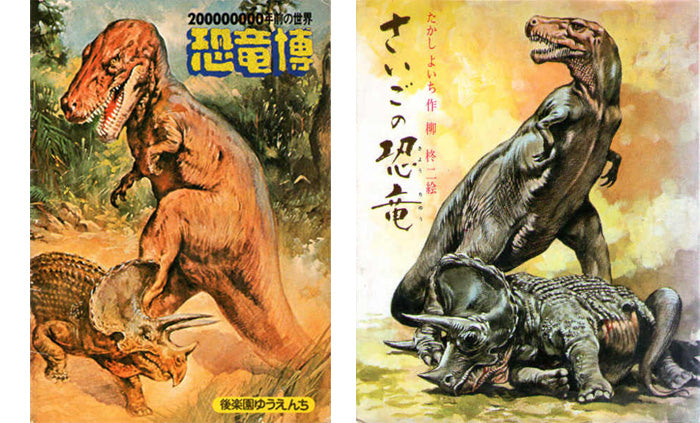
Once upon a time, the image of this greatest rival showdown in the dinosaur world was of a fierce T-Rex roaring, towering over a Triceratops with its horns lowered, looking for an opening, a one-on-one duel in a windswept wilderness. This image is thought to have come from Charles Knight's work in the 1930s, and the depiction of the two giants' battle, which stained the gravure pages and encyclopedia entries of Japanese boy's manga magazines with blood from the 60s to the 80s, is deeply ingrained in the hearts of long-time dinosaur enthusiasts like myself.

Photo 1 Charles Knight's work
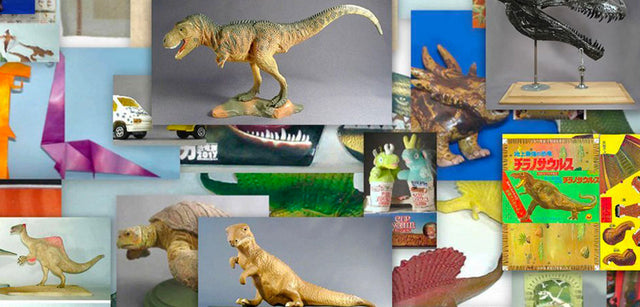
Behold, the nostalgic showdown scenes from the Showa era.

Photo 2 Showdown scenes from the Showa era

Photo 2 Showdown scenes from the Showa era

Photo 2 Showdown scenes from the Showa era

Photo 2 Showdown scenes from the Showa era

Photo 2 Showdown scenes from the Showa era

Photo 2 Showdown scenes from the Showa era
Photo 3 is an extremely rare item from even further back in time, an illustration from a book titled "Zoku Doubutsu no Kyoui" (More Wonders of Animals) published by Shinkosha in 1932. It might be older than Knight's work.
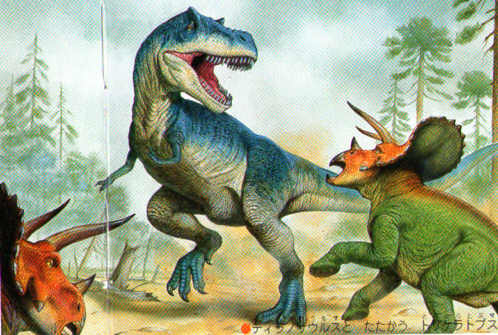
Now, in the 90s, as the image of dinosaurs underwent a transformation, illustrations changed dramatically. Triceratops formed herds, sometimes even circles to defend themselves (like in Mark Hallett's paintings). Tyrannosaurs also hunted in teams, and it was no longer a duel but merely a hunt.

Photo 3 Zoku Doubutsu no Kyoui
(Photos 4 & 5) The ominous atmosphere has receded, and of course, even though I know this is closer to reality, I can't help but feel a little unsatisfied. I want to tell Bucky, "The T-Rex of old didn't resort to cowardly ambushes."

Photo 4

Photo 5
Given how popular this showdown scene is, I expected there would be many film depictions, but to my surprise, I only found two examples in movies. To give some examples of missed opportunities: in "The Lost World" (1925), both T-Rex and Triceratops appear, but the Triceratops is confronted by an Allosaurus. Although visually indistinguishable from a T-Rex, Professor Challenger (it's a silent film) explicitly states it's an Allo, so there's nothing to be done. The T-Rex (or rather, a theropod resembling one) battles an Agathaumas, a Styracosaurus-like ceratopsian that is no longer recognized. In Disney's famous animated film "Fantasia," the T-Rex's opponent is a Stegosaurus. In "One Million Years B.C.," the Triceratops's memorable scene is with an overly large Ceratosaurus. "The Valley of Gwangi" (generally considered an Allosaurus, but according to literature, it's a three-fingered T-Rex) defeats a Styracosaurus, and in "Jurassic Park," the Triceratops is merely sick in bed. So, as far as I've checked, the only two films where the showdown scene between the two giants can be seen are Ray Harryhausen's animated "The Animal World" (1956) (Photo 6) and, surprisingly, "Mothra 3" (1998).

Photo 6 The Animal World
In the former, a volcano erupts before they can even engage, and both are swallowed by lava. In the latter, with its special effects that make you want to avert your eyes, right after the T-Rex attacks the Triceratops, King Ghidorah appears, grabs the T-Rex, and throws it away. It's a complete anticlimax. Of course, recent TV documentaries with their extensive use of CG frequently show confrontation scenes, but just like in illustrations, instead of a careful face-off, the standard seems to be a T-Rex chasing a sprinting Triceratops and taking a bite at the back of its frill.
Finally, let's introduce some figures.
I have three kit sets of T-Rex vs. Triceratops at home. The Aoshima soft vinyl kit "Dinosaur Story" was introduced in
Secret Museum Vol. 63, so I'll introduce the remaining two.

Photo 7
Photo 8 is a smaller kit, and the sculpting is quite new, so it might be from the 90s.

Photo 8
I regret missing out on a kit released by Lunar Models, an American garage kit manufacturer, which faithfully modeled Knight's artwork.
There are also kits of a crouching T-Rex. The crouching pose itself has been seen in illustrations and other media for a long time (what's new about this Bucky is that the skeleton itself is posed), and it seems to have somewhat inspired modelers.
Photo 9 shows a mini-kit manufactured by SHINZEN Zokei Kenkyusho.

Photo 9 SHINZEN Zokei Kenkyusho Mini Kit
Photo 10 is a non-commercial item from Kaiyodo, and I believe the sculptor was Shigemi Yamazaki.

Photo 10 Kaiyodo non-commercial item
Finally, bonus photos 11 and 12. They seem to foreshadow one of the highlights of this dinosaur exhibition: "partially feathered Tyrannosaurus."

Photo 11 Feathered Tyrannosaurus

Photo 12 Feathered Tyrannosaurus
By the way, Photo 12 is a CD, "Blonde Saurus" by the popular 80s rock band REBECCA.
← Older Post Newer Post →