



Vol. 65 History of Dinosaur Plastic Models 10
As I mentioned in Treasure House Vol. 9, 1993, the year of "Jurassic Park," saw an unprecedented dinosaur boom, and the streets were flooded with all sorts of JP merchandise and piggyback dinosaur goods.
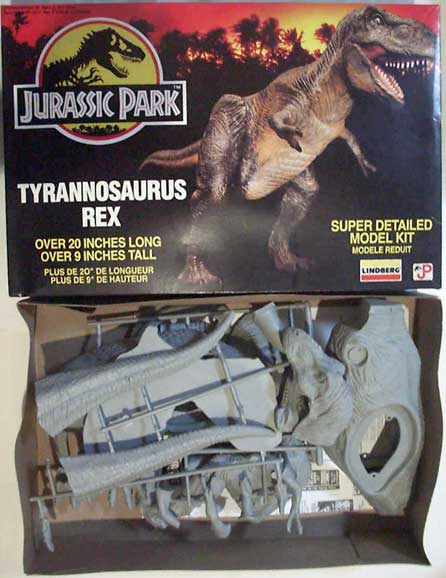
Amidst this trend, Lindberg, a long-established American plastic model manufacturer, released JP dinosaur plastic models. It had been an astonishing 11 years since Airfix's Brontosaurus that an overseas manufacturer had released a new dinosaur plastic model.
So, this time, I'll introduce the Jurassic Park dinosaur kits. Due to their surprisingly large number, the Tamiya "Dinosaur World Series," released the same year and originally planned to be introduced alongside these to conclude the history of plastic models, has been pushed to the next installment.
Lindberg
Five types: Velociraptor (Photo 1), Tyrannosaurus (Photo 2), Dilophosaurus (Photo 3), Stegosaurus, and Corythosaurus (both re-releases of old Pyro products and not featured in the movie. See Treasure House Vol. 56). While there are some minor issues with the proportions, the details are quite good. However, I only built the Velociraptor.


Horizon
The lineup is the same as Lindberg's: Velociraptor (Photo 4), Tyrannosaurus (Photo 5), and Dilophosaurus (Photo 6), but these are soft vinyl assembly kits. As they are based on the movie props, the craftsmanship is magnificent. They exceed 60 cm in length. There is also a Brachiosaurus.


Tsukuda Hobby
There were six types of soft vinyl assembly kits: Tyrannosaurus, Raptor, Dilophosaurus, Brachiosaurus, Triceratops, and Gallimimus, covering the main characters. However, I only bought the Gallimimus, which remains unopened in the back of my closet. This is because finished versions of the exact same items were sold in parallel, and I ran out of steam after collecting those. Normally, a true enthusiast would buy the kits too, but at the time, there was just too much to buy, so I ended up being a bit timid.


Looking back, I realize I didn't build much that year, perhaps too busy collecting. I certainly felt, "Once I build the top-tier Horizon kit, I'll be satisfied... I'm tired of painting the same colors."

In 1997, the second film, "The Lost World: Jurassic Park," was released, and this time, the venerable manufacturer "Revell" released Tyrannosaurus and Velociraptor kits (Photo 10). These two are separate kits, but their bases can be connected in the Aurora style (Treasure House Vol. 57). Aside from the Tyrannosaurus having a tail that's too short, they are very well made. Two types of vehicles from the movie were also released, but I skipped them as they aren't dinosaurs.
Hasegawa, another leading Japanese plastic model manufacturer alongside Tamiya, well-regarded for its scale models like airplanes, also released four standard types: Tyrannosaurus, Triceratops, Stegosaurus, and Pteranodon. Though small kits of about 15cm, their proportions and details are impeccable, truly showcasing Hasegawa's quality. The regrettable part, however, is that the Tyrannosaurus, no matter how favorably viewed, is clearly an Allosaurus. Its hands even prominently feature three fingers. Who, and where, made such a mistake...? Perhaps they mistakenly made an Allosaurus, but since Allosaurus doesn't appear in the movie, they passed it off as a T-Rex, thinking it wouldn't be noticed. If this were a scale model, it would be like a Panther tank package labeled as a Tiger tank, leading to a product recall. It's sad how dinosaur models are seemingly undervalued. Well, it's a good kit if you view it as an Allosaurus.
(Photos 11, 12, 13)


By the time "Jurassic Park III" was released in 2001, plastic models were no longer being produced, and instead, Kaiyodo's JP III series of candy toys were developed. Times had certainly changed.
← Older Post Newer Post →