




Vol. 41 In Memory of Extinct Dinosaur Figures
The "British Museum (Natural History) Dinosaur Series," which was previously confirmed to be extinct (?), is a dinosaur model series that is very familiar and cherished by dinosaur enthusiasts of our generation. For over ten years since its import to Japan in the early 1980s, there was no dinosaur model that surpassed it in terms of quality and cost performance, and it filled the souvenir sections of museums and events. Because it was so commonplace, I, for one, was regrettably unaware that the number of these models on store shelves was decreasing.
I would like to look back at this now-defunct (though still available in Japan) series, which combined precision, durability, and affordability (200-2500 yen in Japan!).
I first learned about these dinosaurs in the December 1977 issue of the model magazine "Hobby Japan," which featured a special article titled "Lost World: The Ancient World"—the first dinosaur feature in a model magazine to my knowledge. It was introduced alongside newly released Airfix dinosaur plastic models and the increasingly rare Aurora Prehistoric Scenes (Treasure House Vol. 10). The article stated, "[These are models sold inside the British Royal Natural History Museum (?), not toys, but magnificent 1/48 (some American collector books say 1/45, often 1/40 in Japan) pure scale models—they are splendid models, living up to the name of 'museum-made.' Unfortunately, they are not sold domestically, nor even in Britain outside the museum...]". At that point, all I could do was yearn for them. It's no wonder I found them at the New York Natural History Museum in 1980, bought a whole bunch, and shed tears (Treasure House Vol. 20). Since then, I've used them in dioramas (Treasure House Vol. 15) and was delighted by unexpected new releases—which accurately reflected the proportions of their time—it was a long association. However, since the last two models were released in '93, they had been half-forgotten. Now, as I gaze at them again, considering their "extinction," I find them to be remarkably well-made and full of character. Let's introduce them chronologically.
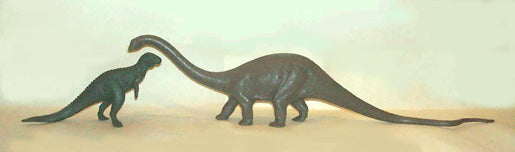
Photo 1
1974: Megalosaurus, Diplodocus
*The Diplodocus's neck is so elegant.

Photo 2
1975: Scelidosaurus, Stegosaurus, Triceratops, Glyptodon, Mammoth
*Megalosaurus and Scelidosaurus are historical dinosaurs of the British Natural History Museum.

Photo 3
1977: Tyrannosaurus
*Still cool even with its tail dragging!
1978: Plesiosaurus, Pteranodon
1980: Iguanodon
*Casually in a forward-leaning posture.

Photo 4
1984: Brachiosaurus
1985: Cetiosaurus
1987: Apatosaurus
1988: Mamenchisaurus
*A remarkable 5 out of the 21 species in the series are sauropods! The Cetiosaurus model is probably the only one in the world. At that time in '87, the slender-faced Apatosaurus was only named as such by Kaiyodo Araki's work (vs. Ceratosaurus). The giraffe-like posture of Mamenchisaurus was a trend back then.

Photo 5
1986: Ichthyosaurus
1988: Liopleurodon
*Another local specialty.

Photo 6
1988: Stenonychosaurus (Troodon)
This one is about 1/10 scale. It's probably the world's first mass-produced figure with a fully bipedal stance, and even today, probably the only Troodon model (though there are many dromaeosaurids), making it rare. It's a superb model that even shows binocular vision.

Photo 7
1989: Baryonyx, Muttaburrasaurus
*Baryonyx is a dinosaur recently described and housed at the British Natural History Museum. Muttaburrasaurus is also from the British Commonwealth (Australia).
This series is too good to just disappear. I wonder if some manufacturer could take over the molds and continue selling them.
← Older Post Newer Post →