

New Dinosaur Treasure Museum

Vol. 23 Dinosaur Origami

Recently I read a science fiction novel called "Kraken" (by China Miéville, published by Hayakawa Bunko in 2013). The setting is modern London. The story is a "non-stop entertainment SF" about the fate of a museum curator who gets caught up in a bloody struggle over a colossal squid specimen, which is the key to the end of the world, that mysteriously disappeared from the Natural History Museum's tank. The struggle involves psychics with various skills (magicians, cults, gangs, Scotland Yard, etc.) who lurk in London's underworld. In the story, an origami artist who owns a Japanese goods specialty store appears. He is a master of a secret art that allows him to fold people alive, but he is a minor character who meets a tragic end when his body is forcibly folded soon after his appearance. On the shelves of his shop, there are dinosaur origami samples... After reconfirming the global recognition of dinosaur origami, I finally get to the main topic of this article.

"Origami dinosaurs" are a major genre that cannot be avoided when talking about dinosaur modeling, but it feels presumptuous for me, someone who is terrible with paper and can't even fold a crane, to talk about it. I kept putting it off, but after reading this book, I decided to take it on. However, I can't do it alone, so I asked for full cooperation from a powerful assistant. He is Hiroaki Takai, a member of the Dinosaur Club and an origami artist who has published many origami dinosaur works. http://www.asahi-net.or.jp/~uz4s-mrym/page/origami0.html I've known Mr. Takai for nearly 30 years since the Dinosaur Club was founded. We meet once a month at the club's get-togethers, and he is a "connoisseur" with deep knowledge in many fields, not just dinosaurs and origami. Speaking of which, a book co-authored by Mr. Takai called "DINOGAMI" was published in London, the setting of "Kraken". In that book, Mr. Takai is introduced as an "origami master". How cool is that?

Well, since you can see how to fold dinosaurs on Mr. Takai's website, I'd like to explore the history of dinosaur origami here. Origami can be broadly divided into traditional origami (what you might call anonymous) and creative origami (where the creator is known), and of course, dinosaurs fall into the latter category.

History of Origami
http://www.origami.gr.jp/Archives/People/OKMR_/history.html
http://origami.ousaan.com/library/historyj.html

While there are countless images of dinosaur origami available online now, when did people start folding dinosaurs? According to Mr. Takai:

"In modern creative origami, Akira Yoshizawa researched origami before the war and began publishing his work after the war. When Godzilla and the Ultraman series were released in Japan, and the concept of dinosaurs became widely known, he probably also created dinosaur origami. I believe early origami artists such as Akira Yoshizawa, Kōshō Uchiyama, and Kunihiko Kasahara created several dinosaur origami pieces. Some of them have been diagrammed and remain in books."

The dinosaur works remaining as books could be traced back to 1967 this time. This is "Origami Asobi" (Origami Play) by Kōshō Uchiyama, which Mr. Takai owns (Image 1).
hihoukan_23-1.png


The book also contains diorama photos, so characteristic of the Showa era, of dinosaurs attacking Tokyo Tower and giant tankers. Mr. Takai himself recreated one (Image 2). They look so endearing.
hihoukan_23-2.png


The 1979 book "Origami Natural History I: Various Animals" (by Akira Yoshizawa) (Image 3) features a rather plausible Iguanodon.
hihoukan_23-3.png
This book compiles a series that ran in the magazine "Yoiko", and its first appearance is estimated to be around 1975. Mr. Takai also folded this one for me. The small one in the back is what I tried to fold. The diagrams were clear enough that I managed to get it into shape, but I acutely felt the difficulty of folding neatly. Still, Mr. Takai complimented me, saying it was good for a beginner, which made me feel a little happy...

Incidentally, it was around this time that Mr. Takai created his first original origami work. When he was in elementary school (late 60s to early 70s), he saw a book with finished photos of dinosaur origami (unfortunately, the title is unknown) at the library and reportedly folded them through trial and error.

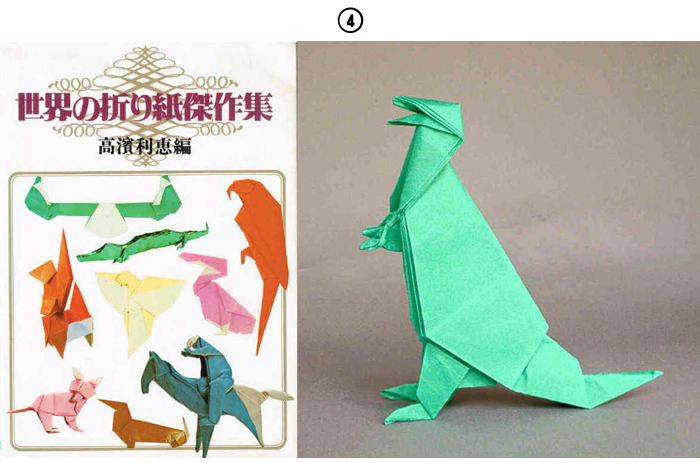
The 1977 book "Sekai no Origami Kessakushu" (Masterpieces of World Origami) features a Tyrannosaurus (Tyrannasaurus! as recorded in the English name) by American John Montroll. (Image 4) shows one I tried to make, getting carried away and taking Mr. Takai's words "it's easy if you use bigger paper" at face value. After a struggle, it miraculously came out.
hihoukan_23-4.png
The paper is all crumpled, though... It was difficult, Mr. Takai! I almost gave up at the frog base. Mr. Montroll seems to be a leading figure in dinosaur origami in America. (Image 5) shows some of his books, published in 1985/89/2010 from left.
hihoukan_23-5.png


The 1979 book "Origami - Image and Creation" (by Yoshihide and Sumiko Momotani) has a Brachiosaurus folding diagram in the chapter "Infant Origami Theory." This information came from a friend of Mr. Takai, and I was lucky enough to find the book on Amazon. Since it was a simple design, just an arrangement of a crane, as expected for infants, I was able to fold it relatively smoothly. This is probably about my skill level... But please, don't scrutinize the details too much. (Image 6)
hihoukan_23-6.png


After the 1980s, the world of origami changed dramatically. Again, a comment from Mr. Takai:

"In the 1980s, Jun Maekawa published "Viva! Origami", which provided a theoretical explanation for folding very complex origami. After that, various dinosaur origami appeared, including relatively simple ones and complex works. Moreover, today, not only Japanese but also overseas origami artists are creating dinosaur origami."

"Viva! Origami" was published in February 1983. It is said to contain a diagram for folding a Tyrannosaurus. In August of the same year, "Paper Magic 3D Origami Dinosaur, Insect, and Animal Editions" (by Keisuke Iwakura) was also published, and since then, many dinosaurs of highly skilled origami, pursuing realism, have been created. On the other hand, there are artists like Mr. Takai who value the inherent joy and charm of origami, providing a relief for general origami fans.

(Image 7) shows books of skillful works from the 1980s-1990s that I bought even though I knew I couldn't make them.
hihoukan_23-7.png
Among them, what really blew me away was Issei Yoshino's "Tyrannosaurus Skeleton Folding Diagram" (1992). It's an overwhelming work that involves complex folding and assembly of 21 pieces of paper. I thought no ordinary person could ever fold it, but then I remembered a member of the Dinosaur Club who had beautifully folded it, and I was amazed again! I searched online and found a photo of the completed work. It's incredible.

This time, Mr. Takai introduced me to the page of realistic origami artist SHUN, http://openthink.blog.fc2.com, where you can enjoy many incredible images of dinosaur origami that don't seem humanly possible. Please search for them. Also, many folding diagrams for dinosaur origami are available, so why not give it a try? When you do, please use larger paper, as commercially available 15cm origami paper can be difficult to fold. (This is advice from Mr. Takai.)


Now, here's my collection of origami works, a little boastful section.

(Image 8) features some rare (?), Mr. Takai's goods, introduced with gratitude for his cooperation this time.
hihoukan_23-8.png
This is a book Mr. Takai self-published in 2004, and a piece I probably received as a business card (?) when we first met. That means it's been hanging on my wall for about 30 years! Both would be coveted by Mr. Takai's fans.


(Image 9) is "Pterosaur Variations" by Tetsuo Kimura, also a member of the Dinosaur Club.
hihoukan_23-9.png
Mr. Kimura is not a professional artist, but he creates beautiful works.


(Image 10) is actually a work by my colleague, jazz pianist Hiromu Aoki http://main.aokihiromu.com/.
hihoukan_23-10.png
It's an unusual style, making it three-dimensional by stuffing it. The T-Rex isn't folded from paper, but from a hand towel. Mr. Aoki's "origami" is as famous in the industry as my "dinosaurs."


(Image 11) is a work by origami artist Kazuya Matsumoto https://twitter.com/matsumoto_ori12, who folded a life-sized Spinosaurus origami at the Dinosaur Exhibition in Makuhari in 2009.
hihoukan_23-11.png
This is the memorable Albertosaurus I received when we were together on the North American tour for "Frontiers of Dinosaur Science" in 1995 (Secret Treasure House Vol. 21). Originally, it stood on two legs, but with old age, at 20 years old, it...


Mr. Matsumoto exhibits realistic origami dinosaurs at the Shinjuku Mineral Fair every summer, but (Image 12) shows a rare, simple "Crystal Palace Park Paleontology Set" that was exhibited at last year's Mineral Fair.
hihoukan_23-12.png
Having been there myself (Secret Treasure House Vol. 39), I bought this without hesitation, thinking it had to be a diorama (and it was cheap...). The prehistoric creatures and cycad leaves are by Mr. Matsumoto; the rest, I concocted from "box" and "Prehistoric Origami tree" diagrams. I think I captured the atmosphere well, what do you think?


Finally, something unrelated to origami, but surprising information about Crystal Palace Park.

The March issue of the magazine "UP" published by the University of Tokyo Press features an article about Crystal Palace Park titled "Giant Beasts Stand by Trees, Strange Scaly Evil Insects in the Pond." The title comes from a report on Crystal Palace Park written in the report of the Iwakura Mission, led by Tomomi Iwakura, in 1872 (Meiji 5)
http://ja.wikipedia.org/wiki/%E5%B2%A9%E5%80%89%E4%BD%BF%E7%AF%80%E5%9B%A3
This was more than 20 years before the word "dinosaur" was coined, and the report describes them as "birds, beasts, and insects of the ancient world." This alone is surprising, but the article further states that, 10 years earlier in 1862 (Bunkyū 2), Yukichi Fukuzawa visited the same place.
http://ja.wikipedia.org/wiki/%E6%96%87%E4%B9%85%E9%81%A3%E6%AC%A7%E4%BD%BF%E7%AF%80
Unfortunately, his report, "Seiyō Kibun" (Record of a Journey to the West), only mentions, "Outside the (Crystal) Palace, a splendid garden has been opened as a place of amusement," and does not touch upon the exhibits. However, there were Japanese people who saw "dinosaurs" in the Edo period, which should be a major event that rewrites the history of dinosaurs in Japan... but why didn't any dinosaur experts notice?

And Yukichi Fukuzawa appears in the steampunk novel "The Difference Engine," set in a fictional Victorian London, which also features dinosaurs. And with that neat loop back to the beginning, that's all for this time.


Older Post Newer Post