
New Dinosaur Treasure Museum

Vol. 22 Keichousaurus

This time, it's all about Keichousaurus, also known as Guizhou dragon, a familiar sight on Yahoo Auctions (though not actually a dinosaur).
Keichousaurus has now become synonymous with dubious fossils. Indeed, with such a large number of "picture-perfect fossils" circulating and being touted as genuine, it's understandable why people would think that. Recently, it seems that product descriptions on Yahoo Auctions and elsewhere often include disclaimers such as "repaired" or "highly likely to be a fake."
Actually, I'm quite fond of Keichousaurus, and in the past, I used to bid on fossils and spend my nights cleaning them as a hobby (I still do it sometimes when I remember). For this purpose, I even bought a stereomicroscope (also on Yahoo Auctions). Of course, there were times when the fossil completely disappeared after cleaning, but since they only cost a few thousand yen, it was easy to give up. And then there were those occasional big hits! That's how I got hooked on auctions, and before I knew it, I had collected more than ten specimens. This time, I'd like to pick out a few from my collection to introduce and shed some light on Keichousaurus, which is often underestimated by paleontology fans. After all, it's a member of a distinguished lineage that produced the plesiosaurs, the lords of the Mesozoic seas.

Despite the abundance of Keichousaurus in circulation, there is very little academic information available. A quick search online only brings up products from fossil shops, and shamefully, there isn't even a Japanese Wikipedia page.
(There is an English version: http://en.wikipedia.org/wiki/Keichousaurus)
To summarize the limited information available:

Keichousaurus hui
Class Reptilia / Subclass Diapsida / Order Sauropterygia / Nothosauroidea / Family Pachypleurosauridae / Genus Keichousaurus

Found in marine deposits from the Middle Triassic of Guizhou Province, China. The descriptive paper is surprisingly old, written in 1958.

The differences in the scapula and coracoid compared to plesiosaurs are explained in issue 22 of "Weekly Journey through 4.6 Billion Years of Earth," which has finally been completed.

And that's about all the information I can share, which is sadly limited.

hihoukan_22-1.png
I even have a book like this written by the famous Dr. Xu Xing (Photo 1), but it's mostly in Chinese and doesn't contain detailed diagrams of the skeletal structure, so it's useless except for the photos of the localities.

It's not clear when Keichousaurus fossils began to appear on the market, but Ryuichi Kaneko's book "Mystery of the Pterosaurs: The Age of Pterosaurs, Plesiosaurs, and Ichthyosaurs," published by Futami Shobo in 1995, makes detailed reference to nothosaurs, but the name Keichousaurus does not appear. Since Mr. Kaneko would not have overlooked it, it must have been an insignificant fossil forgotten in a corner of a museum shelf at that time.

hihoukan_22-2.png
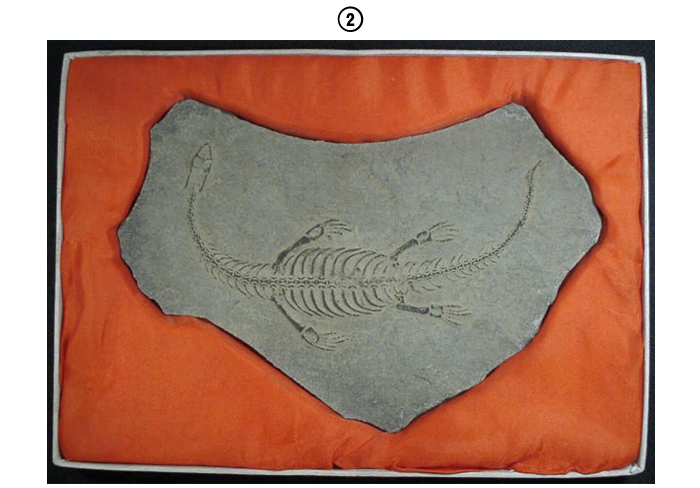
The first time I got my hands on a Guizhou dragon (or was swindled into buying one!?) was before I even knew the name Keichousaurus. I bought it on Yahoo Auctions without any suspicion, thinking it was just a cheap fossil, but it turned out to be a fake fossil with the distinct flavor of Chinese craftsmanship (Photo 2), similar in style to the crazy Archaeopteryx fossil I introduced previously (Secret Treasure Museum Vol. 34). How are these made? I imagine it takes a lot of time and effort, so I wasn't too angry about being tricked. I told myself it was a good experience and set my sights on a real one next time.

For some reason, the matrix of Keichousaurus fossils is soft while the fossil itself is hard, making them ideal for amateur cleaning. I use a design knife and work slowly and quietly (since it's the middle of the night). From the results of my efforts, I've selected some particularly interesting pieces.

hihoukan_22-3.png
hihoukan_22-4.png
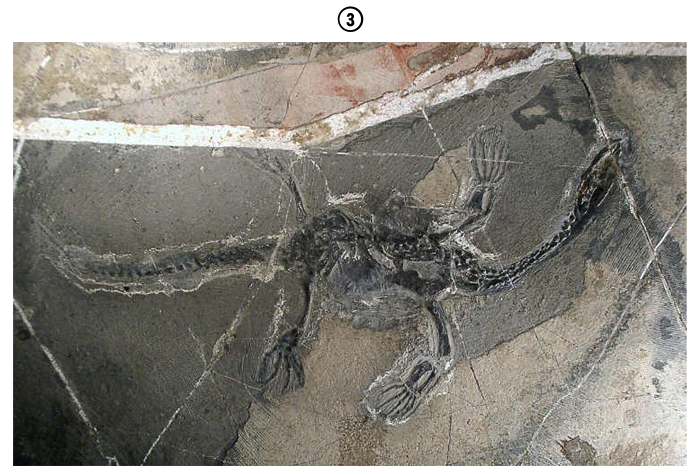
Photos 3 and 4 show partial damage. While it's normal for fossils to be incomplete, when it comes to Keichousaurus, which are almost always found fully articulated regardless of their authenticity, these are more valuable. I like the realism that makes them look like fossils in their natural state.

hihoukan_22-5.png
hihoukan_22-6.png
The individual in Photo 5 is a rare specimen where the trunk vertebrae are lying sideways, allowing us to see the shape of the sides and the articulated state (Photo 6). I felt a bit lucky.

hihoukan_22-7.png
Photo 7 shows a fossil that I've been intermittently cleaning for the past three years. It's surprisingly 3D, though hard to tell from the photo. Unfortunately, the head, which is damaged in the frontal region, has rotated and is resting on top of the cervical vertebrae. Furthermore, there's some mysterious object at the base of the hind limb... It's so interesting that I can't stop cleaning it.

hihoukan_22-8.png
Photo 8 is a close-up of the skull of the individual in Photo 7 and two other individuals. Since there is a pineal foramen, I wondered if plesiosaurs also had one, so I searched online and found a description of plesiosaurs in the "Sekai Daihyakka Jiten 2nd Edition" which stated that "a pineal foramen opens on the upper surface of the skull." I learned something new.

hihoukan_22-9.png
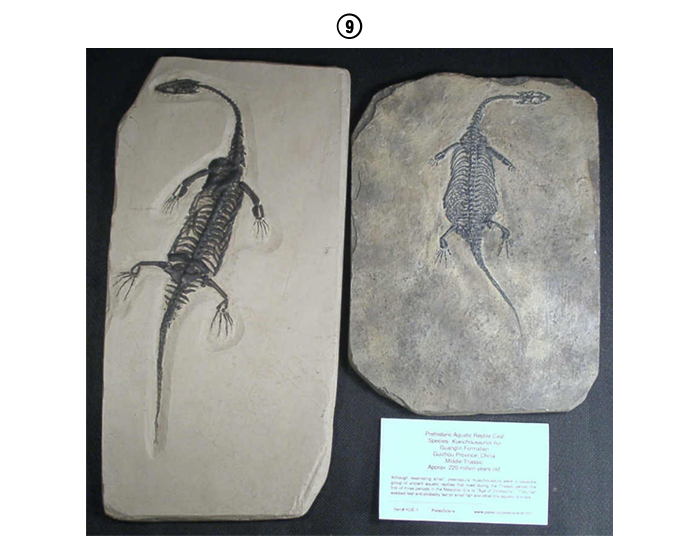
Photo 9 is an authentic replica. I bought it as a reference for cleaning, but it costs around 30,000 yen, which is more expensive than a real fossil. The one on the right is a fossil with embryos, which has been a hot topic recently, but honestly, it's hard to tell.

Well, since it's not very "Secret Treasure Museum-like" to just show fossils, I'll line up some figures now.
hihoukan_22-10.png
However, the only Keichousaurus figure I have is a life-size model from Taiwan? that I acquired at last year's Ikebukuro Mineral Show (Photo 10). So, I guess I'll just have to make do with some closely related nothosaurs...

hihoukan_22-11.png
Nothosaurs standing on a rock on a stormy coast were a common sight in old dinosaur books (Photo 11: from left, "Dinosaurs: From Birth to Death 3 - Marine Reptile Nothosaurus (1987)," "Color Version Mystery Ancient Creatures 4 - Marine Reptiles, Pterosaurs (1971)," "Dragons of the Sky and Sea (1973)"). As a result, there are surprisingly many figures of them. Some have appeared in the Secret Treasure Museum as "other miscellaneous items" before, but I'd like to introduce them again as the main characters.

hihoukan_22-12.png
Photo 12 Kaiyodo Collection Series (1980s) originally sculpted by Kazunari Arakawa. Approximately 1/20th scale. (Secret Treasure Museum Vol. 61)

hihoukan_22-13.png
Photo 13 Marushin's soft vinyl "Great Dinosaur Series" (1970s). A regrettable repaint. (Secret Treasure Museum Vol. 37)

hihoukan_22-14.png
Photo 14 A 1970s item from the French manufacturer "Starlux." For some reason, there are two versions. (Secret Treasure Museum Vol. 6 and New Secret Treasure Museum Vol. 8)

hihoukan_22-15.png
Photo 15 On the left is a 4cm long prize from SEREDDIES cereal in the UK (1950s). On the right is a relatively new item from the American manufacturer Play Vision. (New Secret Treasure Museum Vol. 8)

hihoukan_22-16.png
Photo 16 A 10cm figure from Safari's "Prehistoric Marine Animals" tube, which is still sold today. Since it was released after Keichousaurus appeared, its aesthetic is quite different from older models.

hihoukan_22-17.png
Photo 17 A rubber toy, about 5cm long, with a magnet inside for some reason, which I probably bought in the 70s. This might be the hardest item to find among those I've introduced.

hihoukan_22-18.png
And while I was looking for pictures of nothosaurs in old encyclopedias, I made an unexpected discovery. Kodansha's Korotan Bunko "Dinosaur Encyclopedia" had this illustration (Photo 18). This is a depiction of Keichousaurus from 1977. And there are even four types of nothosaurs! Korotan Bunko, not to be underestimated.

hihoukan_22-19.png
Photo 19 shows the curtains in my bedroom. When I found fabric like this on Yahoo Auctions, I had no choice but to have it made into curtains. Plus, my favorite Coelophysis is there.


Older Post Newer Post