







Collectible Dinosaur Figures Made with Soft Material
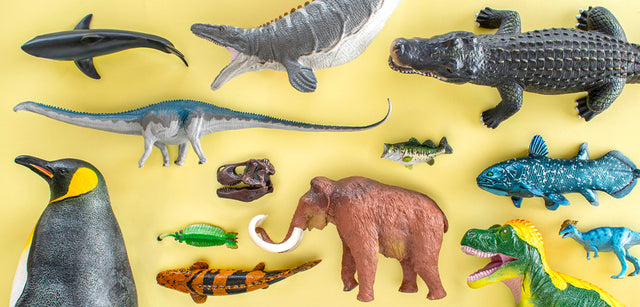
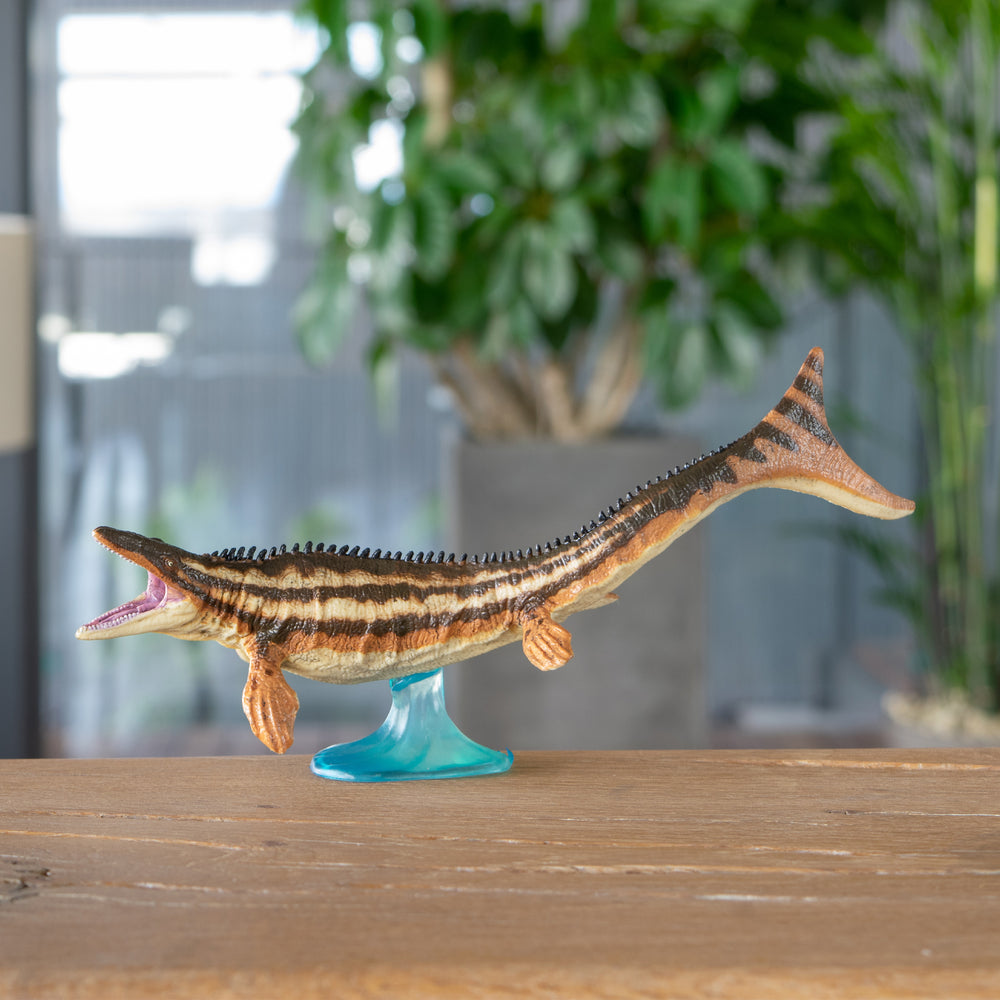
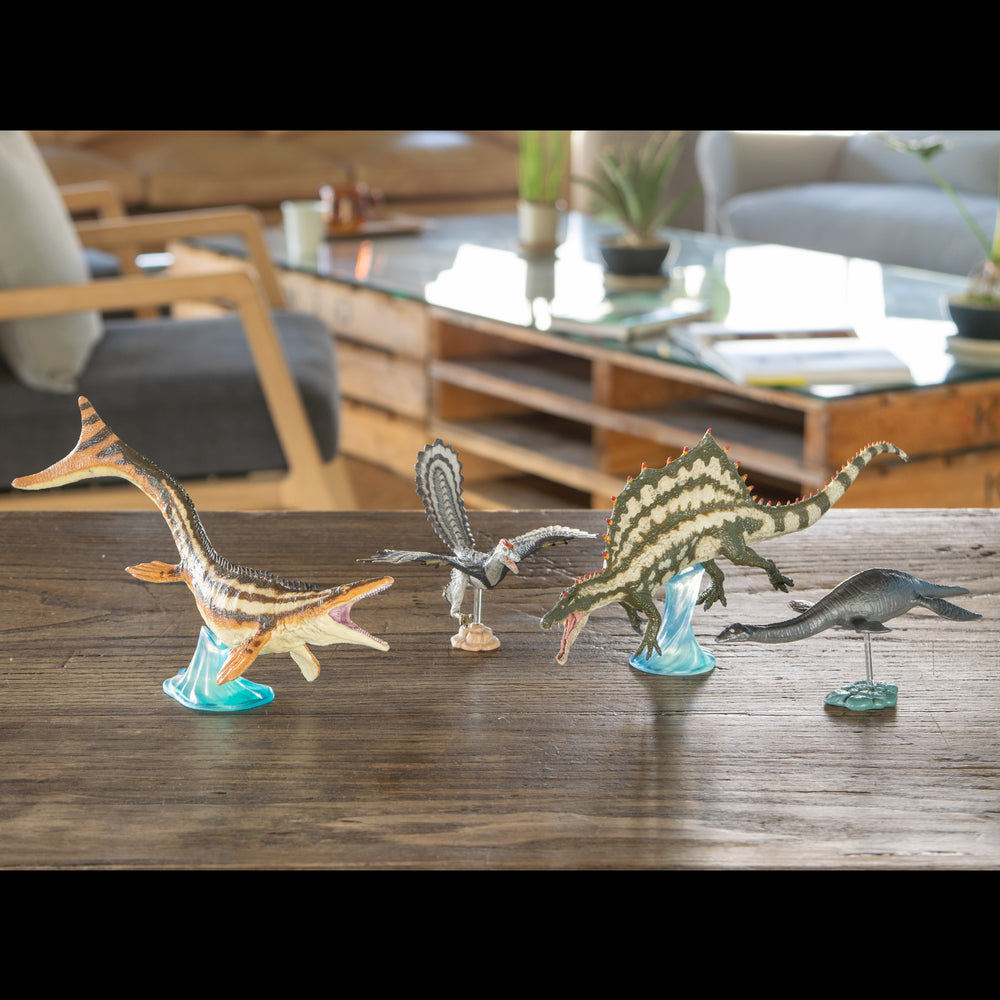
A PVC figure of Mosasaurus, a giant predatory marine reptile that flourished in Late Cretaceous seas. Its collectible size makes it enjoyable both for play and display.
Mosasaurus
Classification: Reptilia/Squamata/Mosasauridae
Size: Total length 12.5–18 meters
Period: Late Cretaceous
One of the largest members of the Mosasauridae, it was a marine reptile characterized by a crocodile-like head, a streamlined barrel-shaped body, and limbs evolved into flippers.
Its head had a double-jointed jaw that allowed it to open its mouth very wide, and it is thought to have swallowed captured prey whole. Recent research on the close relative Platecarpus has also suggested that it may have had a shark-like crescent-shaped tail fin.

Interview with Supervisor Kazunari Araki
- Mosasaurus has joined the Favorite lineup for the first time. It became especially famous through movies. What impression do you have of it?
- Even before the movies made it famous, Mosasaurus was one of the best-known extinct marine reptiles of the Cretaceous, alongside Elasmosaurus. Fossils of mosasaurs have also been discovered in many parts of Japan, making them surprisingly familiar prehistoric creatures here—perhaps even more familiar than dinosaurs. I am very happy that it has finally joined the lineup. (Laughs)
- Mosasaurus is thought to have been adapted to life in water. Were there any particular features you considered when sculpting it?
- It may actually have had a smooth body surface suited to aquatic life, but because Mosasaurus belonged to the same group as modern monitor lizards, I also wanted to show that its body was covered in scales. I therefore used scales and wrinkles reminiscent of modern monitor lizards.
- Mosasaurus is considered closely related to snakes based on features such as its jaw structure and palatal teeth. Did you draw on any of these features when sculpting it?
- Its teeth are conical rather than dagger-shaped like those of dinosaurs or sharply pointed like those of snakes, but it could open its mouth very wide like a snake. It is also thought to have had a well-developed organ for detecting smells with its tongue, as in lizards and snakes, so the tongue is forked at the tip.
- What image inspired the pose?
- A certain film features a memorable scene of it surfacing and snapping up prey, but for this model I chose a pose of it diving deep underwater to catch ammonites and fish. Instead of the long, eel-like tail fin traditionally depicted, I represented a crescent-shaped tail fin like that reconstructed for some ichthyosaurs in recent years.
- What inspired the coloring?
- Previous reconstructions of large marine animals often use gray color schemes similar to those of whales and sharks. For this model, I took a more adventurous approach and tried a pattern inspired by land-dwelling monitor lizards and fish.
- Finally, could you share your comments on this model?
- Mosasaurus is one of my favorite prehistoric animals. I considered whether to use the long, slender appearance common in older reconstructions or the streamlined, torpedo-like shape seen in more recent reconstructions, and decided to combine the best elements of both. I also wanted to add claws to the tips of the flippers, but...
Supervisor Profile
Kazunari Araki
One of Japan's leading dinosaur model artists, he creates dinosaur reconstruction models for natural history museums and master models for dinosaur encyclopedias and other publications.