
New Dinosaur Treasure Museum

Vol. 70 History of Ceratosaurus: The Ceratosaurus Clan - New Year's Edition

Following the abelisaurids, descendants of the Ceratosaurus from the last issue, the head of the Ceratosaurus family, Ceratosaurus itself, is finally making its long-awaited appearance. But before that,

Here's some auspicious news for the New Year, the kind that makes you say, "This is a great start to the spring!"


Image 1

I now possess the "Lost World Sugoroku" (New Treasure House Vol.30), which I found on an online used bookstore about 10 years ago and, after hesitating for several tens of minutes, decided to buy, only to find it was sold out – a nightmare come true. I found it on the "Nihon no Kohon'ya" (Japanese Used Books) website early in the new year and immediately clicked to buy it. The price was also half of what it was before, 10,000 yen, so I felt as grateful as if I had drawn 100 "daikichi" (great luck) omikuji. (Image 1)
This time, I'm sharing this good fortune in high quality.

*This Sugoroku seems to have been distributed or sold by the Nagoya Hirokoji Chitose Theater, the screening venue, when the movie "The Lost World" was released in August 1925. It is noted as being illustrated by Ikuharu Watanabe and Taryuko Kitamura. The actual item will be exhibited at the "Dinosaur Encyclopedia - Imagination/Creation of the Lost World" exhibition.


Now, on to the main topic: the history of Ceratosaurus.
Ceratosaurids, simply put, appeared in the early Jurassic period and, while overshadowed by the mainstream Tetanurae theropods, which included star dinosaurs like Tyrannosaurus, Allosaurus, Spinosaurus, various raptors, and of course, birds, they were a tenacious lineage that survived until the K-Pg boundary. Here, however, we will not delve into such history, but rather introduce the changes in their figures and other representations over time.
Ceratosaurus has been a known dinosaur for a long time (Marsh, 1884), and its first appearance in Japan was probably earlier than any other dinosaur. It was a concrete statue named "Ikkakuryu" (one-horned dragon) installed at the "Peace Memorial Tokyo Exposition" held in Ueno Park in 1922. (New Treasure House Vol.65)
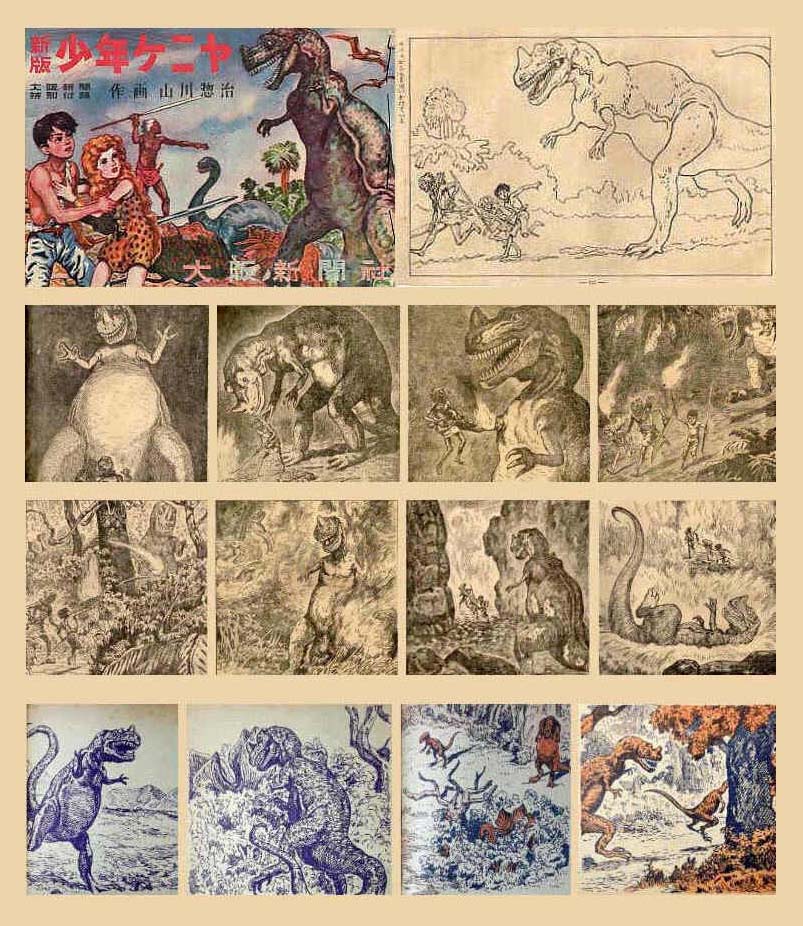
It then lay low for a while (dinosaurs with a single horn on their nose appeared in the 1930s manga "Kaiki-tō Seibatsu" (Conquest of the Mysterious Island) - New Treasure House Vol.32), but soon after the war, it was revived in the setting of "Shōnen Kenya" with a striking, menacing face drawn by Sōji Yamakawa that could almost be traumatic.

Image 2

Sōji Yamakawa seems to have a fondness for Ceratosaurus, featuring it not only in "Shōnen Kenya" but also in "Prehistoric Boy Sabin," which I've discussed in a few episodes before. (The top three rows of Image 2 are from the "New Edition Shōnen Kenya," a special supplement to the Osaka Shimbun in June 1953.) Cerato plays the role of the final boss. The fourth row is from Sabin in the December 1956 issue of "Shōgaku Gonensei" (Fifth Grade). It also appears in the main story of Shōnen Kenya.

Even so, just adding a single horn to an Allosaurus's snout (which was the understanding at the time), why did it become so ferocious and monstrous?


Image 3

In the subsequent 60s and 70s, riding the monster boom, Cerato, with its monstrous appearance, performed quite well. It appeared not only in gravure pages of boys' magazines but also on book covers. (Image 3)

*As an aside, there are several kaiju (monsters) with a single horn on their nose. I'm not very knowledgeable about kaiju, so I did a quick search.

Marine Kong / Baragon / Gomora / the husband and wife Seamons and Seagoras / and, although the horn isn't particularly prominent, Anguirus / and even "The Great Yokai War: Guardians" (I thoroughly enjoyed Director Miki's style, but this naming was a bit much, I thought. Someone should have pointed out that "La" wasn't included!), which drew the ire of kaiju fanatics, had a modest, realistic horn.


Image 4

Whether the single horn of monsters originated from Ceratosaurus, or conversely, whether Ceratosaurus's horn brought it popularity as a dinosaur, making it reminiscent of a monster, is a chicken-and-egg question. However, during the Showa era of monsters, toys that were neither clearly Ceratosaurus nor clearly kaiju were sold. (Image 4)

Among these, only the Kenko Chocolate bonus at the top right of the upper left row, the "Super Kaiju Series" at the bottom left (despite being explicitly labeled "Ceratosaurus" on the package), and the Clover 1/50 Dinosaur Series at the far right can be definitively identified as Ceratosaurus. The large soft vinyl figure is from Miura Toy, and at auctions, it is known as a Ceratosaurus-like counterfeit kaiju. The others are unidentified. The one on the right is an art piece created in 1960; for more details, please see New Treasure House Vol.21.

At this point, for some reason, Ceratosaurus remained a rather obscure presence in the West. Even Brian didn't draw it (C. Knight, as expected for a dinosaur from his own country, depicted it facing a Stegosaurus), and it was absent from the long-established dinosaur figure manufacturers often featured in the Treasure House, such as Marx, MPC, Starlux, Sinclair, Miller, the Nabisco and SHREDDIES cereal premiums, and the SRG metal models. There was no sign of Ceratosaurus anywhere.

However, in 1966, the most famous Ceratosaurus in Ceratosaurus history debuted. It was the Ceratosaurus that confronted the Triceratops in the movie "One Million Years B.C." "One Million Years B.C." was the bible of dinosaur movies until "Jurassic Park" was released in 1993. The dinosaurs animated by Ray Harryhausen have become a myth for dinosaur fans of our generation.
Although our Cerato is defeated, it is one of the greatest scenes in dinosaur movie history.


Image 5

And about two years ago, Star Ace Toys released a magnificent figure of this Cerato. It's from the same series as the Allosaurus in New Treasure House Vol. 58 and the Triceratops in Vol. 66. I hadn't seen it for a while, but it appeared on Yahoo Auctions for immediate purchase, so even though it cost over 30,000 yen, I bought it without hesitation. It's a substantial figure, 30cm tall. It comes with surprisingly small figures of Raquel Welch and others, emphasizing the enormous size of the Cerato on screen. (Image 5)

While Ceratosaurus figures may not have been particularly popular, movies featuring Ceratosaurus have been made in the West for a long time. Let's trace the path that led to "One Million Years B.C."

"Brute Force" A silent film made by D.W. Griffith in 1914. The Ceratosaurus appears around the 9-minute mark, but it doesn't do anything in particular, just eating grass?


"UNKNOWN ISLAND" An American film from 1948. The dinosaurs here are suit actors. Their movements are pitiful, but the facial sculpting is decent. It's said to be the first color dinosaur movie.
This was released in Japan under the title "Jurassic Island" and can still be purchased today.


"The Animal World" An American film from 1956. The dinosaur scenes were handled by model animation legends Willis O'Brien and Harryhausen, and the footage directly connects to "One Million Years B.C." Ceratosaurus appears around 5 minutes and 33 seconds, defeating a Stegosaurus, but another Cerato appears around 6 minutes and 27 seconds. They fight fiercely over the Stegosaurus's carcass and both fall into a valley.
Furthermore, after this scene, the main event, the battle between T-Rex and Triceratops, awaits. The dinosaur scenes from "The Animal World" were included as bonus footage on the previously sold DVD "The Black Scorpion," which is still available on Amazon.

This is a newer, but delightful, video.
"Early Man" A 2018 British stop-motion animated film from Aardman Animations, famous for "Shaun the Sheep." It features an homage scene to the Cerato vs. Triceratops battle from "One Million Years B.C." at the very beginning.

A must-see!


Image 6

Now, fast forward to the 1980s. The Kaiyodo Garage Kit by Kazunari Araki makes its appearance. (Image 6)

Please also see Treasure House Vol.61/62. The Cerato on the left was created by Araki in 1978 when he was still a high school student, and it was his first prototype for Kaiyodo. It's a kit that I assembled after it was released in '84, and I'm somewhat embarrassed to say that it will be exhibited at the "Dinosaur Encyclopedia - Imagination/Creation of the Lost World" exhibition starting in March. The one on the right is a kit from '85, Cerato VS Apatosaurus. This marked the beginning of the era of realistic Cerato models.

*The Kaiyodo Cerato skeletal model will be introduced later.


Image 7

The 90s, which began with a dinosaur goods explosion (New Treasure House Vol.18), saw a surge of various dinosaur goods, making the dinosaur market vibrant. Of course, Ceratosaurus was no exception. (Image 7)

From the top, a well-made American garage kit, about 45cm tall. I probably bought it at Wonder Festival, but I've forgotten the manufacturer's name. There's a Metriacanthosaurus in the same series. Does anyone know the manufacturer?

Below that, on the left, is a metal figure, also from an unknown manufacturer. The larger one is about 10cm tall, but the scale detailing is incredibly fine. To its right is an original soft vinyl figure from the nostalgic "UNESCO Village Great Dinosaur Expedition Hall." Please see Treasure House Vol.48.

The Cerato figures from Schleich, Safari, and the Boston Museum of Science (manufacturer is Battat) from the 90s. They are quite different in style from current ones. The Boston Museum of Science ones are still sold today under the brand Terra, albeit in different colors.

The bottom left is a rather unremarkable Chinese rubber doll, about 20cm tall, but it somehow has a strange presence. The paint job is solid for this type of item. When I was "excavating" Cerato figures from my room this time, I must have had it in the back of my mind, as I found it quickly.

Conversely, the pretty ceramic Cerato made little impression, and I just happened to notice it on the shelf.

On the right is a magnet, probably from the early 90s, bought and then forgotten when dinosaur merchandise flooded stores like Hands.

Image 8


"The Jurassic Park series' similar-but-different red-faced Ceratosaurus"
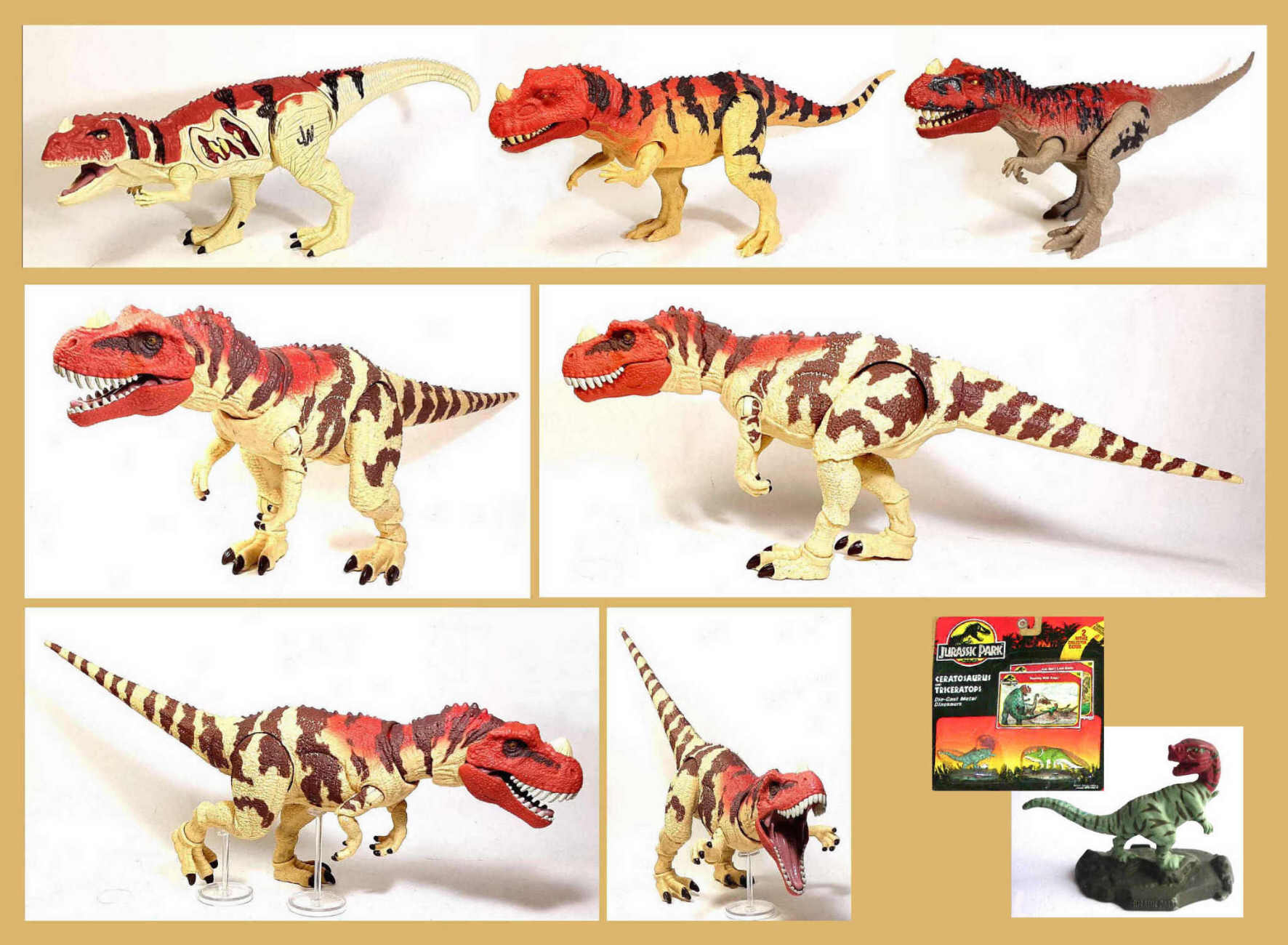
From left: "Jurassic World" (Hasbro), "JW Fallen Kingdom" (Mattel), "JW Camp Cretaceous" (Mattel)
However, Ceratosaurus only appears in the main movie of "Jurassic Park III," and only for a fleeting moment.
The red face is strangely unsettling.
Below is an item from the "Hammond Collection," released to commemorate the series' conclusion and encompassing the entire series. It's a high-quality action figure with excellent detail and posing, and it moves well. Of course, the price is also premium.
And to its right is a die-cast mini-figure released in 1993 with "Jurassic Park." It comes in a blister pack with two figures, and surprisingly, it already has a red face. It's unlikely that the concept for JP III was already decided at this point, so it suggests that this mini-figure was used as a reference when designing the JP III Cerato. It feels like unraveling the history of the JP series.

Image 9
Now, let's introduce the skeletal models. (Image 9)
First, the 1/20 kit by Kaiyodo, sculpted by Shigeru Yamazaki. I believe it's from the 90s. For more on Mr. Yamazaki, please see Treasure House Vol.26/31 and New Treasure House Vol.55.
The skull below was sold at the museum shop when the Gunma Museum of Natural History first opened (1996). There was also a Camarasaurus (Treasure House Vol.48) and a Triceratops, which I regret not buying to this day. I think it cost around 30,000 yen. The plate indicates it's specimen USNM4735 from the Smithsonian Museum. This is the holotype discovered by Marsh.
Next to it is something that mysteriously appeared in my room. It has developed a nice color due to age. Amazon still has the same thing, but it's an excavation kit. I don't remember excavating it.
Below that are Honehone Zaurus, Kaiyodo's Chocolasaurus, and a metal keychain.

In fact, Favorite also previously sold a Ceratosaurus skull.
Why didn't I buy it... It's one of those "regretted not buying" items.

And what I almost bought this time was a 1/10 full skeletal model from the Chinese manufacturer Kikuishi. It costs 56,000 yen, but it's very tempting.

Image 10
Shifting gears, here are Japanese Cerato figures released after 2000.
The one in the looking-back pose is a product called 4D Puzzle Saurus Deluxe. I don't know the manufacturer or other details. Next to it is Bandai's Dinosaur Gallery (2006), then Chocolasaurus (2003), and a Gacha Action THE Dinosaur from Takara Tomy Arts about two years ago. The one in the back is from Happinet's Great Age of Dinosaurs, released in 2007.
Below are the latest Cerato figures, currently available. And at Daiso, no less! The sculpting is quite good, and after painting it, it turned out nicely.
Image 11
Next are the currently available Ceratosaurus from PAPO and CollectA. Both are quite original. And then there's the rapidly increasing number of high-quality Chinese products. I really wanted the highly-regarded PNSO one, but it was almost 10,000 yen, so I reluctantly went for the cheapest in its class, the Eden Toys one for about 3,000 yen, and it turned out to be much cooler than I expected! However, there's a mystery here: it seems to be the same as the 9,000 yen ITOY brand, except for the paint job and base. Is it a copy? Or is it a popular version from the same manufacturer? Chinese dinosaur models sold on Amazon and elsewhere, despite having the same shape, inexplicably vary in manufacturer and price. You have to be careful, as cheaper ones sometimes have sloppy paint jobs. This time, the main body was fine, but why are there two snails, about 50cm in real size, crawling on the base (when I first saw the photo, I thought they were beached ammonites, but they clearly had horns and eyes) which is different from ITOY's? The mysteries of Chinese dinosaurs are unfathomable. (Image 11)
Image 12

The Ceratosaurus special concludes with Ceratosaurus family dinosaurs other than Ceratosaurus itself. CollectA's Saltriovenator and Mattel's Jurassic World series Genyodectes. Who would have thought such niche dinosaur figures would be released! (Image 12)
Since both are unknown dinosaurs to me, for those who want to know more, click here.
These are pages by U-san, the "Carnivore" and Dinosaur Club member:
Saltriovenator
Genyodectes

This year, I made two new discoveries in my hobby of researching "Japanese Dinosaur Books."

Image 13

Minakata Kumagusu's Dinosaurs
Minakata Kumagusu was, of course, a great scholar from the Meiji to Showa periods, and I always thought it impossible that such a person wouldn't have touched upon dinosaurs. However, I had no way of searching for "dinosaurs" within his vast body of work. But early in the new year, I received some delightful information from A-san, a reader of the Treasure House who is currently studying in the UK... Dinosaurs appear in the dragon section of "Jūnishi Kō" (Studies on the Twelve Zodiac Animals), where he eloquently discusses the zodiac animals with his immense knowledge, specifically in the entry on dragons titled "Tawara Tōta and the Dragon Palace." I immediately purchased "Minakata Kumagusu Zenshū Vol. 1" on Amazon. I put off a thorough reading for later and quickly flipped through, searching for dinosaurs. In Chapter 2, "What is a Dragon?", he mentions Iguanodon, and in Chapter 3, "The Origin and Development of Dragons (1)", he refers to Pterodactylus. In Chapter 4, "The Origin and Development of Dragons (2)", he drew what appears to be his own illustrations of Stegosaurus, Triceratops, Plesiosaurus, and even, surprisingly, a classic cryptid, Hans Egede's sea serpent. What caught my attention was his use of the term "kakkoze" (過去世) for ancient times, which was commonly referred to as "zensakai" (前世界) or similar. I looked it up and discovered that "kakkoze" is a Buddhist term. What a great find! Thank you, A-san. (Image 13)
* "Minakata Kumagusu Zenshū Vol. 1" Heibonsha 1971 p134,/p137
The next mission is to acquire the magazine "Taiyō" (The Sun), issued in February 1916, where this article was first published.

Another book I acquired on Yahoo Auctions is:
"The Yellow Earth: The Natural Science and Culture of North China" by J.G. Andersson, translated by Hisakazu Matsuzaki, Zayuhō Kankōkai (1942)


Image 14


This is a translation of a book (1934) by the Swedish Dr. Andersson, who conducted research in China at the request of the Republic of China government before the war. Dr. Andersson was involved in the excavation of the sauropod Euhelopus (then known as Helopus) and Peking Man, in collaboration with paleontologist Zdansky, and the book describes interesting details of the excavation process. However, considering that the book was published in 1942, during the height of Japan's war with China on the continent, I was deeply moved by the fact that such a 461-page book, explaining the prehistoric culture and fossils of an enemy nation, was published at all, even in a limited edition of 2200 copies, especially when looking at the almost too-clean illustration of Euhelopus, which doesn't seem to belong to wartime. (Image 14)
Illustration VI (page not specified) / p61


Older Post Newer Post