

Vol. 11 My Dinosaur Life Story, Part 2: "Becoming a Full-Fledged Dinosaur Fan After Encountering the Warm-Blooded Theory in 1976's The Great Dinosaur Age"
Despite having reached my sixtieth birthday, I recently stumbled upon something that inexplicably delighted me: while watching Kyary Pamyu Pamyu's music video "PONPONPON," I noticed a BULLYLAND Archaeopteryx on her head. (Incidentally, this video also features a CGI Pteranodon flying around.) I suppose I'll continue to be like this for the rest of my life. By the way, am I the only one who, every time I try to say "Kyary Pamyu Pamyu" and trip over my words, is reminded of the "Old Ones" from mythology, with their unpronounceable names? Speaking of which, the "Pachycephalosaurus" that Professor Obata so heavily abbreviated last time is also quite a mouthful.
Back in 1976, I was only 23, performing as a budding jazz pianist primarily in jazz clubs around Shinjuku and Roppongi. As someone with chronic collecting syndrome (a constitution like a shark, where I'd die if I wasn't constantly collecting something), at that time I was engaged in the perfectly respectable hobby of collecting jazz LPs. (You can see what has become of the shelves that once held over a thousand records, now occupied by dinosaur models, in Treasure House Vol. 9.) However, I was still reading books like the "Dinosaur Museum" introduced last time, maintaining my connection with dinosaurs.
If it weren't for "The Great Dinosaur Age" (by Adrian L. Desmond, published by Futami Shobo) coming out in April, I might be a normal dinosaur-loving pianist who had mastered the path of jazz. This book truly became "the one book that changed my life."
As for its contents, it begins with the history of dinosaur discovery, starting with the discovery of the Maastricht Mosasaurus, and introduces early dinosaur research, following the standard pattern. About a quarter of the way through, Professor Ostrom and his colleagues appear, developing the warm-blooded theory. The discussion also covers the ecology of Tyrannosaurus, and it brings in the T-Rex stupidity theory of W.E. Swinton (author of "Dinosaurs: Their Genesis and Extinction," introduced last time) and the arboreal Hypsilophodon theory as examples of the arch-villains of the conservative cold-blooded camp. Just when the discussion was getting heated, the trump card of the warm-blooded camp, Deinonychus, made its grand entrance. I was completely captivated by the famous illustration drawn by Robert Bakker (Photo 1).

It wasn't that there were no previous reconstruction drawings of dinosaurs running with their tails raised. For example, ostrich-like dinosaurs (drawn by Burian) running in the background of a Tyrannosaurus, or Iguanodon (a large number of Iguanodon fossils found in Bernissart are thought to have fallen off a cliff and died as a group) dashing towards a cliff (?), and the classic Ornitholestes trying to catch an Archaeopteryx, and so on. (Photo 2)

However, this first appearance of Deinonychus was something entirely different. It completely swept away the previous image of dinosaurs as monsters wriggling in the dark, gloomy air of the Mesozoic Era. To use a cliché, it was full of dynamism and vitality, and heralded a shining new age for dinosaurs. (Although now that I'm older, I also appreciate the dark Mesozoic.)
Regarding the warm-blooded theory, I unconditionally supported it out of a youthful, naive value system of "conservatism = evil, innovation = justice." Since then, I've felt indignation towards cold-blooded scholars, making me wonder if I was beyond just "warm-blooded" and actually "hot-blooded" in my passion! In any case, I decided to follow the future of the new dinosaur theories.
Returning to the book, the latter half was also full of stimulation, including the now-discredited upright posture of sauropods, the conversely established theory of birds = dinosaurs, and the warm-blooded pterosaur theory, which was supposedly proven by the discovery of "Sordes," the hairy devil of Kazakhstan. The final chapter is, as expected, "The Mystery of Extinction," but the meteor impact theory would not appear for several more years.
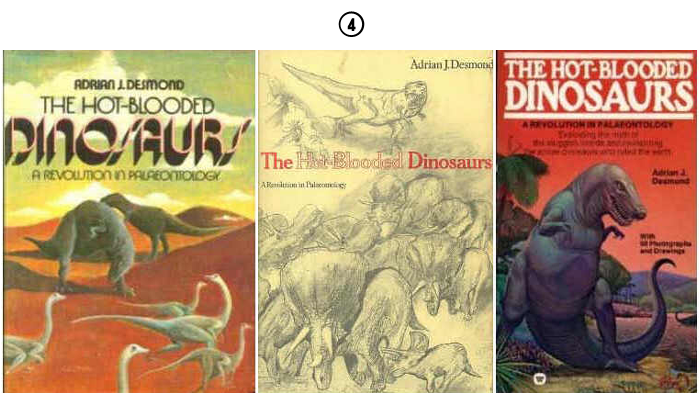
Actually, this book has been published four times. (Photo 3)

"The Great Dinosaur Age" April '76
"The Mystery of Dinosaur Habitation" August '77
"The Mystery of Dinosaur Extinction" October '87
"The Mystery of Dinosaur Extinction" July '89
It's almost like "The Mystery of Renovation and Retitling." The Japanese titles have no relation to the original title, "THE HOT-BLOODED DINOSAURS." The cover illustrations are also peculiar; the first two have a Deinonychus-like appearance but with Tyrannosaurus fingers, and the latter two seem to be directly contradicting the content. So, I wondered about the foreign editions and searched... this is what I found. (Photo 4)

The one on the right is definitely picking a fight.
It's a shame that the content wasn't revised during the 1980s reprints, and it was already outdated by the time it was published (for example, the meteor theory was absent).
Next, following "The Great Dinosaur Age," are some particularly memorable books that introduced new dinosaur representations.
"The Dragons of Eden" by Carl Sagan, Shujunsha (1978) (Photo 5)

This book is about the evolution of the brain, and dinosaurs are only used as an example, but I can't forget the eyes of Saurornithoides (Troodon), which are considered the most intelligent.
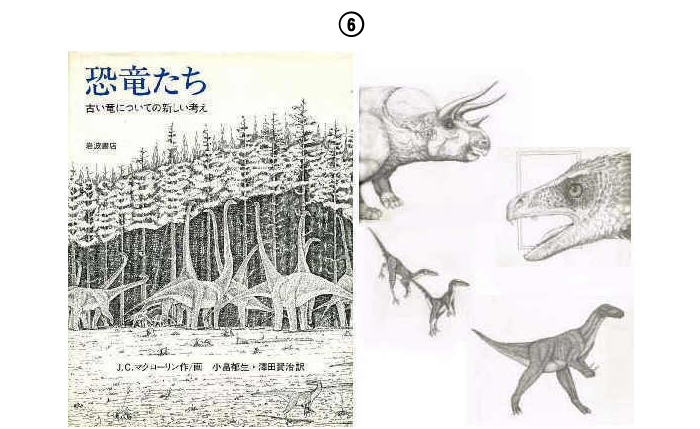
"Dinosaurs: A New Look at Old Dragons" by J.C. McLoughlin, Iwanami Shoten (1982) (Photo 6)

This book is packed with illustrations of new dinosaurs, almost to an excessive degree. They even have feathers now. Triceratops, in its pursuit of newness, went completely out of control! This is what it became. Surprisingly, there's even a model that立体化 this. I introduced it once in Treasure House Vol. 4, but let me show it again. (Photo 7)
There are also memorable purely domestic books. While they don't necessarily introduce new dinosaur images, they were pioneers of the "mook" format, covering dinosaurs from various angles.
"Bungeishunju Deluxe: Dinosaurs 200 Million Years" (1978) (Photo 8)
From dinosaur encyclopedias to New Nessie, memories of Futabasuzukiryu, and introductions to dinosaur books. Deinonychus is briefly introduced in the Dinosaur A La Carte corner. The pure white feathered Pteranodon in the color gravure was a trend at the time, and I was also captivated, painting the Eida-made plastic model in the bottom right of the picture white.
"Asahi Graph: Dinosaurs of China" (1981) (Photo 9)

Centering on a feature about Chinese dinosaurs, this issue also contained a plethora of content including a guide to domestic museums and, for some reason, a history of monster movies. What particularly captivated me was the report on Lake Kussharo, and several years later, I would go to Lake Kussharo to search for the wooden carving of Kussie shown in the photo.
I had intended to discuss the "Great Dinosaur Exhibition: Soviet Academy of Sciences Collection" held in Osaka and Tokyo from 1978 to 1979, but I've run out of space. I'll just note that during that exhibition, alongside Tarbosaurus and Saurolophus, the warm-blooded "Sordes" also came to Japan.
Finally, I'd like to conclude by showcasing my Deinonychus collection.
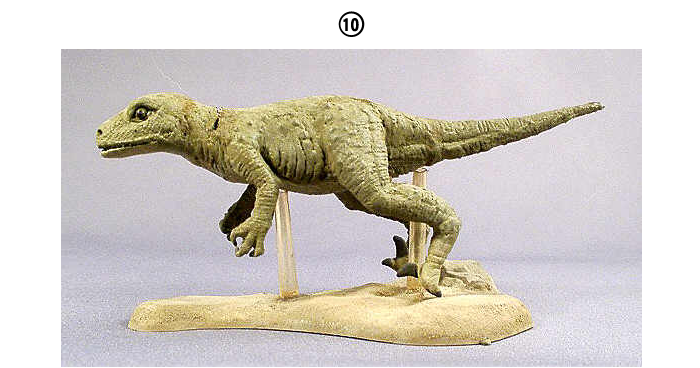
For nearly a decade after my encounter with Deinonychus, there were no Deinonychus figures or kits available. This is what I reluctantly cobbled together from a Hong Kong-made rubber toy. It's rather pathetic. (Photo 10)

In the mid-1980s, the long-awaited first kit was released by Kaiyodo. Sculpted by Kazunari Araki, 1/20 scale. (Photo 11)

Made by garage kit manufacturer "Alucard" around 1990. 1/20 scale. (Photo 12)

A finished soft vinyl product by Kokoro, sold at the now-defunct "UNESCO Village Great Dinosaur Adventure Hall." Explicitly marked as 1/14 scale. (Photo 13)

Kaiyodo, a finished cold-cast product sculpted by Shinobu Matsumura. (Photo 14)

ANTS Co.'s 1/5 scale skull. Exceptionally well-made. (Photo 15)

Various other toys. The brown one in the middle is made by "STARLUX" from France and is quite valuable. (Photo 16)

In addition, of course, various products are available from Favorite, and I believe there are quite a few in the form of candy toys as well. Although Deinonychus seems to have ceded its position as the representative dromaeosaurid to Velociraptor after JP, it's still far from being out of the game.
Postscript
The dinosaur books from the 70s that I've been introducing since last time are actually not treasures at all; they're readily available on Yahoo Auctions. And, somewhat sadly, for about 500 yen. Please do buy them and experience the enthusiasm surrounding the birth of the warm-blooded theory.
← Older Post Newer Post →