





Vol. 40: Dinosaurs in Showa-Era Boys' Manga Magazines, Part 1
This time, and next time, I was planning to introduce the majestic dinosaurs that graced the gravure pages and special features of shonen manga magazines from the 1960s and 70s (primarily the five major weekly shonen magazines: "Sunday," "Magazine," "King," "Jump," and "Champion"), which instilled in me the image of "dinosaurs" when I was a boy. However, as soon as I flipped through the magazine pages to check the content, what appeared were "Iga no Kagemaru," "Osomatsu-kun," "Submarine 707," "Tensai Bakabon," feature articles on cars, weapons, pro-wrestling, and the occult, and advertisements for plastic models of the time. "Everything is so nostalgic..." I muttered, and couldn't help but read through them. As a result, I've had trouble getting started on my manuscript and am now rushing to meet the deadline.
The books I have at home are, of course, not relics from my childhood; I found them all by chance at used bookstores or online. Finding books without "Dinosaur" written on their spines in a used bookstore is a matter of luck, but thankfully, online, the contents are described, so I've managed to collect quite a few. However, the full scope of "dinosaurs in shonen magazines" is still largely unknown.
*This time, I haven't included cover images except for books with dinosaurs on the cover. Personally, there are many cool cover illustrations of warships and airplanes that excite me, but...
First, from "Weekly Shonen Sunday" (Shogakukan), a long-established publication alongside Magazine.

Source: "Weekly Shonen Sunday" 1964, Issue 18, "The Science of Dinosaurs" (Shogakukan)
Seven pages of color at the beginning. Following the Stegosaurus on the title page, there are articles titled "This is amazing!! Unusual Dinosaurs," "The Great Dinosaur Duel!!," and "Do Dinosaurs Still Exist!?" (① Top). Perhaps due to its popularity, a series called "The Science of Dinosaurs" ran for eight weeks starting from issue 25 of the same year (Text: Seiichi Saeki / Illustrations: Koji Hagiwara ① Bottom). Unfortunately, I only have the first installment, "Dinosaurs appeared 200 million years ago!!," the third installment, "Brontosaurus, the largest animal on Earth," and the seventh installment, "Dinosaurs that lived in Japan." These are serious and understated articles published in the latter half of the book. While the Trachodon featured in the seventh installment is now disproven (I believe it was a fossil of a horse or something similar), at the time, it was written that this was the first dinosaur fossil in Japan and "big news."
*I found a real-time explanation from that period, "Geological News," online.

Source: "Weekly Shonen Sunday" 1966, Issue 1, "Surprising Illustrated Explanation: Dinosaurs"
14 pages of color at the beginning. In addition to explanations of dinosaurs, there are illustrations on the theme of "What if dinosaurs were still alive," which seem to foreshadow the famous picture book "Dinotopia." (②)
Issue 9 of 1967 has a special feature on "One Million Years B.C.," but unfortunately, I don't own it.

Source: "Weekly Shonen Sunday" 1968, Issue 9, "Monstrous Animals of the Prehistoric Age" (Shogakukan)
A unique collection of extinct mammal illustrations by Gojin Ishihara. The Trilophodon has quite an impact (③). There's also a charging Arsinoitherium and, for some reason, a Brontotherium riding on an ice floe.

Source: "Weekly Shonen Sunday" 1968, Issue 21, "Great Dinosaur Pictorial" (Shogakukan)
There's no special feature article, but at the beginning, there are two fold-out color pages, each folded into four, which open up to a super-wide illustration of about 1 meter (④). The dinosaur descriptions are a mess: "Tyrannosaurus (Lion Dragon) Cretaceous period (approx. 180 million to 30 million years ago)" and "Brontosaurus (Thunder Dragon) Jurassic period (approx. 140 million to 70 million years ago)." At this point, the difference in their eras seems like a minor detail. The artwork is good, however... On the back, there are more accurate combinations such as Mammoth vs. Sabre-toothed Tiger, and Stegosaurus and Archaeopteryx (Illustrated by Yoshiyuki Takani).

Source: "Weekly Shonen Sunday" 1968, Issue 38, "Great Sea Monsters" (Shogakukan)
The subtitle is "Summer Horror Feature." It's a special on marine cryptids, and Basilosaurus (referred to as Zeuglodon in the text) and Plesiosaurus appear. (⑤)
*For some reason, Sunday in this particular year was packed with dinosaur-related features. It's a mystery why, as there were no dinosaur exhibitions happening.

Source: "Weekly Shonen Sunday" 1968, Issue 42 (Shogakukan)
From this issue, a series titled "Dinosaur Country Loch Ness Expedition" began, a report on the first Japanese expedition to Loch Ness by Seiichi Saeki, a science commentator for Sunday. In connection with this, the opening features a 15-page color special titled "I Saw It!! The Loch Ness Monster." In addition to introducing the usual photos and pages speculating on its true identity, there were also things like this. The bird's-eye view of Loch Ness is beautiful, but the "Reconstruction of Loch Ness in Ancient Times" seems a bit forced, doesn't it? Perhaps "Dinosaur Death Battle" scenes were essential for shonen magazines. The series has been confirmed up to 6 installments. (⑥)

Source: "Weekly Shonen Sunday" 1968, Issue 44, "Great Dinosaurs - Full-Color Dinosaur Encyclopedia" (Shogakukan)
This is a long-awaited major dinosaur feature. From the opening color pages to "Loch Ness Expedition 3" in the series, it spans a remarkable 34 pages. The cover also features a Tyrannosaurus skull, with a daring design showing only the front of its snout. The content includes many skeletal photos and detailed explanations, with the only classic dramatic illustration being "The End of the Iguanodon," making it almost like a children's encyclopedia. (⑦)

Source: "Weekly Shonen Sunday" 1968, Issue 46, "Great Age of Dinosaurs" (Shogakukan)
And then, two weeks later, dinosaurs reappear in Issue 46. "Great Age of Dinosaurs." As the subtitle "Thrilling Masterpiece Story" suggests, this issue is a complete change from Issue 44, packed with bloody battle scenes that boys love. The main color illustrations are by the master Shigeru Komatsuzaki. The illustration titled "The End of the Dinosaurs" (drawn by Yoshiyuki Takani) depicts dinosaurs sharing a sinking island in the sea (a situation I've seen somewhere before but can't recall). While it symbolizes extinction, the explanation doesn't mention the illustration, instead discussing climate change and other very ordinary things. With the color pages and "Loch Ness Expedition 5," it totals 29 pages. Furthermore, it's a major special feature with an additional 8-page gag manga. (⑧)

Source: "Weekly Shonen Sunday" 1969, Issue 27, "Dinosaur Valley," "Great Dinosaurs 100" (Shogakukan)
A 16-page color spread at the beginning introduces the movie "The Valley of Gwangi." While it mainly uses stills from the film, I've included it because there are also some illustrations. The illustration of the circus dinosaur accompanies the scene where Gwangi fights circus elephants. "Great Dinosaurs 100" is a 14-page special feature where you can learn 100 trivia facts about dinosaurs. For example, "19: Approximately 230 species have been discovered so far (that's how many there were back then~)," and "69: The horns of ceratopsians were not for weapons but for felling trees and digging roots. Triceratops, in particular, would wedge branches between its horns and eat their leaves (innovative!)." (⑨)
*From 1961 to 1962, the manga version of "Shonen Kenya," which also featured dinosaurs, was serialized, so there might have been some dinosaur features.
That concludes Sunday. As for the other major publication, "Magazine," its volume is comparable to Sunday's, so I'll save it for next time. Here, I'll introduce the dinosaurs from "King" and "Jump."
"Weekly Shonen King" (Shonengahosha)
Source: "Weekly Shonen King" 1968, Issue 16, "20th Century Dinosaur Great Survey" (Shonengahosha)
Unfortunately, I don't own this and its contents are unknown. The color gravure is also titled "Dinosaurs Are Alive." This title, if it were today, would refer to birds... Is it about cryptids?

Source: "Weekly Shonen King" 1969, Issue 14, "Primeval Great Beast" (Shonengahosha)
11 pages of color at the beginning. Looking at the cover, it seems like a feature on extinct Cenozoic mammals, but the subtitle is "Mammals from 300 Million Years Ago Seen in Fossils." Surprisingly, half the pages are dedicated to therapsids. (⑩)
"Weekly Shonen Jump" (Shueisha)

Source: "Weekly Shonen Jump" 1981, Issue 42 (Shueisha) "Shonen Book" October 1962 (Shueisha)
Unfortunately, I only own one issue of "Weekly Shonen Jump" featuring dinosaurs, issue 42 from 1981. And even that is just the cover. However, "Shonen Book," a monthly magazine that was the precursor to Jump, has an 8-page feature titled "Giants and Dinosaurs" in its October 1962 issue. The illustrations are quite powerful, and while the cover is a Komodo dragon, I couldn't resist showing it. Incidentally, the giant seems to be Gigantopithecus, but there's no detailed explanation. (⑪)

Source: "Weekly Shonen Jump" August 1978 Special Issue (Shueisha)
And then, around the time I was awakening as a dinosaur goods collector, the August 1978 special issue of Shonen Jump featured an unprecedented 85-page dinosaur special in manga magazine history. This was timed with the "Great Dinosaur Exhibition" by the Soviet Academy of Sciences. The composition and text were by a young Ryuichi Kaneko. As I mentioned in New Treasure House Vol. 14, I'll provide a detailed introduction here.
First, a gravure spread titled "The Greatest Duel in History," bound horizontally in a three-fold format. The combatants are Tyrannosaurus Rex and Tarbosaurus efremovi (a lost species name, now unified as bataar). The setting is the Bering Strait, which was once a land bridge. On the back, titled "World of Dinosaur Civilization," there's an imaginative illustration (partial) of a city built by dinosaurs that never went extinct and its inhabitants. Four years before the Dinoscauroid, these dinosaur people, though they have tails, are dressed in clothes and boast an advanced mechanical civilization.
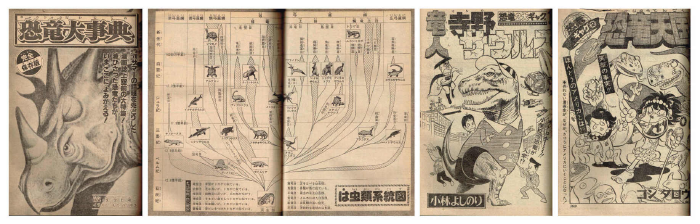
The feature's title page shows an Iguanodon skeleton in a Godzilla-like stance. (⑫)

What about the content of "This is a Dinosaur!"? The reconstructions and explanations of dinosaurs are antiquated; Brachiosaurus and Parasaurolophus are aquatic, and Hypsilophodon climbs trees. While the "Great Age of Dinosaurs" (New Treasure House Vol. 11) and "Dinosaurs of Eden" had already introduced small bipedal carnivores in horizontal postures, it would still take some time for other dinosaurs to be revamped. Even Kaneko-san, a leading expert, offers explanations based on old theories, yet he writes, "Recent research suggests that dinosaurs may actually have been warm-blooded animals, and further research is anticipated." That's impressive. Moreover, on the "Size of Dinosaurs" page, he introduces the newly discovered Quetzalcoatlus (still unnamed) by comparing it to a Mitsubishi F-1 fighter jet, and the Atlantosaurus to a Type 74 main battle tank, showcasing his otaku spirit. Other articles include a comparison table of mammal and dinosaur ecology (where the warm-blooded theory is mentioned) and ways to utilize a Brachiosaurus carcass! And considerations on cryptids. Kaneko-san's distinct style was already bursting forth. (⑬)

And then, the "Dinosaur Encyclopedia." First, after presenting a serious reptile family tree that seems out of place for a shonen magazine, it introduces as many as 230 species of Paleozoic and Mesozoic reptiles. Starting with primitive reptiles, it continues with therapsids, sauropods, and finally, pterosaurs and marine reptiles, all arranged in alphabetical order. For example, there are 34 species of therapsids, from Acrocanthesaurus to Metriacanthosaurus (including Ezosaurus = Ezomikasasaurus with illustrations), and about 15 species of ceratopsians, from Agathoumas to Leptoceratops, in the last section on dinosaurs. The sheer volume of information in this encyclopedia was unprecedented, truly a triumph for Ryuichi Kaneko.
As an extra, it also features two dinosaur gag manga. "Dragon Man Terano Saurus" is by Yoshinori Kobayashi, known in recent years as a right-wing commentator, and "Dinosaur Heaven" is by Taro Kon. (⑭)
Next time, in the second part, I plan to introduce "Shonen Magazine," "Shonen Champion," "Bokura Magazine," "Shonen World," and others.
← Older Post Newer Post →