

Vol. 45 "Children's Science Magazine, Part 1: First Half"
The "Eureka October 2018 Special Feature: The World of Illustrated Encyclopedias" (published by Seidosha) that I read the other day was both very interesting and informative. I bought it for the dinosaur articles by Kyo Kobyashi and Ken Tsuchiya, but it was also full of deep illustrated encyclopedia stories, making me think that if I had read it before writing "Our Illustrated Encyclopedia" for the Shin Hihokan, I could have expanded on the topic even more. However, the information I had hoped for regarding old, unknown dinosaur illustrated encyclopedias was ultimately missing, and in that regard, I inwardly smirked, thinking, "I won!"
Despite its subtitle "Poetry and Criticism," this "Eureka" magazine is over 90% niche topics. The February issue of this year also featured a special on "The World of Cthulhu Mythos," with enthusiastic followers sharing their passion. I wish they would put together a dinosaur special with the same level of enthusiasm.
Now, I'd like to introduce some science magazines for children, but their overall picture is almost completely shrouded in mystery. There's a vast number of them, and many books have no hint of dinosaurs on their covers, so finding dinosaur articles is more up to the grace of God than in shonen manga magazines. For now, I've decided to record what I know, titling it "Part 1," but I have no idea when I'll get around to writing "Part 2"...
Kodomo no Kagaku (Children's Science) (Seibundo Shinkosha)
"Kodomo no Kagaku," first published in 1924, might be Japan's first science magazine for children. And it's also the only children's science magazine currently in publication! ※wikipedia
The special feature in the November issue, released in October, was "The Mystery of Biological Extinction," and since dinosaurs made a brief appearance, I bought it and added it to my "Dinosaur Book List." This issue was surprisingly the 991st issue. There's an online column titled "Long-lived Magazines and the Origin of Magazines" that includes a ranking. "Kodomo no Kagaku" is inexplicably missing, but if it were included, it would apparently rank 7th in longevity. Finding dinosaur articles within this vast collection is an extremely difficult task. Currently, I've confirmed about 50 issues, but I only own 18 of them. These are also relatively recent issues; finding pre-war or 1950s issues and introducing them in "Part 2" is one of my remaining life goals, I suppose.
*My copy of "Kodomo no Kagaku" has already gone to the Gunma Museum of Natural History, so unfortunately, I can only provide data and the cover image (Image 1).

●January 1973 issue: The serialization of the educational manga "Inferring Dinosaur Companions" began and continued for one year.
●November 1973 issue: "Dinosaurs from the Soviet Union"
Introduced "The Soviet Dinosaur Exhibition" held at Miho Bunkaland.
●April 1990 issue: "These Are Dinosaurs!!"
Re-evaluating dinosaurs / New dinosaur images / Are dinosaurs still alive? / Dinosaur parenting / Dinosaurs that lived in Japan, etc.
●November 1992 issue: "Tracking! Japanese Dinosaurs"
Dinosaurs of the Tetori Group / Developing Japanese dinosaur research
●April 1995 issue: "Dinosaur Life Activities"
Dinosaur life seen from their eggs / Exploring dinosaur life from family and diet / Observing dinosaur life from their footprints, etc.
●January 1998 issue: "Dinosaur Classroom: Thinking About Dinosaurs," a manga, and a section introducing dinosaurs from around the world began serialization, continuing until April 1999.
●May 1999 issue: Continuing under the title "Dinosaur Companions," an educational manga featuring pterosaurs, marine reptiles, synapsids, etc., was serialized until December 1999.
●January 2000 issue: "Excavation of a Giant Ichthyosaur Fossil"
A report on the excavation of the largest ichthyosaur ever discovered in Canada. Also, a manga explaining extinct mammals, "We Mammals," began serialization until the August 2000 issue.
●From the September 2000 issue, the dinosaur introduction manga "Oidon Goes to the World of Dinosaurs" continued until at least the March 2001 issue. During its serialization, special features on dinosaurs were also included.
●October 2000 issue: "What Kind of Creatures Were Dinosaurs?"
Discovery, osteology, classification, exhibition / Research methods / Cladistics / Habitat, habits / Eggs / Footprints / Paleopathology and vertebral reinforcement / Biomechanics / Molecular paleontology / Presence or absence of respiratory turbinates, etc. The content is surprisingly rigorous for a children's magazine.
●March 2001 issue: "Dismantling and Investigating an Apatosaurus Skeleton" - A report on the dismantling and investigation of the Apatosaurus at the National Museum of Nature and Science.
●August 2002 issue: "Tyrannosaurus"
Explains the relationship between Tyrannosaurus and birds using cladistics.
●August 2007 issue: "Lost Creatures"
Consisting of two parts: "Five Mass Extinctions That Triggered Biological Evolution" and "Lost Animals: How to Avoid Further Extinction."
●September 2009 issue: "Fossil Excavation Operation"
Basic knowledge of fossils and a report on an excavation experience at the Ammonite Center. It came with a poster titled "Biological Evolution Seen Through Fossils."
●August 2012 issue: "This Is What We Know So Far! Tyrannosaurus and Its Era"
Introduced new information about Tyrannosaurus in detail. Feathered T-Rex appeared.
●January 2014 issue: "Mysteries Surrounding Fossils"
Is there a complete hadrosaur skeleton in Hokkaido? And more.
●March 2015 issue: "Fossil Excavation and Restoration"
Finally, a part of the skull was found! The story of the discovery and excavation of a hadrosaur in Hokkaido, and more.
●May 2016 issue: "The Great History of Dinosaur Discovery"
Traces the history of dinosaur discovery and restoration.
●November 2018 issue: "The Mystery of Biological Extinction"
Mysteries of extinction and extinction research / The mystery of the largest mass extinction in history / What does extinction bring to Earth?
As shown, by quickly taking up the latest dinosaur news and providing deeply dug-in content that doesn't shy away from complex topics even for children, this magazine rivals adult science magazines like Newton. It even reported on the Mukawaryu before any other science magazine.
From January 1998 to 2001, paleontological educational manga were serialized without interruption. These were all by the same team: Yoshihiro Funaki (composition) and Takahiro Sekiguchi (manga). This duo also seems to have serialized a manga called "Kagaku Manga Saiyuki: Let's Goku" before that, and a collection of dinosaur episodes from it, "Dinosaur Watching" (July 1993), was released as a single volume. However, the series of works from 1998 onwards, unfortunately, does not seem to have been compiled into a single volume.
A site created to commemorate the 90th anniversary of "Kodomo no Kagaku" allows a glimpse into the contents of several issues, including the inaugural one. Upon taking an unrestricted peek, I found suspicious articles: "Ancient History Spoken by Nature" in the March 1929 table of contents and "The Beginning of Life" in the October 1941 table of contents. I won't be able to confirm if dinosaurs appear until I get my hands on them someday.
*As a side note, finding "dinosaur" in the table of contents doesn't necessarily mean anything. Recently, I found "Italians' Beloved Dinosaurs" in the table of contents of Hiroshi Itsuki's essay collection "Mimizuku no Sanpo," and since it was selling for 1 yen on Amazon, I bought it. I had a slight expectation that Hiroshi Itsuki would talk about dinosaurs, but alas... it was just a single phrase: "Opera is, so to speak, a modern-day dinosaur."

"Kodomo to Kagaku" (Showa Shoin) might be a knock-off magazine like "Misora Hibari" or "Enoken," but since there's no information online, I don't know for sure. The cover of the May 1950 issue, titled "Fighting Dinosaurs in the Himalayas," shows a Godzilla-sized dinosaur crushing a tank, but the fight is only on the cover. The article is a two-page piece titled "History of the Earth." It features illustrations of Tyrannosaurus, Stegosaurus, Triceratops, and Brontosaurus, but these are also in Gunma, and it's a shame I can't show them (Image 2).


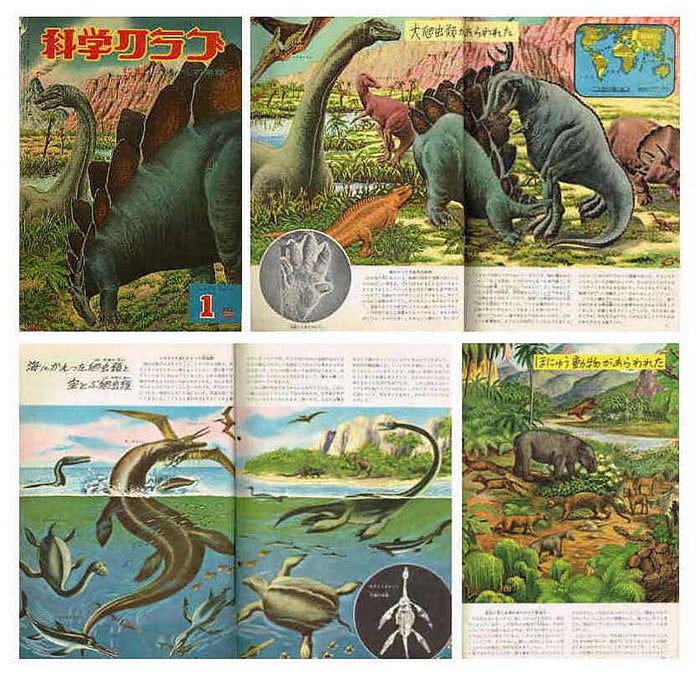
For some reason, as a child, I never knew "Kodomo no Kagaku" or "Kodomo to Kagaku"; the one ingrained in my memory is "Kagaku Club" (Shinundo), which I introduced in Shin Hihokan Vol. 10. Let me show you its surprisingly rich content again. It's "Evolution of Earth, Organisms, and Humans" from Vol. 1, No. 10 (July 1956) (pp. 29/30-31/34-35) (Image 3) and "Creatures of the Ancient Past" from Vol. 4, No. 1 (October 1958) (pp. 6-7/8-9/23) (Image 4). The illustration in the middle of Image 3 is simply a flipped version of the famous Peabody Museum mural (though trees and other elements are added). It makes me lament, "Is this really okay?" but this was a common occurrence with dinosaur illustrations in昭和 (Showa)-era Japan.
I also don't remember reading the magazines I'm about to introduce when I was a child.
Kagaku to Gakushu (Gakken Holdings)
Two magazines, "Kagaku" (Science) and "Gakushu" (Learning), were published monthly for each grade from 1st to 6th year. They reportedly continued from 1946 to 2010.
※wikipedia
Many of them had children's photos on the covers, so it's hard to find them on Yahoo Auctions without a good product description. And with 24 issues a year, finding a needle in a haystack might be easier. The general trend was that special features were put together when there was a major dinosaur exhibition. And sometimes, 5th and 6th-grade science issues came with dinosaur skeleton models as supplements. (Hihokan Vol. 60)
Here, I will list the data and some photos and illustrations of the books I own, as well as the issues with dinosaurs on the cover, in chronological order.


●"3rd Grade Science" June 1966 issue
Dinosaurs in Nessie
A short news article stating that it seems dinosaurs really exist.
●"5th Grade Science" November 1968 issue (pp. 6-7)
Stories of imagining big things from small things.
This is a special feature on learning Earth's history from fossils. (Image 5)
●"5th Grade Learning" April 1971 issue (pp. 4-5)
Dinosaurs lived in the Japanese archipelago too!
A 14-page special feature on the discovery of Futabasaurus suzukii. Plesiosaur vs. shark is a rather rare composition (Image 5).
●"2nd Grade Learning" October 1972 issue (p. 67)
Secrets of Dinosaurs
Dr. Ikuo Obata in his younger days appears as "Dinosaur Professor." (Image 5)
●"5th Grade Science" October 1973 issue (pp. 8-9/18-19)
Dinosaur Continent. A major special feature spanning 50 pages. Explains from the Paleozoic to the Cenozoic eras with continental distribution maps with animal illustrations, fossil photos, etc. The dramatic manga "Fossil Story: The Mystery of Brontosaurus," drawn in a Golgo 13-like style, hard-boilingly depicts the discovery story of the famous footprints believed to be Allosaurus chasing Apatosaurus. It also came with a Brontosaurus skeleton kit as a bonus. Despite being such a huge dinosaur special, why was the cover a land iguana??? (Image 5)
●"2nd Grade Learning" December 1976 issue
Dinosaur Surprise Picture Book
●"5th Grade Learning" December 1978 issue
Dinosaurs Sleeping in the Gobi Desert
A special feature coinciding with "Lost Creatures: The Great Dinosaur Exhibition (Collections of the USSR Academy of Sciences)" held at the National Museum of Nature and Science, among other places.
●"6th Grade Science" May 1980 issue appendix
Dinosaur and Fossil Encyclopedia (Image 5)
●"2nd Grade Learning" September 1985 issue
Secrets of the Dinosaur Iguanodon
A special feature coinciding with the National Museum of Nature and Science's "Special Exhibition Iguanodon: From the Royal Belgian Institute of Natural Sciences Collection."
●"6th Grade Science" January 1988 issue (pp. 10-11)
Dinosaurs. A 36-page major special feature. Includes composite photos using Kaiyodo kits (Image 5).
●"6th Grade Science" May 1988 issue (pp. 14-15)
Dinosaurs, Part 2, a major special feature on Brachiosaurus. The Brachiosaurus skeleton kit from Hihokan Vol. 60 is included as a supplement. It introduces the then-latest "too much dinosaur renaissance" image of Brachiosaurus, such as the upright Brachiosaurus familiar from Jurassic Park, Brachiosaurus raising its young, and a running Brachiosaurus, etc. (Image 5)
●"4th Grade Science" July 1988 issue
Extensive coverage of the world's largest dinosaur museum
●"5th Grade Science" July 1988 issue
Hello Dinosaur Babies. Covered dinosaur eggs and juvenile fossils at the Royal Tyrrell Museum. From this point on, Gakken may have started moving towards the 1990 Makuhari Messe Great Dinosaur Expo. (Image 6)
●"3rd Grade Science" June 1989 issue
Dinosaur Babies Born! (From the April issue, a campaign manga "Makuhari Mystery Zone" began in preparation for the Great Dinosaur Expo at Makuhari Messe the following year.)
●"3rd Grade Science" July 1989 issue (pp. 4-5)
Dinosaurs lived in Japan too! (Image 6)
●"6th Grade Science" November 1989 issue (pp. 8-9)
The Last Dinosaurs. Thoroughly introduced various extinction theories.
A quiz rally with dinosaur goods as prizes also began. (Image 6)
●"3rd Grade Science" December 1989 issue
Canadian Dinosaur Army Lands in Japan
●"3rd Grade Science" January 1990 issue
Tyrannosaurus Appears! (Image 6)
●"3rd Grade Science" February 1990 issue: Great Dinosaur Expo
●"3rd Grade Learning" February 1990 issue (pp. 24-25)
Colorful Dinosaurs, True or False!?
A page answering various dinosaur questions and a preview of the "Great Dinosaur Expo" featuring "Tyrannosaurus Skull Cleaning Public Display." The photo is of "Black Beauty" halfway through cleaning! (Image 6)
●"3rd Grade Science" March 1990 issue (p. 3)
Great Dinosaur Expo: Revived Dinosaurs (Image 6)
●"5th Grade Learning" August 1990 issue
Great Excavation in Japan and Canada
●"6th Grade Science" December 1999 issue
Pirates' Dinosaur Christmas Datchu~no
Journeyed to Late Cretaceous North America with the popular idols Pirates while listening to the included CD. Includes Christmas songs sung by dinosaurs.
●"6th Grade Science" January 2000 issue
Chicken X 3 = Dinosaur!? How to make a dinosaur skeleton model using three chickens. Also included a bonus fossil specimen set. (Image 7)
●"6th Grade Science" December 2000 issue
Pirates' Jurassic Christmas
Included a CD, continuing from the previous year.
●"6th Grade Science" November 2002 issue
"Fossils" are Messengers from Ancient Times
Included a fossil excavation and specimen set. (Image 7)
●"4th Grade Science" October 2003 issue
Dinosaur Time Slip: Find Stego's Mom! Included a renewed Stegosaurus skeleton. (Image 7)
●"6th Grade Science" October 2003 issue
Dinosaur Revival. Explains the process of dinosaur excavation and restoration with photos. Included a fossil excavation and specimen set. (Image 7)
●"6th Grade Science" April 2004 issue
Revive! Dinosaur World
Included a fossil excavation and specimen set (Image 7).
●"6th Grade Science" April 2005 issue
Fossils are Gifts from Ancient Times
Again, included a fossil excavation and specimen set. (Image 7)
●"5th Grade Science" February 2007 issue
Stegosaurus Great Research!
Of course, it came with a Stegosaurus skeleton. (Image 7)
The "fossil set" that has been included as an appendix repeatedly is something like this. (Image 8)
The left is the fossil specimen set from the January 2000 issue. The right is the fossil excavation and specimen set from the April 2005 issue.
Since this has become unexpectedly long, I'll cover the other magazines next time, spanning into the new year.
To wrap up this year, here are the "Jurassic World: Fallen Kingdom" figures, which I declared complete last time.

But when something like this is released, I can't help but buy it... (Image 9)
On the left is the Sinoceratops, which I previously lamented was a "sad dinosaur that wouldn't be made into a figure." While it did become a figure, it clearly looks like a Pachyrhinosaurus, making it even more disappointing... but if you consider it as a Pachyrhinosaurus, it has a rather expressive, good face.
And on the right is the full skeleton of the Indominus Rex. It's quite impressive, about 45cm long. It's part of a playset named "Quest For Indominus Rex," recreating the movie scene where they collect DNA from the Indominus at the bottom of the pool. The set also includes a submarine and a previously released giant Mosasaurus, but I was lucky enough to get one without the Mosasaurus from Sekaimon. If I had two giant Mosas in my room, I'd be completely overwhelmed. I also impulsively bought a set with a T-Rex skull, which was displayed at the Lockwood Manor, and a Maisie figure with a tiny T-Rex.
And here's the "Fallen Kingdom room" I created by getting rid of CD cases (Image 10). I also tried playing with the Indominus set.
Thank you for your readership this year. I look forward to seeing you again next year.
← Older Post Newer Post →