Vol. 49: "Mukawa Dragon Support Project - Hadrosaur Subfamily Figures Extravaganza"
On July 14, my dinosaur room was featured on NTV's "Shuichi." I didn't promote it much beforehand, but it seems to be a very popular show, as many acquaintances who happened to watch it were equally astonished. When Yuichi Nakamaru of KAT-TUN (everyone refers to him as "kun" for some reason) asked a question, I blurted out my honest feeling: "Dinosaur goods are a quagmire..." This seemed to resonate with many otaku, and I'm sure those of you reading this column nodded in agreement, thinking, "Of course..."
And this summer, the quagmire deepened a little more.

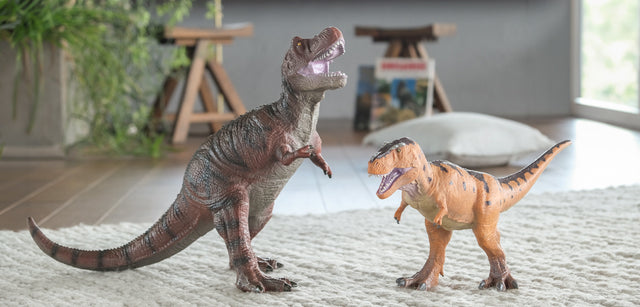
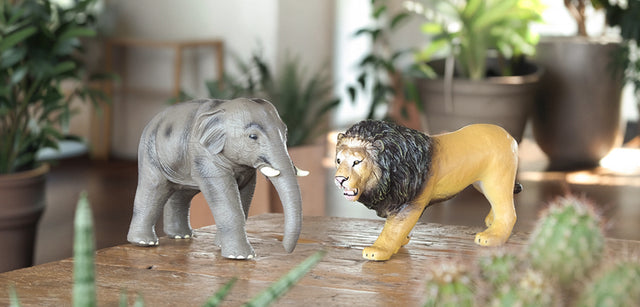
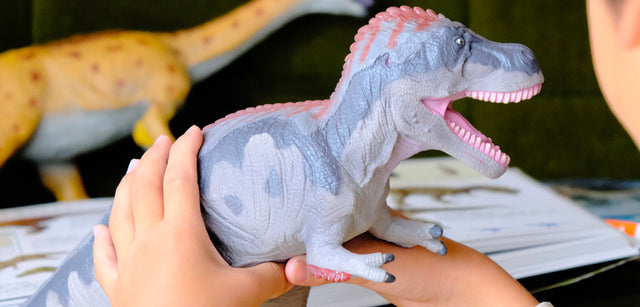
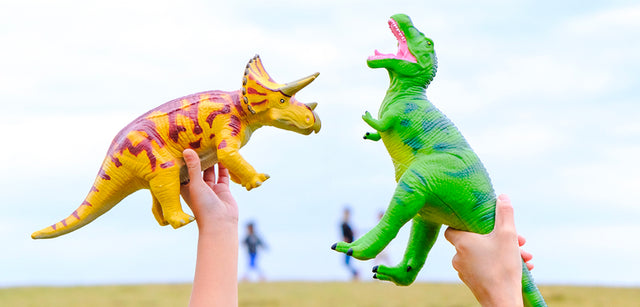
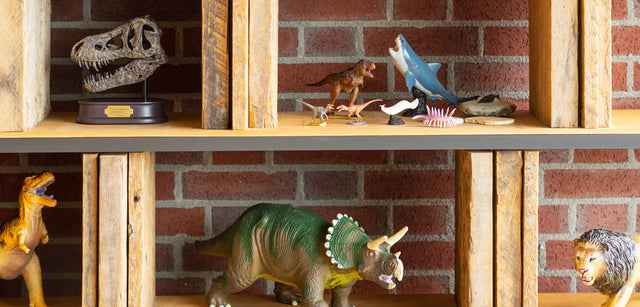
"Dinosaur Expo 2019" goods (Image 1)
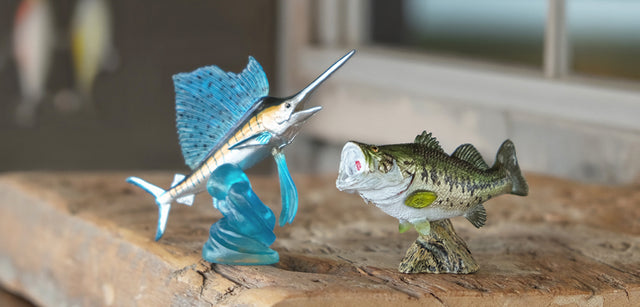
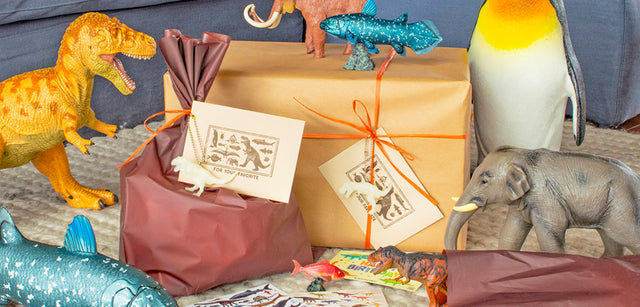
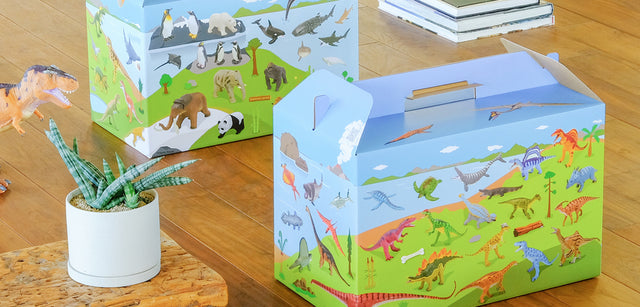
Actually, the four items shown here are original goods from the "Mukawa Town Hobetsu Museum" and are not official goods of the dinosaur exhibition. As for the official goods of the dinosaur exhibition, I naturally got the set of 5 Kaiyodo mini-figure bronze versions that came with the advance ticket. I'm currently planning to buy the colored versions sold in the venue's gacha machines through a bulk purchase on Yahoo Auctions.
Other official goods include "Sumikko Gurashi," "Domo-kun," "Umaibo," and "Zoids pre-sale???"... These are outside my area of interest. I was worried that, like two years ago, I would only be able to feature snacks. Pushing past the fluffy Deinocherius and Deinonychus plush toys overflowing in the shop, I finally reached a corner for the "Mukawa Town Hobetsu Museum" and found these items. I was genuinely relieved.
The Mukawaryu and Deinocheirus figures are about 1/35 scale and a bit expensive at 6,000 yen, but they are handmade in Mukawa Town, and I heard from a staff member who happened to be there that the cost is too high to break even, so I couldn't not buy them. I found out later that the Mukawaryu figure seems to be based on the model used to determine the pose when assembling the skeleton (which appeared on NHK's Sarameshi), and if that's the case, it's a very satisfying purchase.
The 3D paper puzzles of the Mukawaryu skeleton and the Hobetsu-produced mosasaur "Phosphorosaurus" are more expensive than similar products generally available, but they are larger and astonishingly detailed. The Mukawaryu has 92 pieces, and the Phosphorosaurus even depicts its palatal teeth. In fact, there were also Tyrannosaurus (modeled after Scotty, which is owned by the Hobetsu Museum and on loan to Dinosaur Expo 2019) figures and paper puzzles, but I hesitated to buy them. Was it because I became more conscious of the quagmire? But I'm going again after summer vacation, and if they're still there, I'm not confident I can resist. And if they're sold out, I'll surely regret not buying them furiously.
Putting aside the goods, this "Dinosaur Expo" had an unprecedented number of highlights. First, the unexpected holotype specimen of Deinonychus that greeted visitors was probably the most valuable item this time. It triggered the Dinosaur Renaissance, is the origin of today's feathered dinosaurs, and I finally got to see the actual claw of the culprit who dragged me into this quagmire! I was deeply moved!
And then there was the nostalgic famous scene of Deinonychus attacking a herd of Tenontosaurus (though there were only two). However, the Tenontosaurus were much smaller than I remembered (please see Secret Treasure House Vol. 62), making it seem like even one could be easily defeated. If they were to be counter-attacked by something like that, the name Deinonychus would be sullied. (The cannibalism theory presented was rejected among us, as it's unlikely an animal would cannibalize when food is lying right in front of it!)
Deinocheirus was surprisingly huge, unusual, and its towering figure was almost awe-inspiring. It was a far cry from "Nico," the pink fluffy mother dinosaur from NHK Special who suddenly raised her feathers and made funny faces (like Chiko-chan!), with long eyelashes and big, bright eyes... Writing this, I suddenly realized something. Is Nico = Chiko? Is this NHK's clever strategy to gain popularity? If so, NHK is formidable.
*Incidentally, NHK disappointed me again this year. While the anthropomorphism of dinosaurs (giving them names, making them tweet) and exaggerating stories (Mosasaurus attacking dinosaurs on the shoreline like orcas, Troodon fishing, etc.) are still within the scope of entertainment, how can diverse herbivorous dinosaurs congregate on a barren coast like a savanna? Also, it's unhelpful to lump mosasaurs, plesiosaurs, and ichthyosaurs together as "sea dragons" without any explanation. Ichthyosaurs never even appeared once. And most importantly, "Gina," the awkward, giant-lizard-like mosasaur that attacked with its mouth wide open, had no palatal teeth! Even the paper puzzle has them...
Let's return to Deinocheirus. When I looked at the fossil, I noticed something odd: three metatarsals arranged side-by-side, even though it's an ornithomimosaur. I had assumed that ornithomimosaurs had arctometatarsals (I'm ashamed to admit I've never been able to say it smoothly on the first try). Since there was no explanation about this at the venue or in the catalog, I looked it up when I got home and found that there were species like Harpymimus and Garudimimus that did not have arctometatarsals, and Garudimimus, in particular, was reclassified into the Deinocheiridae family in 2014. I unexpectedly learned something new.
And then there's Mukawaryu. Information about it has been flowing out since its excavation, and it's truly a blessing to have the eagerly awaited complete skeleton lying before my eyes. It was an amazing fossil. It's completely understandable why Dr. Yoshitsugu Kobayashi boasts it as the best dinosaur fossil in Japan and keeps churning out books about it.
However, the overwhelming visual appeal of Deinocheirus and the largest Tyrannosaurus, "Scotty," seemed to draw more attention at the venue. Certainly, Mukawaryu is a visually unassuming dinosaur. Moreover, the Hadrosaurinae subfamily, to which Mukawaryu belongs, is probably one of the most unassuming dinosaurs in the dinosaur world. The other dominant group in the Hadrosauridae family, the Lambeosaurinae subfamily, includes well-known figures such as Parasaurolophus, which boasts the highest number of figures among Hadrosauridae, as well as Corythosaurus, Lambeosaurus, and Tsintaosaurus. Their strength lies in being identifiable thanks to their peculiar crests. In contrast, the biggest star of the Hadrosaurinae subfamily, Maiasaura, is treated as only valuable with its young, and the barely identifiable Saurolophus is recognized as merely a Parasaurolophus with a shorter crest.
However, the Hadrosaurus, precisely named after the Hadrosaurinae subfamily, is a historical dinosaur that was assembled as the first bipedal dinosaur by Hawkins, who created the Crystal Palace Dinosaurs, in 1868. (The genus Hadrosaurus still exists today.)
http://mentalfloss.com/article/65323/10-facts-about-hadrosaurus
And from the 50s to the 60s, dinosaurs of the Hadrosaurinae subfamily, known as Trachodon, were regulars in figure series. This time, I collected figures of the Hadrosaurinae subfamily, from that era up to Mukawaryu. The title is "Mukawaryu Support Project - Hadrosaurinae Figure Grand Assembly."
●The lineage from Trachodon to Edmontosaurus

First, take a look at this (Image 2).
This is Brian's famous T-Rex vs. Trachodon, one of the dinosaur masterpiece dioramas from Luna Models, an American garage kit manufacturer from the 80s-90s, which also appeared in Secret Treasure House Vol. 18. This time, please focus on the Trachodon.

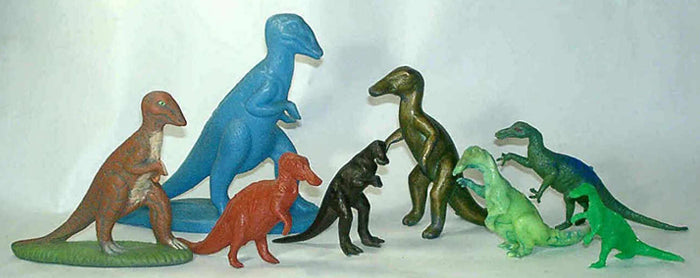
(Image 3) shows Trachodon figures sold by old American toy manufacturers. The three from the left are SINCLAIR (Secret Treasure House Vol. 35) from the 60s. The two in the center are metal; the smaller one is ALVA from the 50s, and to its right is SRG from the 40s to 50s. Then there are the famous MARX, a Hong Kong copy of MARX/MPC that was widely distributed in Japan long ago (I was dismayed to find I don't have the original at home. I must buy it...), and TIMMEE TOY, all from the 50s-60s. During the Trachodon era, they didn't have cheek pouches and clearly looked like duck-billed dinosaurs, and I think their unique appearance made them popular. As classification and names changed to Anatrosaurus, Anatotitan, and Edmontosaurus (I'm not entirely clear on this; there seems to be a theory that they're all Edmontosaurus now), and cheek pouches appeared, they became gentle and plain-faced, similar to Iguanodon (New Secret Treasure House Vol. 38), and their lack of other distinguishing features likely affected their popularity as figures.

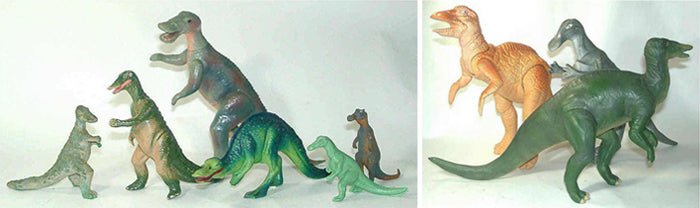
(Image 4, left) From the 70s to early 80s. Trachodon and Anatrosaurus are mixed, but all still have distinct duck-like faces. In the back is a domestic product, Clover's 1/50 dinosaur series (Secret Treasure House Vol. 38) Trachodon, with "1981" engraved. In the front row, from left, is an unidentified eraser (the paint I once applied has peeled off nicely), a 70s French STARLUX Anatrosaurus and a Shantungosaurus, which was rare at the time. Then, sandwiched between an unknown manufacturer's Trachodon?, is a 1972 Trachodon from INPRO in the UK.
(Image 4, right) Anatrosaurus from the 80s. All are large, about 30cm. On the left is an American PLAYSKOOL, next to it is an unknown type from IMPERIAL, a Chinese manufacturer, made in 1989. In the foreground is the Anatrosaurus from the 80s Tsutsuba 1/30 dinosaur series. This is a monumental model, as it was the first to feature cheek pouches.
After that, for about 20 years, dinosaur figures from the Trachodon to Edmontosaurus lineage virtually disappeared from our home.

(Image 5) Edmontosaurus
All the items on the top shelf are from the last 10 years. On the left is a Miniature Planet item that is still on sale. In the center is a souvenir from the "Dinosaur 2009 - Miracles of the Desert" exhibition held at Makuhari Messe in 2009, featuring "Dakota," an Edmontosaurus with a mummified fossil that was one of the highlights of the exhibition. On the right is a character from the 2013 movie "Walking with Dinosaurs." In the movie, it was the largest dinosaur, strutting around proudly in large herds, but the figures are only mini-figures. The pathos of a supporting dinosaur lingers... This isn't helping to promote Mukawaryu!
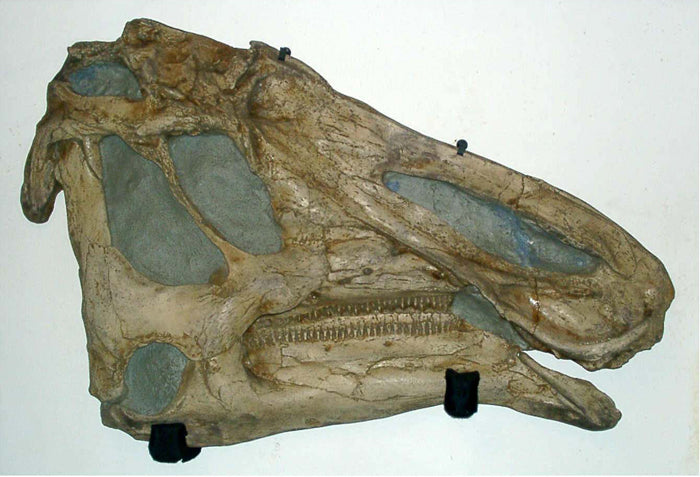
The bottom shelf features one of my proud collections: a 1999 ANTS 1/10 skull model series. They are only about 6cm long, but as you can see, they are very well made. Next to them, looking somewhat out of place, is a replica I got for a ridiculously cheap price on Yahoo Auctions. The genus is uncertain.
Please also see this: "Dinosaur Toy Museum" Anatotitan
And what I regret missing out on is Favorite's scene model "T-Rex vs. Edmontosaurus," which is now out of print. I wanted to display it alongside the Luna Models diorama... You can see images of it.
*The latest Edmontosaurus figures are released by Safari, Jurassic Hunter, and Jurassic Action. The Safari one is quite good, so I ordered it on Amazon, but it didn't arrive in time for this.

●I lined up Kaiyodo's Hadrosaurinae. (Image 6) There's a 1/35 Trachodon (later revised to Anatrosaurus in the catalog) and Maiasaura. And a huge, heavy 1/20 Shantungosaurus. That's all. By the way, the Lambeosaurinae lineup is:
Parasaurolophus (3)
Lambeosaurus (2)
Corythosaurus (1)
Hypacrosaurus (1)
*Neither candy toys nor gacha figures are counted here.
"Dinosaur Toy Museum" Shantungosaurus

●Maiasaura (Image 7)
Maiasaura, which was all the rage in the 90s, seemed to have disappeared from view recently, but it reappeared at this dinosaur exhibition as part of a review of the dinosaur renaissance. Is it the specimen that used to be in the entrance hall of the National Museum of Nature and Science? I'm concerned that there's only one child left.
The mother and child in the front left are what would now be called official goods, sold at the "Great Dinosaur Exhibition - A Story of Dinosaur Parents and Children" held at the National Museum of Nature and Science in 1990. They are made of metal. Behind them is a brooding Safari, and to its right is a soft vinyl juvenile from an unknown manufacturer. In the foreground is an item from the original dinosaur candy toy series, "Latest Dinosaur Studies" released by Bandai in 1993, which I colored (Secret Treasure House Vol. 45). It also came with a child, but it's now missing. Maiasaura is truly nothing without its children.

●Saurolophus (Image 8)
When it first came to Japan in 1978 for the "Lost Creatures - Great Dinosaur Exhibition" with Tarbosaurus, I remember being overwhelmed by its enormous size. It's a shame that souvenir figures weren't made at that time. Although it looks quite cool, there are few figures of it.
The top row features items from the "Dinosaur King" TV anime series, Dinosaur King Series. This series included a rather niche lineup of dinosaurs. To its right is a Shantungosaurus. The bottom row features a 70s soft vinyl, Marushin's "Great Dinosaur" series (Secret Treasure House Vol. 37), and a recent "Dinosaur Kingdom Autumn Festival" series, old vs. new Saurolophus showdown, which I purchased at the Kanna Town Dinosaur Center just the other day.
"Dinosaur Toy Museum" Saurolophus

●Something like this is also hanging on my wall: a Prosaurolophus. (Image 9)

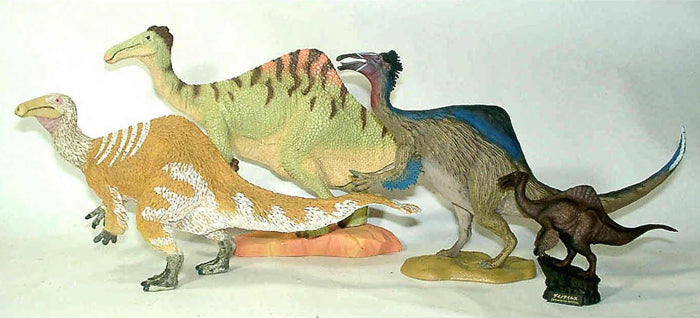
Let's also introduce Deinocheirus figures. As expected of a newcomer, there are few of them. Perhaps because of its peculiar body shape, there's not much room for variation, so they all have similar poses. Now, the one from Kanna Town, which was the first to be made into a figure, is unique with its scaly version. By the way, are the decorative feathers on its head necessary? I think it looks cooler without them.
From the left: a Safari without decorative feathers, the Kanna Town Dinosaur Center, CollectA (there's also a larger deluxe version), and this time's official figure. (Image 10)
Believe it or not, CollectA used to have a figure of the pre-updated Deinocheirus, which looked like a regular ornithomimosaur. Its appearance wasn't very appealing, so I wasn't really tempted to buy it, but now I wish I had. It would have been interesting to line them up.

Now, about another annual summer event, the "Hakubutsu Festival," I had to miss it this year due to it coinciding with the Dinosaur Club's trip to Kanna Town. However, it would be too sad not to buy anything, so I asked a friend to buy some for me. Takao Ito, a dinosaur potter, is a club member, so we communicated by email and decided what to buy beforehand. I got a sake cup of the overly realistic aquatic Spinosaurus and a Deinocheirus, which is currently in season. I've already requested a Halszkaraptor for next time. At Hasamic World, the Archaeopteryx Berlin specimen and Caudipteryx that I had my eye on online sold out quickly, so I was only able to buy a Dilophosaurus, which was disappointing. There's always next year. (Image 11)
Another dinosaur topic this summer.
The other day, I went to see a musical called "On the Town."
It's a Broadway musical produced by Yutaka Sado, known as the conductor of the "Chorus of 10,000," and it's a masterpiece that tells the story of three sailors' 24-hour leave in New York through song and dance. The premiere was in 1944, and the setting remains the same. So, what does this have to do with dinosaurs? Well, there's a scene where the sailors accidentally break a dinosaur skeleton at the natural history museum. It has been performed many times, so different dinosaurs have been broken each time. The one I happened to see on YouTube was a Stegosaurus, and in the 1949 movie adaptation, it was a Brontosaurus. This time, it was a magnificently crafted Tyrannosaurus. From a distance, it could even pass for a replica. However, what was truly disappointing was that it was in the modern horizontal posture. The color was also beige. I couldn't help but write on the survey how moved I would have been if the old AMNH 5027 had been recreated.
Next time will be a summary of this summer. It will be a "Memories of Summers Past" special, featuring the unusually large number of dinosaur books that have been published and will continue to be published, the figures I missed buying this time, and dinosaur events I plan to attend.

Finally, a return to the Mosasaur volume, a 19th-century German paleontological lithograph. It is labeled Hadrosaurus mirabilis Leidy. (Image 12)
← Older Post Newer Post →