Vol. 56 History of Dinosaur Plastic Models 1
The other day, I found a wonderful book at a bookstore called "50-Year History of Japanese Plastic Models," which cost 5,000 yen, and I impulsively bought it. It was truly moving, with color photographs and articles of plastic models I distinctly remembered building as a child. It also came with a CD-ROM appendix titled "Complete List of Showa Plastic Models," which included data on dinosaur plastic models. It was a great discovery to find out the release years of the products. Incidentally, the oldest dinosaur plastic model in Japan, "Walking Stegosaurus" by Imai Kagaku, which I introduced in the first episode of the Secret Treasure Museum, was found to have been released in 1963. I was so inspired that I decided, "If this is the case, I must write about the history of dinosaur plastic models myself," and thus, I will be serializing "The History of Dinosaur Plastic Models" over the next few installments.
I first learned about the existence of dinosaur plastic models in "Plastic Model Dokuhon" (Plastic Model Reader), the first book on plastic models published in Japan in 1961. As an eight-year-old model enthusiast at the time, I would eagerly turn the pages every day, yearning for the exquisite imported kits of airplanes and cars that were introduced in the magazine (domestic products were still more like toys back then). Towards the back of the book, there was a page introducing unusual plastic models, and among atomic power plants, undersea oil fields, and squirrels with fur, a "dinosaur skeleton model that assembled each individual bone" was featured. Although there were no photographs, the article stating "manufactured by RENWAL" was etched into my young mind and remained in the back of my thoughts ever since. Decades later, after becoming a dinosaur collector, I searched for it at every opportunity. It was only recently that I discovered "RENWAL" was a mistake and it was actually manufactured by "ITC." These are the Tyrannosaurus (Photos 1, 2: the modern version was modified by the author) and Stegosaurus (Photo 3) released in 1957, which are considered the world's first dinosaur plastic models, as well as the Brontosaurus (Photo 4) and Neanderthal (Photo 5) skeleton models released in 1962. These were reissued by "GLENCOE MODELS" in the 90s, and the examples shown here are assembled from those reissues (I'd love to have the originals too!). While not assembling every single bone, they are very well made. The Tyrannosaurus, in particular, which appears to be modeled after AMNH5027 at the American Museum of Natural History in New York, is remarkably well done for what is considered the first dinosaur plastic model.


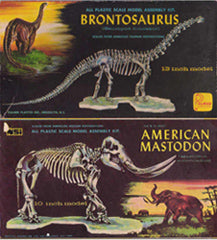
A little later than "ITC," in the late 1950s, a manufacturer called "PALMER" also released skeleton kits of Brontosaurus and American Mastodon. These were re-released in the 1960s with the logo changed to "NATURAL SCIENCE LTD" and in the same packaging. The New York souvenir introduced in Secret Treasure Museum Vol. 20 is an example, shown again here (Photos 6, 7).


Also around the end of the 1950s, "PYRO" released dinosaurs with flesh. They offered the four classic species: Stegosaurus, Tyrannosaurus, Brontosaurus, and Triceratops (Photo 8), with toy-like sculpting. The packaging in the photo is a later version; the original had a comic-style illustration, but unfortunately, I don't own it. "PYRO" released four new types in 1968 (Photo 9).


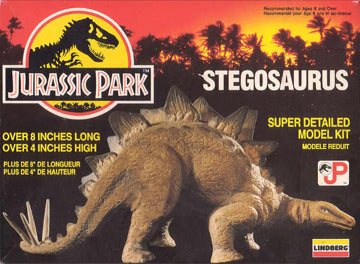
The progress is evident, and the Corythosaurus, in particular, with its Brian-like appearance, is well-made. "PYRO"'s products were later re-released in the 70s by "LIFE-LIKE" as single figures or in diorama settings (Photo 2 in Secret Treasure Museum Vol. 18), and "LINDBERG" re-released Stegosaurus, Tyrannosaurus, Brontosaurus, and Dimetrodon in 1979. Then, in 1993, Stegosaurus and Corythosaurus were improved in detail and added to their Jurassic Park series (Photo 10).
To be continued in the next issue.

← Older Post Newer Post →