

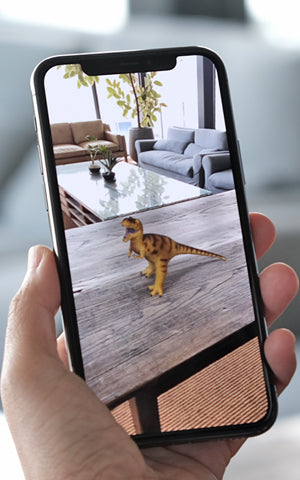


Mini Dinosaurs Picture Book for Kids
index

Tyrannosaurus
One of the most popular dinosaurs and one of the largest terrestrial carnivores of all time. It inhabited all of what is now North America and was the last non-avian dinosaur to thrive until the moment of their extinction. Over 30 fossil specimens have been discovered worldwide, including nearly complete skeletal remains. Its lower jaw was massive compared to other theropods, suggesting an incredibly powerful bite force. Correspondingly, its teeth were robust, with the front teeth, which experienced the most pressure, being thick and long. The teeth had characteristic serrations, a structure well-suited for tearing flesh from prey. Although its forelimbs were degenerate, with only two digits, making them appear frail, they were powerful enough to restrain prey. True to its name, "Rex" (meaning king in Latin), it truly was the king of dinosaurs.
| English Name: Tyrannosaurus Name Origin: Tyrant Lizard Classification: Saurischia / Theropoda / Tyrannosauridae Size: Length 12-14 meters / Estimated Weight 7 tons Period: Late Cretaceous (70 to 65 million years ago) |
 |

Strong Teeth
Tyrannosaurus teeth were sharp and could be over 30 cm long, with fine serrations along the edges. These are thought to have been used for tearing the flesh of prey. It had around 60 teeth, which were repeatedly shed and replaced.
Jaw that could crush bones
Its jaw was incredibly powerful and robust, believed to have been able to crush the bones of its prey. Fossils of Edmontosaurus with parts of their bones torn off by bites, and Triceratops fossils with healed wounds from attacks, have also been found.
Weak Forelimbs
In contrast to its sturdy and powerful hind legs, its forelegs were very small, with only two digits. The exact role of these forelegs is not clearly understood. It is believed that they atrophied and became smaller due to being rarely used. Furthermore, no fossils of its forelegs have yet been discovered.
Imagine its size


Triceratops
Triceratops, along with Tyrannosaurus, is one of the most well-known dinosaurs, a large ceratopsian that lived in the Late Cretaceous period of the Mesozoic era. While ceratopsians have been identified in Asia and North America, horned ceratopsians like Triceratops have only been found in North America. Its name comes from its three long horns on its nose and above its eyes, and there's a story that paleontologist Othniel Charles Marsh (1831-1899) initially misidentified Triceratops horns as belonging to wild cattle. Over 50 skeletal remains, including skulls, have been discovered to date, but despite its massive head, its brain size is estimated to be only about 70 grams. Like Tyrannosaurus and Edmontosaurus, it was also one of the last non-avian dinosaurs to thrive until the moment of the dinosaurs' extinction.
| English Name: Triceratops Name Origin: Three-horned face Classification: Ornithischia / Ceratopsia / Ceratopsidae Size: Length 7-9 meters / Estimated Weight 7-9 tons Period: Late Cretaceous (70 to 65 million years ago) |

|

Three horns
Many people associate Triceratops with these three sharp horns. It had one short horn on its nose and two long horns above its eyes. These are thought to have been used as defensive weapons and in contests between males within the herd.
Frill
Regarding the function of the frill extending from the back of the head over the neck, there are various theories, such as intimidation and defense against predators, or use in territorial disputes and courtship within the same species. One of its characteristics is that this large frill has no holes.
Build
As one of the largest ceratopsian dinosaurs, it had a sturdy and robust build. Its head also accounted for approximately one-quarter of its total body size. With such a heavy-duty build and sharp horns, its charges must have had tremendous destructive power.
Imagine its size


Spinosaurus
Its most distinctive feature is the developed "sail" on its back, which could reach up to 1.8 meters in height. It may have been the largest theropod, but its skeleton is known only from very incomplete remains. Discovered in Egypt by a German paleontologist before World War I, the specimen was transported to Munich. It was published as a new genus and species in 1915, but the original material (known as the holotype) was entirely lost in an air raid during World War II in 1944. After the war, related theropods like Baryonyx (UK) and Suchomimus (Niger) were found to be widely distributed across Africa and Europe during the Cretaceous period, but the development of their "sails" was not as pronounced as in Spinosaurus. The teeth of these spinosaurids were long and slender, lacking serrations, and their elongated jaws suggest a piscivorous diet. Furthermore, recently discovered fossils indicate the possibility of a semi-aquatic lifestyle, similar to crocodiles.
| English Name: Spinosaurus Name Origin: Spiny Lizard Classification: Saurischia / Theropoda / Spinosauridae Size: Length 13-15 meters / Estimated Weight 4-6 tons Period: Late Early Cretaceous to Late Cretaceous (100 to 90 million years ago) |
 |
 Role of the sail?
The most distinctive feature is the "sail" on its back, reaching up to 1.8 meters in height, believed to have been used for thermoregulation, intimidating enemies, and attracting mates.
Slender jaw
Its slender jaw, reminiscent of a piscivorous crocodile, suggests that it primarily preyed on fish.
Was it semi-aquatic?
The fossil specimen discovered in 1912 was lost in an air raid during World War II, hindering research, but recent fossil discoveries suggest the possibility of a semi-aquatic lifestyle, similar to crocodiles.
Imagine its size


Stegosaurus
The largest and most famous of the stegosaurids. Stegosaurids are characterized by two rows of bony plates running along their backs from neck to tail, and they thrived from the Late Jurassic to the Early Cretaceous. Their curved back shape is also distinctive. There is a theory that stegosaurids, including Stegosaurus, lived in herds, as groups of their fossils have sometimes been found together. The four spikes at the tip of their tail are interpreted as having been swung for defense. Stegosaurus can be identified by the large, diamond-shaped or triangular bony plates arranged along its back. Compared to its large body, its head is particularly small, and it is also famous for its small brain (approximately 30 grams, about the size of a pickled plum). However, the actual intelligence of Stegosaurus is not well understood.
| English Name: Stegosaurus Name Origin: Roofed Lizard Classification: Ornithischia / Stegosauria / Stegosauridae Size: Length approximately 6.7 meters / Estimated Weight 2.6 tons Period: Late Jurassic (150 million years ago) |
 |
 Dorsal plates
The bony plates on its back were diamond-shaped or triangular and grew alternately. When Stegosaurus was first discovered, there was no complete specimen, so it was believed that its back was covered with bony plates like a turtle's shell. Also, the design of "Godzilla's" dorsal fins was actually based on Stegosaurus.
Tail spikes
The sharp, four long spikes at the end of the Stegosaurus's tail, which were its greatest weapon. The largest ones are said to have been up to 60 cm long. It would have swung its tail from side to side to fight predators.
Stegosaurus VS Allosaurus
Fossils of an Allosaurus bone have been discovered with injuries that suggest it was attacked by a Stegosaurus's tail spikes. The attacked area was near the base of the Allosaurus's tail. Was it retaliated against during a hunt? The discovery of fossils reveals various scenes from the dinosaur era.
Imagine its size


Allosaurus
One of the largest carnivorous dinosaurs, representative of the Jurassic period. Its distinguishing features include knob-like projections above its eyes, a large head over 1 meter long, thick and powerful hind legs, and well-developed forelimbs. It skillfully balanced its body with a large head and a long, straight, heavy tail. It was more primitive than tyrannosaurids and troodontids in that its carpals were not lunate, the anterior process of its ilium was underdeveloped, and its second and fourth metatarsals did not connect. Although the largest specimens were comparable in size to Tyrannosaurus, its skeleton was not as robust as that of tyrannosaurids. The forelimbs of Allosaurus were not as weak as those of Tyrannosaurus; its developed three-fingered hands had sharp claws that would have been powerful weapons. When hunting prey, it is believed to have ambushed them from bushes, swinging its powerful upper jaw for a surprise attack.
| English Name: Allosaurus Name Origin: Different Lizard Classification: Saurischia / Theropoda / Allosauridae Size: Length 12-14 meters / Estimated Weight 3-5 tons Period: Late Jurassic (150 million years ago) |
 |
 Knob-like projections
Allosaurus is characterized by knob-like projections (crests) above its eyes. Their shape and size are said to have varied among individuals.
Three fingers with powerful claws
Its well-developed forelimbs have three fingers with large, sharp claws (curved claws). These would have been powerful weapons, capable of firmly grasping prey.
Allosaurus teeth
It possessed numerous sharp, large teeth that curved backward and had a lens-like cross-section. Additionally, fossilized Apatosaurus bones with bite marks from Allosaurus have been found. This suggests that Allosaurus preyed on the gigantic herbivorous Apatosaurus.
Imagine its size


Brachiosaurus
Brachiosaurus is one of the largest herbivorous dinosaurs for which almost complete skeletons exist. It has distinct characteristics different from other sauropods, such as longer forelimbs than hindlimbs, a sloped back from shoulders to hips, and a short tail. Its head is small, with a brain size of about 150 grams, and its jaw power is weak. Due to the crest-like swelling in the nasal area, it was once believed to have lived in water, using its nose like a snorkel. However, because it lacks a diaphragm and its lungs would collapse under water pressure, it is now thought to have been terrestrial. Recent research has also revealed that it could not raise its neck vertically, as it did not possess a heart large enough to pump blood to the tip of its head, and due to the shape and articulation of its neck bones.
| English Name: Brachiosaurus Name Origin: Arm Lizard Classification: Saurischia / Sauropodomorpha / Brachiosauridae Size: Length approximately 22 meters / Estimated Weight 30 tons (or 80 tons) Period: Late Jurassic (150 million years ago) |
 |
 Forelimbs
Brachiosaurus forelimbs were longer than its hindlimbs, a feature that distinguishes it from other sauropods. As a result, its back sloped from its shoulders to its hips like a ramp.
Skeleton
It is known as one of the largest herbivorous dinosaurs for which almost complete skeletons exist. Its limb bones and shoulder bones, which supported its heavy weight, were thick and robust.
Long Neck
This long neck is synonymous with Brachiosaurus. It was long enough to reach high tree leaves. Recent research has also revealed that it could not raise its neck vertically.
Imagine its size


Ankylosaurus
The largest and most representative of the armored dinosaurs. Its entire back, from neck to tail, was covered with numerous bony plates and spines. Its skull was also very thick and robust, with triangular horns protruding from the back of its head. The tip of its tail had a hard, club-shaped bone, which is believed to have served as a defensive weapon when attacked by carnivorous dinosaurs such as tyrannosaurids. The teeth of ankylosaurs and stegosaurs were very small and weak, and while their primary diet is unknown, it is likely that they swallowed soft leaves whole and absorbed nutrients internally.
| English Name: Ankylosaurus Name Origin: Fused Lizard Classification: Ornithischia / Ankylosauria / Ankylosauridae Size: Length 11 meters / Estimated Weight 4 tons Period: Late Cretaceous (70 to 65 million years ago) |
 |
 Flat Hammer
The tip of its tail was equipped with a flat, hammer-like club. It is believed to have served as a defensive weapon when attacked by carnivorous dinosaurs such as tyrannosaurids. When defending itself, it would swing this club from side to side, and if it hit an enemy, it surely inflicted significant damage. Since its habitat overlapped with fierce carnivorous dinosaurs like Tyrannosaurus, it likely needed this heavy armor for protection.
Body covered in armor
Ankylosaurus was covered from neck to tail on its dorsal side with numerous bony plates and spines, and its skull was also very thick and robust. This was effective in protecting itself from predator attacks. The armor plating was extensive, even extending to its eyelids. However, its abdomen was vulnerable, so it likely curled up on the ground to escape danger when attacked.
Imagine its size


Pteranodon
One of the most famous pterosaurs, it was the king of the skies during the Cretaceous period. It was also the first pterosaur discovered in North America (in 1871). It is abundantly found in the Niobrara Chalk Formation in western Kansas, with thousands of specimens collected to date. Most fossils are very fragmentary, with only one complete skeleton known. Its most prominent feature is the long, slender crest extending backward from the top of its head (equivalent to the forehead in humans); the largest skulls could reach 1.8 meters in length. Two types are recognized based on crest shape (longiceps and sternbergi). With a wingspan of over 7 meters, it is thought to have glided like a glider on updrafts using its wings. It is believed to have primarily eaten fish, scooping them up near the water's surface, and since it had no teeth, it likely swallowed its prey whole. Pterosaurs were giant flying reptiles that dominated the skies where dinosaurs lived. They are mysterious creatures that are neither birds nor dinosaurs.
| English Name: Pteranodon Name Origin: Wing without teeth Classification: Pterosauria / Pterodactyloidea / Pteranodontidae Size: Wingspan 7 meters (largest individuals may have reached 9 meters) / Estimated Weight 15-20 kg Period: Late Cretaceous (85 million years ago) |
 |

Enormous Crest
The shape of the crest varies by species and is one of the criteria for classification. Pteranodon longiceps is characterized by a crest extending backward, while Pteranodon sternbergi has a crest that is more vertical and significantly expands forward. There are various theories about the crest's role, such as steering, a sail, a radiator, or for courtship display, but recently, the theory that it served as a display to indicate sexual differences has become dominant. The skull reached a maximum length of 1.8 meters.
Flight method
Pteranodon's wings were not very strong, and its primary method of flight involved largely passive gliding on updrafts, rather than relying heavily on muscle power. It was likely not adept at powerful flapping flight.
Light body
Pterosaurs had very light bodies to enable flight, with their skulls, scapulae, and pelvises composed of bones only 2-3mm thick. The interior of the bones had a honeycomb structure with small holes. Its estimated weight is thought to have been 15-20 kilograms.
Imagine its size


Mosasaurus
Mosasaurus was a gigantic carnivorous marine reptile that thrived in the Late Cretaceous seas. It was one of the largest members of the Mosasauridae family, characterized by a crocodile-like head, a barrel-shaped and streamlined body, and limbs evolved into flippers. Its head featured a double-hinged jaw that allowed it to open its mouth wide, and it is believed to have swallowed its prey whole. Recent research on the related species Platecarpus suggests that it may have possessed a crescent-shaped tail fluke, similar to sharks. Mosasaur fossils have also been discovered in various locations across Japan.
| English Name: Mosasaurus Name Origin: Meuse River Lizard Classification: Reptilia / Squamata / Mosasauridae Size: Total length 12.5-18 meters Period: Late Cretaceous |
 |

Jurassic World
In the movie "Jurassic World," its memorable scene of leaping out of the water to catch prey significantly boosted its fame and popularity, making it a major figure today.
King of the Sea
Mosasaurus is believed to have been the apex predator of the Mesozoic seas, reigning at the top of the marine food chain. With its double-hinged jaw, it could open its mouth wide to prey on various marine creatures.
Same family as monitor lizards
Mosasaurus belongs to the same family as modern monitor lizards, earning it the nickname "sea lizard." It is believed to have had well-developed organs for sensing odors with its tongue, similar to lizards and snakes.
Imagine its size

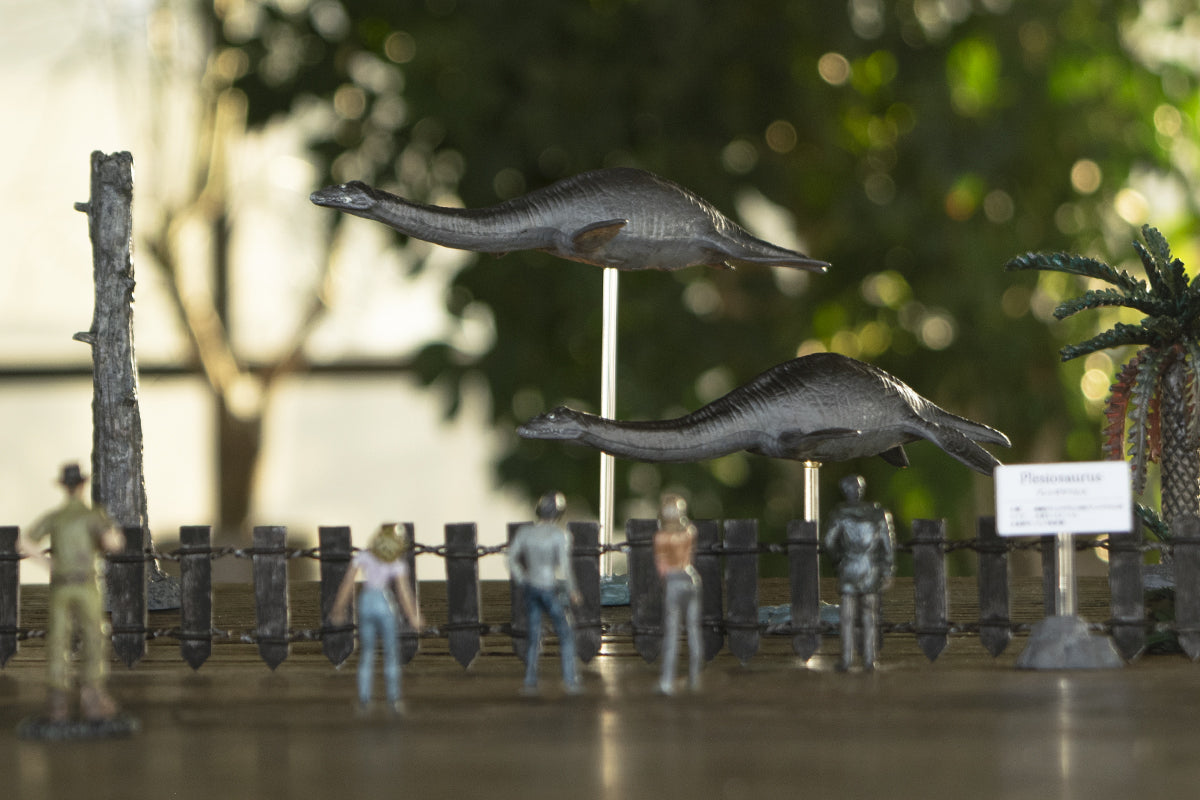
Plesiosaurus
One type of plesiosaur that thrived from the Late Triassic to the Early Jurassic, and an early member of the plesiosaur group. It had a short, robust body and swam using large, oar-like limbs. Gastroliths (stomach stones) were found between its ribs, believed to have functioned as ballast for buoyancy and adjusting its center of gravity. Its eyes were positioned high on its head like a ray, and when its mouth was closed, its sharp upper and lower teeth interlocked outside its mouth, a characteristic consistent with a reptile that primarily consumed fish.
| English Name: Plesiosaurus Name Origin: Near Lizard Classification: Sauropterygia / Plesiosauria / Plesiosauridae Size: Length 3-5 meters Period: Early Jurassic |
 |

Paddle-like Limbs
Its limbs were large and paddle-like, and it is believed to have used them like oars to swim. Did it move its flippers in combination, both forward and backward, and up and down, to propel itself through the water?
Not a dinosaur?
Marine plesiosaurs and ichthyosaurs are not scientifically classified as dinosaurs. Nevertheless, they are highly recognized aquatic reptiles that are indispensable when discussing the world of dinosaurs.
Nessie and Plesiosaurus
Nessie, famous as an cryptid, became a topic of discussion as a Plesiosaurus trapped in Scotland's Loch Ness. It is a globally known cryptid, and its mystique continues to be passed down.
Imagine its size

← Older Post Newer Post →