
New Dinosaur Treasure Museum

Vol.29 Dinosaur Sci-Fi Novels for Boys and Girls of the Showa Era

This time, our theme is juvenile dinosaur science fiction, but before that, a supplement to the previous entry.

I unwittingly missed that Jules Verne's "Journey to the Center of the Earth" was being serialized as a comic in the monthly "Comic Beam" since October of last year. Just a few days ago, the first volume of the tankōbon was released.
https://www.enterbrain.co.jp/product/comic/beam_comic/15200901

The artwork is very meticulous, and the landscapes evoke the copperplate engravings from the original book. In fact, there are several scenes with similar angles that make you grin. (Among the many translated editions, the Iwanami Bunko version contains all the illustrations from the original, which is a great value.) In the first volume, they've just found a water source and taken a breather. I'm looking forward to the scenes of the mushroom forest and the Lidenbrock Sea.

Now to the main topic. A long, long time ago, when I was a boy, bookstore shelves were lined with books titled "○○ Complete Works for Boys and Girls." "Boys and Girls"... a phrase that has a sweet, sour, Showa-era scent to it. Nowadays, I feel like you only hear it used for choirs or comedy duos. Incidentally, books for boys and girls are now called "Young Adult" books. Many Young Adult dinosaur sci-fi novels have been written, but they're no longer about cheerfully going to uncharted lands to defeat dinosaurs like in the old days; the atmosphere has changed considerably.

Juvenile
is a genre, and at places like Mandarake, these books from that era can sometimes fetch tens of thousands of yen. I'm going to introduce some of the best dinosaur sci-fi novels from that time. To confess, most of the books I'm featuring this time weren't actually read during my boyhood. I learned of their existence from two wonderful books published in quick succession in 2013: "Shōnen Shōjo Showa SF Bijutsukan: Hyōshi de Miru Juvenile SF no Sekai" (Showa Science Fiction Museum for Boys and Girls: The World of Juvenile SF through its Covers) by Hiroyuki Ohashi (Heibonsha), and "SF Kisho Collection" (SF Odd Book Collection) by Naohiko Kitahara (Tokyo Sogensha), and then spent a fortune acquiring them.

*On a personal note, at the time, I was more into space sci-fi. I definitely remember reading and can recall titles like "Spaceship Galileo," "Planet No. 10," and "The Adventures of the Alien Bix." I believe I read juvenile versions of "Journey to the Center of the Earth" and "The Lost World," but I'm not certain.

*Last time, when comparing my copies of "Journey to the Center of the Earth" and the "Pellucidar Series," I discovered a "simple way to tell" the difference between general editions and juvenile editions. In juvenile versions, the protagonist often refers to himself as "boku" (I/me, used by boys). This is probably to make it easier for readers to empathize. An interesting example is Yutaka Ishikawa's translation of "Journey to the Center of the Earth." The difference between the juvenile version included in "Sekai Shōnen Shōjo Bungaku Zenshū" (Complete Collection of World Literature for Boys and Girls) (Kadokawa Shoten) in 1957 and 1960, and the 1966 Kadokawa Bunko edition, is simply that Axel changed from "boku" to "watashi" (I/me, more formal/neutral) and the number of kanji increased (though I haven't checked every single word). Furthermore, the 1993 "Kaiseisha Bunko Complete Translation Classic Series" edition, revised by Ishikawa Fumi, the daughter, uses "watashi" despite being a juvenile edition.

That was a long preamble, but now I will arrange the covers, illustrations, etc., from my juvenile collection in chronological order. First, Japanese works.

"Kyoryu to Kaizoku" (Giant Dragon and Pirates) (Kikio Abe, 1949)
The protagonist, Takashi-kun, on his way to the Toro Ruins with his archaeologist father, hears his father tell the story of "Dr. Mammoth's African Expedition" on the train. Dr. Mammoth discovers dinosaurs and tries to bring them back, but is attacked by pirates, and both he and the dinosaurs end up at the bottom of the sea... or so the convoluted story goes. Takashi-kun is very disappointed and resolves to carry on Dr. Mammoth's will. The father's explanation of dinosaurs is quite detailed. The cover showing a Brontosaurus biting a crocodile and the frontispiece depicting a dinosaur rampaging on a ship are excellent. (Photo 1)
fan_hihoukan_29_1.png

"Ma-kyo no Daikai-ryu" (The Great Dragon of the Demon Realm) (Yoichiro Nanyo, 1949)
The protagonist, "boku" (I, used by boys), is a young American who leads an expedition, joined by Japanese circus performers, into a demon realm in the upper reaches of the Amazon, inhabited by dinosaurs, "savages" (original text unchanged), and wild children descended from Date Masamune's vassals... You probably have no idea what kind of story this is, but it would take too long to explain. The protagonists get caught up in battles between "indigenous people," and are horrified to witness a young "physically disabled person with a curved spine" (since this book predates the concept of discriminatory language, the phrases in quotes are alternative expressions) who, in retaliation for being rejected by the chief's daughter, conspires with an enemy tribe, being torn apart as punishment. Anyway, dinosaurs appear in abundance. There are no illustrations within the text, but the double-page frontispiece at the beginning is extensive. (Photo 2)
fan_hihoukan_29_2.png

"Kyōryū-jima" (Dinosaur Island) (Included in Volume 8 of Unno Juza's Complete Works) (1951)
Unfortunately, this book is not in my collection. I do own the 1990 edition of "Unno Juza Zenshu" (Complete Works of Unno Juza), but the illustrations are omitted from that one. The images of this box, cover, and illustrations were found online. I hope to acquire it someday. The text can also be read for free online: http://www.aozora.gr.jp/cards/000160/files/2718_23979.html (Photo 3)
fan_hihoukan_29_3.png

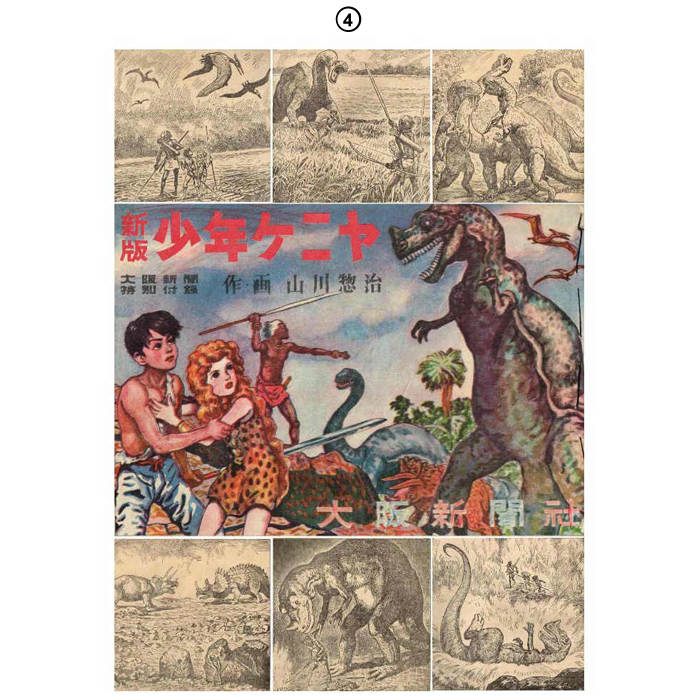
"Shinban Shonen Kenya" (New Edition, Boy Kenya) (Soji Yamakawa, 1953)
This was distributed as a special supplement to the Osaka Shimbun (like a Sunday edition nowadays?) six months before the fourth volume of "Boy Kenya," introduced in the previous "Chitei Sekai" (Underground World), was released. Here, dinosaurs inhabit a valley shrouded in mist deep in Africa. I'm not sure if this falls into the juvenile category, but the artwork is superb... (Photo 4)
fan_hihoukan_29_4.png

"Kairyū-tō" (Monster Dragon Island) (Shigeru Kayama, 1953)
This is a work by the original author of Godzilla. It starts with the protagonist, a boy, being overwhelmed by the sight of a dinosaur skeleton at "Tokyo's Natural Science Museum," raising expectations. However, the subsequent plot is quite ordinary: joining a suspicious doctor's expedition to an island in the South Seas inhabited by dinosaurs, fighting dinosaurs, and getting caught up in conflicts among indigenous people (one-inch-tall pygmies! This is barely acceptable, but of course, it's a parade of discriminatory terms). What's most disappointing is that the illustrations only feature people, with dinosaurs appearing only as bones in a graveyard. Otherwise, there's only a theropod on the title page, which is quite lonely. My copy is a 1985 reprint. (Photo 5)
fan_hihoukan_29_5.png

Next, translated works. Conan Doyle's "The Lost World," for which a new translation has recently been published, will be introduced together next time, so it's omitted here.

"Kyōryū no Sekai" (The World of Dinosaurs) / "Kyōryū Ichioku-nen" (Dinosaurs: 100 Million Years) (Marsten, 1956 / 67 / 76 / 2004)
All four books are translated by Masami Fukushima, but when "The World of Dinosaurs" was retitled "Dinosaurs: 100 Million Years," it became quite an abridged version. The story is about an adventure to the age of dinosaurs using a machine invented at the Time Flight Research Institute (Time Travel Research Institute in "Dinosaurs: 100 Million Years"). There was a villain in the group, but he gets his comeuppuppance from a Tyrannosaurus that appears at the very end. I've collected dinosaur illustrations from the 1956 "Kyōryū no Sekai." (Photo 6)
fan_hihoukan_29_6.png

"Kaitei Kantai" (Underwater Fleet) / "Shinkai no Kyōryū" (Dinosaurs of the Deep Sea) (Pohl / Williamson, 1959 / 78)
In the near future, where humanity has built underwater cities, students from a naval submarine school purchase a used submarine and head to the Tonga Trench, where they engage in battle with mysterious amphibians riding plesiosaurs. A new translation was published in paperback in 1978. Regardless of the plesiosaurs, it's interesting how the image of submarines changed over 20 years. (Photo 7)
fan_hihoukan_29_7.png

"Daiyon Wakusei no Hanran" (Revolt on the Fourth Planet) / "Alpha C no Hanran" (Revolt on Alpha C) (Silverberg, 1970 / 80 / 82 / 86 / 2006)
Alpha Centauri's Fourth Planet, a colonial planet of Earth, is a young world in the heyday of dinosaurs. The protagonist travels there and gets caught up in an independence movement. The 1970 and 1982 editions are from "SF Shōnen Bunko" (SF Juvenile Library). The 1980 and 1986 editions are from Foa Bunko, and while the team of Akashi Nakao (translation) and Ryuji Yanagi (illustrations) remains the same, the translation and illustrations are completely different between the SF Bunko and Foa Bunko versions. However, the scenes where illustrations are inserted are the same. I wonder if there's a reason for this. I compared them out of curiosity. (Photo 8)
fan_hihoukan_29_8.png
The 2006 edition of "Alpha C" features the Foa Bunko translation with modern-style illustrations. And the most delicious scene, in terms of a treasure trove, is this one: where the protagonist buys a dinosaur figurine, "dinosaur bone crafts," a local specialty, at a souvenir shop. (Photo 9)...I want one.
fan_hihoukan_29_9.png

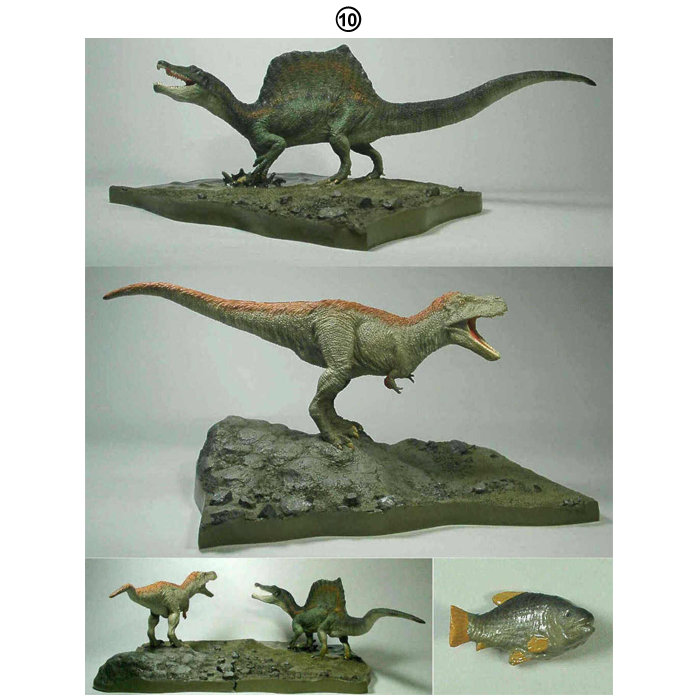
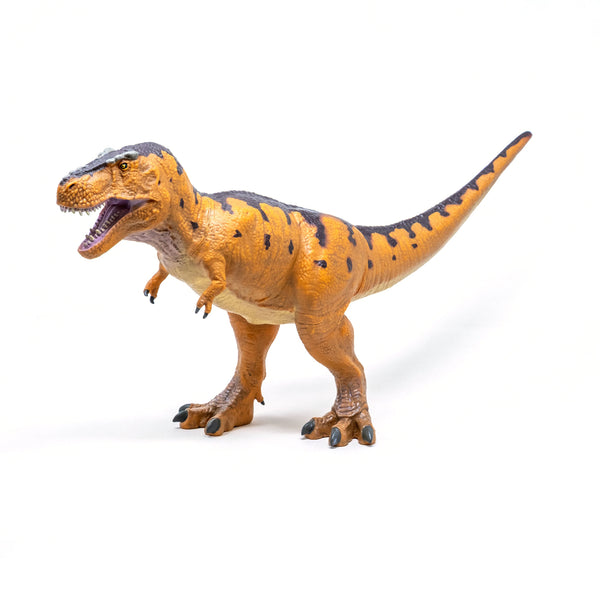
And speaking of figurines, an update on the "Dinosaur Expo 2016" figurines. The Spino and Tyranno made by the Kanna Town Dinosaur Center are significantly better in terms of detail and coloring compared to previous products. The base, which used to be a weak point, is now meticulously crafted like a diorama, and if you buy both, you can connect them to create a Jurassic Park III-like play experience, reminiscent of Aurora and Tamiya's dinosaur plastic models. However, the bonus fish (Lepidotes) for the Spino to hold is a bit underwhelming. And if the Spino catches fish on land, doesn't that negate the new theory? I can't help but worry unnecessarily (Photo 10).
fan_hihoukan_29_10.png

Anyway, perhaps because of their quality, they seem to be selling well. I bought just the Spino during the preview, but when I went again a week later, the Spino was sold out, so I rushed to buy the Tyranno, fearing I'd miss out. They're probably restocked now, but if you want one, get it soon.
This time, I was satisfied because I was able to efficiently collect the venue-exclusive Kaiyodo gashapon. However, if I were to express a wish, I'd really like a life-sized figure of my favorite "Yi"! With that wish in mind, I placed a unique skeletal model of "Scansoriopteryx," a close relative that appeared with many others in "New Treasure House Vol. 21," next to the gashapon "Yi" (Photo 11).
fan_hihoukan_29_11.png

The primary feathers are casually depicted on its forelimbs, but now that I think about it, the elongated third digit resembles the fourth digit of a pterosaur, and a membrane would suit it better.

Finally, a story of a failed juvenile book purchase. I found this in a display case at "Mandarake" in Nakano and impulsively bought it for 8,000 yen without even checking the contents. (Photo 12 left)
fan_hihoukan_29_12.png

"Midori no Mujintō" (Green Desert Island) (Yoichiro Nanyo, 1947)
Before the Pacific War (this story was serialized in the magazine Shōnen Club in 1937), a Japanese family shipwrecked in the South Seas encounters a giant monster on a desert island. However, later in the text, it says, "Later, it was discovered that this great monster was a type of large lizard called a Komodo dragon." ...It's just too much. (Having said that, the illustration on the right side of Photo 12 is from the 1966 edition, which I bought again because it was cheap.)


Older Post Newer Post