
Vol. 28 Return to the Underworld
Happy New Year! For the first issue of the New Treasure House this year, we're featuring subterranean lost world novels, including Jules Verne's "Journey to the Center of the Earth," which we covered in Treasure House Vol. 54. Our main theme this year is dinosaur books.
The reason is that a project to donate my family's book collection to the Gunma Museum of Natural History began at the end of last year. Already, the dinosaur books from the Meiji, Taisho, and early Showa periods that I introduced in New Treasure House Vol. 6 have been stored at the Gunma Museum of Natural History. The intention behind this is that my books had overflowed to the point of being unmanageable, and considering my old age, I wanted to permanently preserve my dinosaur book collection, which I proudly claim is the best in Japan (?). However, since I will no longer be able to introduce books in the Treasure House (though I intend to do it slowly as there is a vast amount), this year I want to introduce dinosaur books by theme, while regretting parting with my collection.
Of course, I haven't stopped collecting dinosaur books, but now that their final resting place has been decided, I'm actually more at ease and fear that I might impulsively buy expensive books. This fear was quickly realized when I recently bought this book:
"Unprecedented Journey to the Underworld"

This is an adaptation of Jules Verne's "Journey to the Center of the Earth," published in the July 1908 issue of the magazine "Boken Sekai" (Adventure World) (Photo 1). It is the second Japanese translation, following "Haku-an Kiki: Chitei Ryoko" (Surprising Story: Journey to the Center of the Earth) from 1885 (please see New Treasure House Vol. 6). According to the "Japanese Jules Verne Research Society," these are the only two Japanese translations from before the war.

An unexpected find was the incredibly grand color frontispiece titled "The Great Sea Monster of the Underground Sea" (Photo 2). For this, 8,000 yen is a bargain. The content is a condensed version of "Haku-an Kiki: Chitei Ryoko," but the characters are different: Professor Lidenbrock is Dr. Thomson (in "Haku-an Kiki," Lidenbrock is not used, he is simply called "Uncle." Perhaps it was an unfamiliar name for people of the Meiji era?), Hans is Gans, just like in "Haku-an Kiki," and the narrator Axel is, surprisingly, a Japanese "I." Incidentally, in the original, Dr. Thomson is the director of the Northern Antiquarian Museum in Copenhagen, where the party stopped. In "Haku-an Kiki," the underground sea is named "Ridenbrock Sea" by the uncle, the discoverer, after himself, as in the original. However, since Dr. Thomson is the leader of the expedition, that method cannot be used, and "I" forcibly declares, "The sea's name is Ri-ji (typo?) nbrock Sea." The monsters encountered in that sea have greatly multiplied.

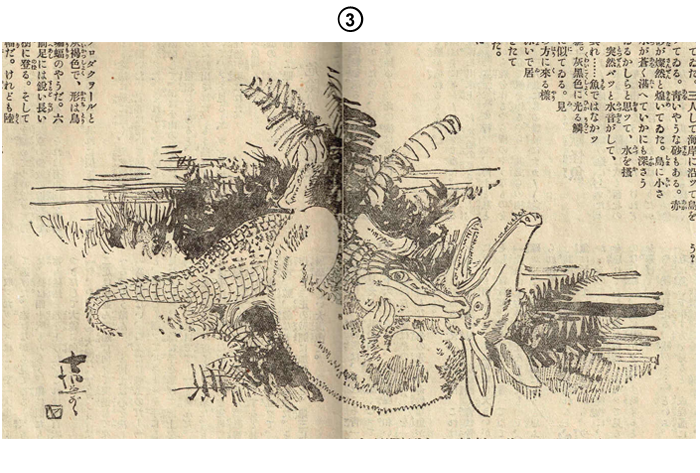
In the original and "Haku-an Kiki," there are only plesiosaurs, ichthyosaurs, and armored fish, but an original episode is inserted where a pterodactyle (mentioned only in Axel's imagination in the original) and a battle between monsters that look like a crocodile and a aardvark (Photo 3) are witnessed on an island they stop at. Around the raft, "dozens of (original text)" large snakes, large turtles, dolphins, sea lizards (?), and whales—which are actually misidentifications of parts of plesiosaurs and ichthyosaurs glimpsed in the waves by the three in the original—engage in a huge brawl. Finally, a Plesiosaurus joins in and takes the climax. Perhaps exhausted by this highly exciting scene or running out of space, the subsequent episodes are rushed, ending with the discovery of a tunnel and the return journey.

Photo 4 shows a post-war edition of "Journey to the Center of the Earth."
Please refer to Treasure House Vol. 54 as well.
Alongside Verne's "Journey to the Center of the Earth," Edgar Rice Burroughs' "Pellucidar series" stands as a classic of subterranean worlds.

Photo 5: Hayakawa SF Series / Hayakawa Bunko SF / Sogensha Suiri Bunko (There are different covers for "The World Inside Pellucidar.")

Photo 6: Other juvenile literature, etc.
For more on these, there is a very deep website, so please check it out.
http://www.princess.ne.jp/~erb/pelluc.htm

And what I almost boasted about, because it's not even introduced on that site, is (Photo 7), "Pellucidar: Land of Terror" and "Crisis in Pellucidar," published in "Boys' Life" magazine in 1967. Before I could boast, I found this site:
http://dejahthoris.la.coocan.jp/fr_pell.htm
Burroughs has many hardcore fans.
Japan also has its own classic subterranean dinosaur world novel: Juuran Hisao's "Chitei Jukoku" (Underground Beast Kingdom), written in 1939. It tells the story of members of the Soviet Academy of Sciences and captured Japanese fishermen who travel from Kamchatka to Sakhalin through an underground passage, only to find themselves in a Mesozoic world. Although it's a dark story where most of the characters die, the description of the gloomy subterranean scenery is superb and it's considered a masterpiece. At the beginning, there's a passage explaining "earth's tunnels," and interestingly, it introduces the setting of Verne's "Journey to the Center of the Earth" as a real place alongside famous caves around the world, claiming that Lidenbrock Sea was named after a legendary underground ocean in Iceland. As the party progresses by boat, the surrounding ecosystem changes from the Triassic, Jurassic, and Cretaceous periods—perhaps influenced by Burroughs' ancient world (Caspack) series? In the Cretaceous zone, they are attacked by a "Tyrannosaurus."

Now, let me boast. (Photo 8) is the September 1939 issue of "Shin Seinen" magazine, where "Chitei Jukoku" was first published. For some reason, it's written under the pen name Abe Masao. And these wonderful illustrations by Teikichi Miyoshi were later omitted from the Kyoiku Bunko edition and the Mitsui Shobo's complete works of Juuran Hisao, making them only available here. Please enjoy them.

Photo 9 shows other subterranean lost world novels. From top left: "Subterranean World Expedition" by Obruchev (Kodansha 1957 / Tsuru Shobo 1976), where a Soviet expedition encounters mammoths and dinosaurs in the underground world of the "Arctic continent" / "The Moon Pool" by A. Merritt (Hayakawa SF Series 1970), a classic fantasy set in an underground world accessible from a South Pacific island, inhabited by frog-men evolved from labyrinthodonts / "The Hollow Earth" by Rudy Rucker (Hayakawa Bunko SF 1991), where Edgar Allan Poe is swept into a whirlpool and journeys into the Earth's interior where pterosaurs fly / "Murder in the Subterranean Beast Kingdom" by Taku Ashibe (Kodansha Novels 1997 / Kodansha Bunko 2001), an homage to "Chitei Jukoku," where an airship descends into an underground world beneath Mount Ararat / "Tunguska Special Mission" by Masaki Yamada (Kodansha 1980 / Kodansha Bunko 1985 / Haruki Bunko 1999), also an homage to "Chitei Jukoku," set in a Siberian underground world inhabited by dinosaurs, pterosaurs (evolved Solenodon!), and mosasaurs / "New Journey to the Center of the Earth" by Hikaru Okuizumi (Asahi Shimbunsha 2004 / Asahi Bunko 2007), which was already introduced in Treasure House Vol. 54. *You can see the illustrations from when this novel was serialized in the Asahi Shimbun on this website: http://www.tis-home.com/tatsurokiuchi/works/32
/ "The Generallife of the Underground" by Ami Amino (Bungeisha 2011), a collaborative publication depicting the outcome of an underground exploration tour "The Mysterious World of the Cretaceous Period" that was募集 on the internet.
"Shonen Kenya" by Soji Yamakawa
This illustrated story, set in Africa, depicts the adventures of Wataru, a Japanese orphan. It features an episode where he goes to an underground world inhabited by dinosaurs, and I vividly remember being engrossed in it as a child. Given the era, it might have been the "manga version" by Kyuta Ishikawa, serialized in Shonen Sunday from 1961, but scenes like being swallowed by quicksand and reaching the underground world, the battle between the giant snake Dana and a ceratosaurus, and the tyrannosaurus climbing the rock face by grabbing Dana's tail and appearing on the surface, all left a strong impression.
*I found this wonderful site:
http://phosphatidylserine.cocolog-nifty.com/blog/2015/02/19611962-764b.html
Dinosaurs appear from episodes 18 to 23. I hope to collect them someday.
*The "manga version of Shonen Kenya" is available as an e-book.

Photo 10 shows my collection of "Shonen Kenya (Dinosaur Appearance Arc)."
The top row is "Sankei Jido Bunko" (1953/1954)
"Sankei Junior Books" (1976)
The bottom row is "Fujimi Ehon Series" (1984) and "Kadokawa Bunko" (1983).

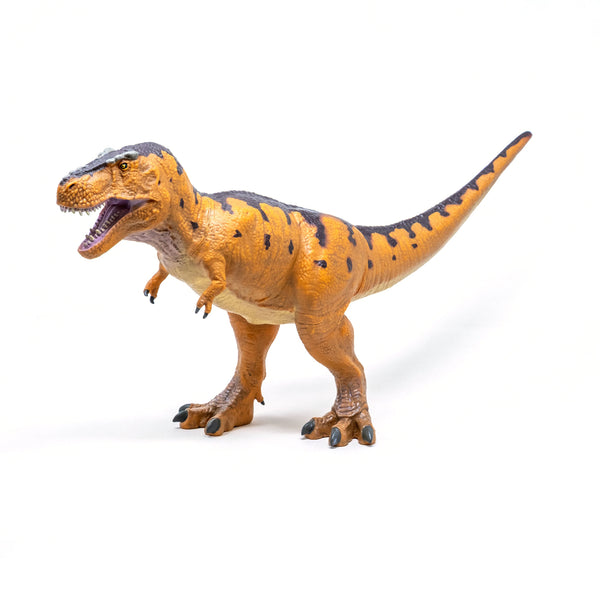
Doraemon "Nobita and the Knights on Dinosaurs" (1988) is set in an underground world ruled by dinosaur-men evolved from Troodon. This is the only underground-world related dinosaur figure I have. It's a confectionery toy plastic model introduced in Treasure House Vol. 46 and also a confectionery toy, a 25th-anniversary figure of the 2004 Doraemon movie. (Photo 11)

Finally, I'd like to introduce a booklet that was an appendix to the January 1966 issue of the boys' magazine "Bokura" (Photo 12). It features two special articles: dinosaurs and time machines. Flipping open the cover, you're immediately greeted with a two-page spread titled "This is the Dinosaur Base of Loch Ness," complete with an explanatory diagram showing how Loch Ness is connected to a subterranean dinosaur world beneath the surface. There's also a report-style article titled "Exploring the Dinosaur Base of Loch Ness," which is enjoyable to read with a childlike wonder.
Aside from the five confirmed films of "Journey to the Center of the Earth" (see Treasure House Vol. 54), the only other underground dinosaur world movie I can recall is "The Land That Time Forgot" (1976 UK), with its absurd fighting scenes featuring actors in brontotherium-like suits. However, the movie "Iron Sky 2," whose trailer is currently available online, is something I'm really looking forward to. They raised production costs through crowdfunding last year, but there's been no further information since. Will the main feature actually be produced? Here you can see an extraordinary scene with a Nazi underground empire and the Führer riding a Tyrannosaurus giving a Nazi salute: https://www.youtube.com/watch?v=JKPwtDjzJMI
Next time, in addition to introducing my book collection (I haven't decided on the theme yet), I also plan to feature goods from "Dinosaur Expo 2016," where an aquatic Spinosaurus will appear. I'm looking forward to that as well.
← Older Post Newer Post →