




New Dinosaur Treasure Museum

Vol. 34: "Our Dinosaur Study Encyclopedia"

The best way to keep up with the latest dinosaur discoveries is through "educational illustrated books" found in the children's section of bookstores. Currently, there are several series available, including Shogakukan's "NEO," Poplar Publishing's "WONDA," Gakken's "LIVE," and Kodansha's "MOVE." Among these, "MOVE" was revised last year (while others were published in 2014) and features new faces like "E" and "Fukuivenator," as well as new restoration drawings of Deinocherius and the black Archaeopteryx. For some reason, Spinosaurus isn't shown swimming in it.
Each of these books is packed with dinosaur illustrations, where the top dinosaur illustrators of our time compete to show off their skills, offering a level of appreciation different from books that rely on contemporary CG dinosaurs. And at 2000 yen each (across all publishers), they're an absolute bargain. Furthermore, the number of dinosaurs introduced with illustrations is extraordinary. For example, if you open the "Dromaeosaurid Group" page in "MOVE," you'll find 18 species introduced, including unfamiliar names like Austroraptor, Achillobator, Linheraptor, Unenlagia, Mahakala, Balaur, Rahonavis, and Tianyuraptor. Do today's dinosaur-loving children really remember all of them? It's too much for an old-timer like me to keep up with.

While these educational illustrated books are at the forefront of dinosaur studies, they were much more tranquil a generation ago. This time, we'll trace the roots of educational illustrated books.

I've written about my childhood dinosaur experiences in "New Secret Treasure House Vol. 10," and my favorite books back then were from the "Shogakukan's Educational Illustrated Books Series." Unfortunately, there wasn't a "Dinosaur Illustrated Book," but dinosaur illustrations were included in several other illustrated books. These included "Illustrated Book of Birds," "Illustrated Book of Animals," and "Illustrated Book of Earth" (①), all from the late 1950s. The "Illustrated Book of Birds" only featured extinct birds, but it's a precious book I've had since childhood. The "Illustrated Book of Earth" introduced the history of life in its opening color pages.

*Here's a website about the history of Shogakukan's educational illustrated books:
http://japanknowledge.com/articles/neo/002.html

n_hihoukan_34-1.png

References
"Illustrated Book of Birds" by Nagaoki Kuroda (1957) p. 70 / "Illustrated Book of Animals" by Tadao Koga and others (1956) pp. 100-101 / "Illustrated Book of Earth" by Shigezaburo Kanuma and others (1958) pp. 14-17, Shogakukan

The "Shogakukan's Educational Illustrated Book Series" was succeeded by the "Educational Encyclopedia Series" in the mid-70s, with "Creatures of the Distant Past" released in 1976 and "Fossils, Rocks, and Minerals" in 1980. Then, in 1990, "Illustrated Book of Dinosaurs" was published, marking the first "Dinosaur Illustrated Book" in the Shogakukan Educational Illustrated Book Series' 34-year history (though various other dinosaur illustrated books had been released during that time). The dinosaurs in "Creatures of the Distant Past" were mostly depicted in a somewhat outdated, "Burian-esque" style, which was prevalent at the time, but the "Illustrated Book of Dinosaurs" showcased cutting-edge dinosaur styles from 1990. (②)
This then evolved into "Shogakukan's Illustrated Encyclopedia NEO" in 2002, with a new edition released in 2014, which continues to this day.

n_hihoukan_34-2.png

References
"Creatures of the Distant Past" (1976) pp. 20-21, 72-73 / "Fossils, Rocks, and Minerals" (1980) p. 129 / "Illustrated Book of Dinosaurs" (1990) pp. 26-27, Shogakukan

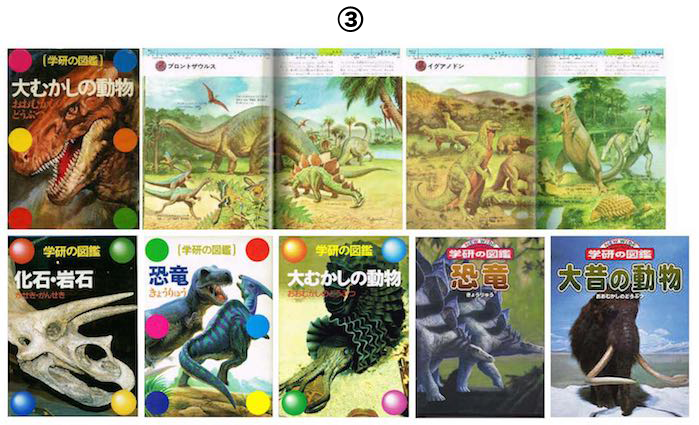
Gakken's Illustrated Encyclopedia, another long-established educational illustrated book series, preceded Shogakukan in paleontology-related publications, with "Animals of the Distant Past" (also full of Burian-esque drawings) in 1972 and "Fossils and Rocks" in 1976. Then, as if by arrangement with Shogakukan, "Dinosaurs" was released in 1990. Like the Shogakukan version, dinosaurs from the post-dinosaur renaissance era were depicted more colorfully. In 1994, a "New Revised Edition of Animals of the Distant Past" was published, which was a strange mix of new dinosaur illustrations and those from the 1972 edition. Then, in 2000, the "New Wide Gakken Illustrated Encyclopedia" series launched "Dinosaurs" and "Ancient Animals," which, after two revised and expanded editions, led to "Gakken's Illustrated Encyclopedia LIVE" in 2014. (③)

n_hihoukan_34-3.png

References
"Animals of the Distant Past" (1972) pp. 62-63, 72-73, Gakken

*In 2003, a tie-in toy with Gakken's 1990 "Dinosaurs" illustrated book was released. Why they didn't use the already-published "New Wide" version is a mystery. The figures aren't great, but apart from the Elasmosaurus holding a Pteranodon, the combinations are based on the illustrated book. (④)

Poplar Publishing's "Poplaria Grand Illustrated Encyclopedia WONDA" series, with "Dinosaurs" and "Ancient Creatures," came out in 2013, and Kodansha's "Moving Encyclopedia MOVE: Dinosaurs" in 2011, making them relative newcomers to the educational illustrated book scene. Kodansha apparently had an educational illustrated book series in the past, but it's unclear if it included paleontology-related titles.

n_hihoukan_34-4.png

While researching for this feature, I found a book called "I Love Illustrated Books!" (Sairyusha 2014) on Amazon. This book contained a page titled "The Oldest Educational Illustrated Books," stating that the oldest known educational illustrated book series in Japan was published by Hoikusha starting in 1945. I tried searching on an online used bookstore and found "Educational Animal Illustrated Book (1951)" for 800 yen. I just had to buy it!
It was a mere 39-page book, but it was indeed an educational illustrated book filled with color animal illustrations. And as expected, dinosaurs too! Unfortunately, they were in black and white. (⑤)

Here's another site regarding the origins of educational illustrated books:
http://mononoke.asablo.jp/blog/2013/10/16/7010089

n_hihoukan_34-5.png

References
"Educational Animal Illustrated Book" (1951) pp. 38-39, Hoikusha

The aforementioned "I Love Illustrated Books!" contained a description of what constitutes an educational illustrated book. It states that the image of an educational illustrated book typically has two characteristics: a specimen-like page layout with color photographs and illustrations, and serialization by category, such as "Animals," "Plants," or "Fish and Shellfish." Countless "Dinosaur Illustrated Books" that don't meet these criteria are too numerous to introduce. However, since it would be lonely to only feature educational illustrated books this time, I will also showcase paperback-sized children's encyclopedias that have continued since the Showa era. (⑥)

n_hihoukan_34-6.png

The strongest lineup is boasted by Shogakukan Korotan Bunko, with seven books published: from "Encyclopedia of Dinosaurs" (1977), which featured 252 species, including amphibians to mammals and even some obscure ones, to "Encyclopedia of Tyrannosaurus," which focused exclusively on tyrannosaurids with only a brief mention of other theropods and no mention of other dinosaurs at all, and "Encyclopedia of Everything Dinosaurs," which includes many recent prehistoric creatures like Mai and Fukuititan.
"Encyclopedia of Dinosaurs" (1977) / "Latest Secrets of Dinosaurs Encyclopedia" (1994) / "Encyclopedia of Dinosaurs" (1994) / "Encyclopedia of Dinosaurs" (1995) / "Latest Encyclopedia of Dinosaurs" (2000) / "Encyclopedia of Tyrannosaurus" (2005) / "Encyclopedia of Everything Dinosaurs" (2010).
Next up is Keibunsha's Encyclopedia series, with four titles. "Encyclopedia of Dinosaurs" (1979) describes 220 species of prehistoric creatures with illustrations. "Encyclopedia of Dinosaur Knowledge" (1988) doesn't introduce species individually but is packed with various dinosaur information. Of particular interest to the Secret Treasure House is an article titled "Dinosaur Goods Collection," which features Tamiya plastic models, Yonezawa wooden and metal assembly dinosaurs, and even Kaiyodo garage kits. The 1992 and 2001 editions of "Encyclopedia of Dinosaurs" are largely similar, but they offer unique and artistic prehistoric illustrations, albeit with fewer species. There's also a section explaining how to build dinosaur models.

"Encyclopedia of Dinosaurs" (1979) / "Encyclopedia of Dinosaur Knowledge" (1988) "Latest Edition - Encyclopedia of Dinosaurs (1992) / "Latest Edition - Encyclopedia of Dinosaurs (2001).

And from Jitsugyo no Nihon Sha, there are two books: "Complete Encyclopedia of Dinosaurs" (1981) and "New Edition - Complete Encyclopedia of Dinosaurs" (1988). These have fewer species (150/100 respectively), but their explanations are comprehensive.

Akita Shoten's "Latest Edition - Dinosaur Encyclopedia" (1978) doesn't specify the number, but it includes quite a few species. There's also a chapter introducing Japanese dinosaurs.
Futabasha's "Interesting Dinosaur Illustrated Book" (1980) has somewhat cartoony illustrations, but its content is rich, including articles on the then-recently introduced warm-blooded theory and opposing views.
Toen Shobo's "Great Monster - Dinosaur Trivia Master" (1981) is a niche book that collects photos of dinosaurs and monsters, primarily from model animation films.
Kodansha's "Interesting Quiz Encyclopedia" (1979) has 90 multiple-choice questions on baseball, cars, and dinosaurs. For example, a difficult question like this: What is a characteristic of Cryptorheido? ① Its ancestors are unknown ② It has a short neck ③ It has no limbs. The correct answer is ①.
Gakken's "Kyōryū" (2002) is a less than 100-page book for young children with no kanji, but its photos and illustrations are surprisingly rich.

(⑦) Changes in the appearance of Troodon in Korotan Bunko: Pachycephalosauridae → ??? Sauropodomorph → Nocturnal → Feathered

n_hihoukan_34-7.png

References
"Encyclopedia of Dinosaurs" (1977) p. 168 / "Encyclopedia of Dinosaurs" (1994) p. 109 / "Latest Encyclopedia of Dinosaurs" (2000) p. 120 / "Encyclopedia of Tyrannosaurus" (2005) p. 188 / "Encyclopedia of Everything Dinosaurs" (2010), Shogakukan

(⑧) "Dinosaur Goods Collection" (Encyclopedia of Dinosaur Knowledge)

n_hihoukan_34-8.png

References
"Encyclopedia of Dinosaur Knowledge" pp. 266-271, Keibunsha

Now, changing the topic, let's talk about Archaeopteryx. The actual London specimen of Archaeopteryx will be "making its first visit" to Japan at the "British Museum of Natural History Exhibition," which starts on March 18th at the National Museum of Nature and Science in Ueno. It's been a long time since such a major figure in dinosaur history has come to Japan. I remember seeing the actual "Berlin specimen" fossil at the "World's Largest Dinosaur Exhibition" held in 1984, in a giant tent pitched on the vacant lot where Takashimaya now stands at the south exit of Shinjuku Station. The Archaeopteryx, which was a highlight of the dinosaur exhibition alongside "Brachiosaurus" (at least in my memory at the time), was placed in a secluded space with a red velvet backdrop. It was treated like a jewel, and visitors could only view it from a distance through glass... I vaguely recall thinking it was like Tutankhamun's golden mask. This exhibition showcased the Humboldt University collection. And Humboldt University was located in what was then East Berlin! It truly feels like another era. The Brachiosaurus brancai from that time is now called Giraffatitan...

n_hihoukan_34-9.png

(⑨) A metallic figurine I bought as a souvenir at the venue. It wasn't expensive, but when photographed, it shines brightly and feels somewhat precious. Also, the catalog and the Brachio-touch certificate (a staple of dinosaur exhibitions back then).

n_hihoukan_34-10.png

I'm really looking forward to the "British Museum of Natural History Exhibition." I'm especially excited to see the Archaeopteryx London specimen because I didn't get to see it when I went to London previously (Secret Treasure House Vol. 40). And the merchandise! It seems a newly 3D-printed replica of Mantell's Iguanodon tooth will be available for purchase, and I'm determined to get it, even if it's a bit pricey. Next time, I'll introduce my new acquisitions and, in celebration of the London specimen's arrival in Japan, present a "Collection of Archaeopteryx Figures."
(⑩) I tried to imitate the flyer by combining my Berlin specimen with a HANSA plush toy.


Older Post Newer Post