



Vol. 33 "20th Century Dinosaur Comics - Part 2"
First, some additional information from last time.
In "Mojako," a 1971 work by Fujiko Fujio (before the "F" was added), there's an episode called "Planet of the Dinosaurs" where a theme park planet appears, offering dinosaur (actually robot) hunting. This was 20 years before "Jurassic Park," and it might even be the world's first dinosaur theme park story.
"Ambassador Magma" (Osamu Tezuka, 1965) begins with a prologue where the protagonist's family is transported, house and all, to the age of dinosaurs by the evil emperor Goa. There's also an episode titled "Adventures in the Dinosaur Century."
This information comes from my fellow dinosaur club members. As expected, they're thorough.
Now, in the second part of this series, I'll introduce post-dinosaur renaissance manga by genre. Many works incorporate new dinosaur depictions.
[Sci-Fi/Fantasy]
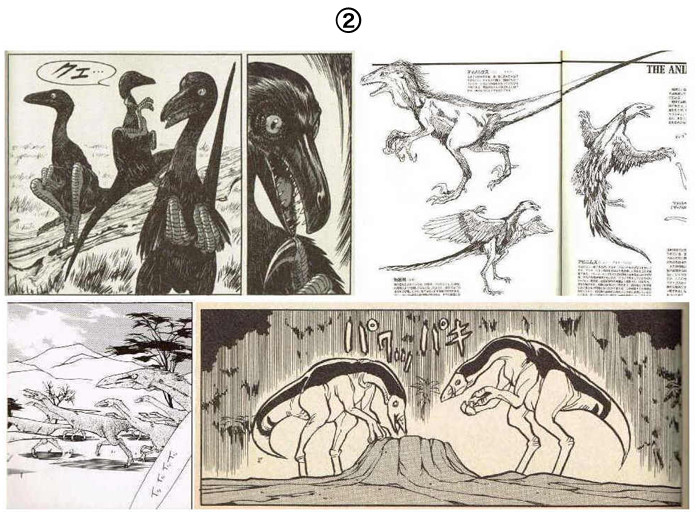
Hoshino Yukinobu, considered a pioneer in hard science fiction manga, seems to love dinosaurs and ancient creatures, often featuring them in his works. His 1981 work "Saber Tiger" includes the titular story where a single saber-toothed tiger changes humanity's fate, and "Tar Trap," which features the fossilized complete skeleton of a sauropod serving as a "stepping stone" for a mastodon about to drown in a tar pit. Then, "Blue Hole" (2 volumes), published by Kodansha from 1992 to 1998, and its sequel "Blue World" (4 volumes), are epic tales set in modern times and the Mesozoic era (also connected to the Paleozoic era) linked by a submarine time tunnel called the Blue Hole. These works are packed with trendy dinosaurs of the time, such as Maiasaura, as well as the latest dinosaur information and extinction theories. All of his dinosaur illustrations are superb, especially the depictions of feathered deinonychosaurids (referred to as Deinonychus in the text), which still hold up well today. In "Umi Haruka Sariyuku Kemono-tachi" (The Sea of Departing Beasts), published by Schola in 1992, in addition to the titular story that intertwines the chase of the battleship Bismarck during World War II with plesiosaurs, there's "Shima no Tsumi" (Island of Sin), featuring Steller's sea cows. In "El Alamein no Shinden" (Temple of El Alamein), also from Schola in 1998, a German tank crewman in the North African front during WWII accidentally discovers the ruins of an Egyptian temple where they find mummified sauropods, believed to have been used in the construction of the pyramids. Last March, Shogakukan released "Taiko Yori no Shisha" (Messengers from Antiquity), a collection of ancient creature-related works (including "Umi Haruka Sariyuku Kemono-tachi" and "El Alamein no Shinden"). It's a so-called convenience store low-priced book, and while sales have reportedly ended, it can still be purchased on Amazon. It's a great deal.
"The Five Star Stories" (Mamoru Nagano, Kadokawa Shoten, 1987~)
This is said to be a hugely popular ongoing fantasy manga, but I've never actually read it, so please refer to this.
I stumbled upon dinosaurs in the "Animals inhabiting Joker (the star system that serves as the setting)" section at the end of Volume 4 (1991). The setting is that Earth-native dinosaurs also live there, and the manga provides regular dinosaur explanations. I'm delighted that the author, "based on his own arbitrary speculation," gave Deinonychus feathers.
"Kaseki no Kioku" (Memory of Fossils) (Yoshihisa Tagami, Akita Shoten, 1986-1987, all 3 volumes)
This is a "mystery, hard-boiled, time-slip sci-fi" that begins with a series of tragedies (caused by dinosaurs, of course) occurring in a remote mountain village with an ancient legend of a "master." It's a manga for adults, full of erotic scenes. While the dinosaur explanations interspersed throughout are good, the dinosaur illustrations themselves are a bit... disappointing. I wish they had the same quality as the frequently appearing female nudes, at least.
"Dinosaur King" (Mizuki Sakura, 1994)
Science fiction writer Chiaki Kawamata handled the story. It's an overly fantastical tale of a war between the Mu Empire people who rode dinosaurs in the Cretaceous period and the Yamato tribe, who would later become the Japanese people. The Mu Empire is destroyed by a meteorite impact. The dinosaurs are powerful, but their proportions and movements are unnatural, suggesting that the artist was not very accustomed to drawing them.
"Kyoryu Wakusei" (Dinosaur Planet) (Akihito Yoshitomi, 1995)
This is a manga adaptation of an anime broadcast as part of the NHK program "Tensai Terebi-kun," which has become a legend among some dinosaur fans. Despite being a children's program, the anime featured the involvement of Ryuichi Kaneko and Narimasa Honda, making it a cutting-edge representation of dinosaur paleontology at the time. The dinosaurs in the manga are simplified and cartoonish, but they capture the essential details. According to Wikipedia, a remarkable 73 species of ancient creatures appear, but unfortunately, most of them were cut from the comic version.
*On a personal note, I'm a bit proud to have recorded all episodes of "Kyoryu Wakusei" and its sequel "Gene Diver." I hope the videotapes haven't deteriorated...
(Image 1) Covers of Sci-Fi/Fantasy works

(Image 2) Four small theropods: Feathered Deinonychus ("Blue Hole 2" Yukinobu Hoshino, 1993, Kodansha, p.8 / "The Five Star Stories IV" Mamoru Nagano, 1991, Kadokawa Shoten, pp.182-183) / Ornithomimus? ("Dinosaur King" Mizuki Sakura, 1994, Enix, p.79 / Troodon ("Dinosaur Planet 1" Akihito Yoshitomi, 1995, Media Works, p.53)

[Shojo Manga]
The books introduced here were mainly published under shojo comic imprints such as "Hana to Yume Comics (Hakusensha)" and "Margaret Comics (Shueisha)". However, from one of these, "Asuka Comics (Kadokawa Shoten)", a full-fledged dinosaur sci-fi fantasy that rivals "Blue Hole" has emerged.
It's "Aoi Ryu no Tani" (Valley of the Blue Dragon) by Junko Sasaki (1990-1993, all 7 volumes). I can't possibly summarize the entire plot, but the story begins something like this.
The author seems to be a big dinosaur enthusiast, and the work is filled with convincing dinosaur illustrations and jokes that will make dinosaur fans chuckle. For example, in a scene where modern-born dinosaurs are sent back to the Late Cretaceous, the characters worry if it's okay to send dinosaurs from the Jurassic and Early/Middle Cretaceous indiscriminately. The "device" connecting the Cretaceous and modern times is also original. Each volume includes a dinosaur essay where the author talks about her own history with dinosaurs, and it was heartwarming to read that she was deeply moved by Desmond's "The Great Dinosaur Age." In the first volume, there's a scene where a villain tells the protagonist boy, "I don't like your face, you look like a guy from a shojo manga," which made me wonder if the author had wanted to release the work in a different format. However, once you get used to the shojo manga faces, even an old dinosaur fan like myself can get engrossed.
(Image 3) Cover of "Aoi Ryu no Tani" and a scene of a roasted Elasmosaurus (Junko Sasaki, 1990, Kadokawa Shoten, p.33)

The world of shojo dinosaur manga is diverse, with everything from romantic comedies, historical dramas set in fictional worlds (royalty is a common theme), gag manga, and even what would now be called boys' love stories. I've listed them in chronological order.
"Bravo! La Nessie" (Keiko Takemiya, Shogakukan Bunko, 1982)
This is the titular work of a classic shojo manga comedy short story collection, featuring a boy with stars in his eyes and a cute Nessie with a heart symbol. However, the protagonist boy shows a surprisingly serious side in his first encounter with Nessie, exclaiming, "What is this—?! A reptile, sauropterygian order, Jurassic... plesiosaur?!" and even includes a diagram of a plesiosaur skeleton.
"Yumemiru Wakusei" (Dreaming Planet) (Fumio Sato, Shogakukan, 1982-1984, all 4 volumes)
A drama of love and hate (?) set in the royal court of a super ancient civilization that flourished on the continent of Pangea. Dinosaurs and pterosaurs are used as transportation and labor, but they don't drive the plot.
"Ryuu no Nemuru Hoshi" (Planet Where Dragons Sleep) (Reiko Shimizu, Hakusensha, 1987)
This is a boys' love story, but the protagonists are two beautiful boy robots. It's a tale of them getting caught up in a royal dispute on a planet inhabited by dinosaurs. Despite the title, dinosaurs appear only briefly in volumes 1, 4, and 5 out of all 5 volumes.
"Dokkin Time Trip" (Neko Nekobe, Kodansha, 1988)
Thanks to a strange family moving in next door, spacetime is disrupted and dinosaurs appear.
"Hana-gara Tyrannosaurus" (Flowery Tyrannosaurus) (Tomoko Kuramochi, Shueisha, 1988)
A romantic comedy. I bought it because of the title's Tyrannosaurus, but I was speechless when I realized it referred to the pattern on the protagonist girl's panties.
"Tomadou Pteranodon" (Confused Pteranodon) (Shihoko Sugiyama, Hakusensha, 1989)
What started as a romantic comedy about a boy from 100 million years ago emerging from a rock turned into a reckless action story where the boy and his pteranodon partner fight monsters created by ancient humans.
"GONDWANA" (Takako Yamazaki, Hakusensha, 1990)
Using a time machine, they travel to the continent of Gondwana where the Atlantean civilization flourished. There, dinosaurs and humans coexist peacefully, but eventually the continent splits and sinks beneath the sea. Well, it is Atlantis after all.
"Time Princess" (Yoko Ei, Kodansha, 1994)
The protagonist girl gains the power to time travel through the spirit of time and even visits the age of dinosaurs.
"Suimeikyuu: Ryukohan no Satsujin" (Green Labyrinth: Murder at Dragon Lake) (Yu Kamiya, Hakusensha, 1994)
A boys' love detective story set by Loch Ness. Some rather awful plesiosaur skeletons appear.
"Ichioku-nen no Fuuin" (Seal of a Hundred Million Years) (Noriko Yamauchi, Shueisha, 1997)
I thought it was a time travel story, but it turned out to be a psychological suspense where the protagonist woman, temporarily losing her memory after hitting her head, is plagued by nightmares of dinosaurs and murder.
"How Many Miles to Babylon?" (Izumi Kawahara, Hakusensha Bunko, 1997)
This story is about protagonists who travel to the dinosaur era with a magical ring, give dinosaurs a cold, and that leads to the extinction of the dinosaurs.
(Image 4) Shojo manga covers and ancient creature illustrations: "Bravo! La Nessie" Keiko Takemiya, 1982, Shogakukan, pp.31/39 / "Yumemiru Wakusei 1" Fumio Sato, 1982, Shogakukan, p.5 / "GONDWANA" Takako Yamazaki, 1990, Hakusensha, p.93 / "Suimeikyuu: Ryukohan no Satsujin" Yu Kamiya, 1994, Hakusensha, p.72

[Anthropomorphic Dinosaur/Ancient Creature Manga]
Works that anthropomorphize animals and sometimes make them talk have been numerous since "Choju-giga" (presumably), but Japanese dinosaur manga (at least in my collection) only goes back to "Kyoryu Daikikou" in 1989.
"Kyoryu Daikikou" (Great Dinosaur Journey) (Dairoku Kishi, Shueisha, 1989)
A total of 11 stories, mainly featuring creatures from the Mesozoic Era. While the reconstruction drawings are somewhat outdated, they are drawn with great care, which is appealing. For some reason, the manga adopts the volcanic theory for dinosaur extinction. *In 2012, a short story collection titled "Renmeijutsu," including the sequel "Daikyoryuki" (where dinosaurs are updated in a modern style), was published by PHP Comics.
"Genju Jiten" (Dictionary of Primeval Beasts) (Jiro Taniguchi, Kodansha, 1990)
This work consists of 18 stories, focusing on extinct mammals of the Cenozoic Era, with additional tales of synapsids, turtles, and ichthyosaurs. Each story is quite stylish; for example, the chapter "Kame wa Mannen Proganochelys" (Turtles Live for Ten Thousand Years, Proganochelys) is a metaphorical story where the protagonist, a Triassic turtle, witnesses the rise and fall of dinosaurs and lives to see the Cenozoic Era. It was reissued by Futabasha in 1998 with commentary by Ryuichi Kaneko.
"Garyu: Kaseki no Kioku" (Sleeping Dragon: Memory of Fossils) (Hideki Mori, Shogakukan, 1996)
This manga imagines the final moments of dinosaurs based on real fossils, such as combat fossils, and here the dinosaurs do not speak. The latter half includes a medium-length story titled "Ryunosuke's Dream," where a boy from the Edo period travels to Mongolia and encounters the complete skeleton of a Tarbosaurus in the Gobi Desert.
"GON" (Masashi Tanaka, Kodansha, 1992-2002, all 7 volumes)
GON, who looks like a baby Tyrannosaurus, interacts with existing animals in this manga that contains no dialogue, not even sound effects. However, the final chapter of "GON SELECSION," released in 2013, titled "Lucky Lucky's Birth," features the extinct mammal Stylinodon as the protagonist. Paraceratherium, pterosaurs, and even Archaeopteryx make appearances.
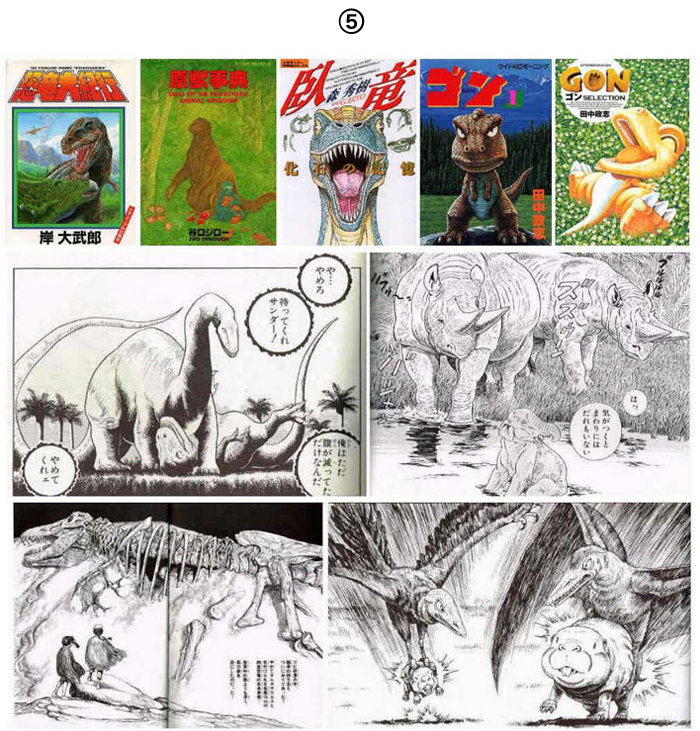
(Image 5) Covers and ancient creature illustrations from anthropomorphic manga: "Kyoryu Daikikou" Dairoku Kishi, 1989, Shueisha, p.77 / "Genju Jiten" Jiro Taniguchi, 1990, Kodansha, page unrecorded / "Garyu: Kaseki no Kioku" Hideki Mori, 1996, Shogakukan, pp.280-281 / "GON SELECSION" Masashi Tanaka, 2013, Kodansha, page unrecorded

[Other Dinosaur Manga]
"Saurus Heigen" (Saurus Plain) (Yukio Shishikura, Takeshobo, 1983)
An erotic four-panel manga set in primeval times.
"Mashonen Beetei" (Mysterious Boy Beetei) (Hirohiko Araki, Shueisha, 1984)
Includes the episode "Kyoryu Kaseki Dorobo Jiken no Maki" (The Dinosaur Fossil Theft Case), where a Spinosaurus skull is stolen from a dinosaur exhibition.
"Nonki-kun" (Yoji Hokura, Shogakukan, 1985~)
The heartwarming gag manga "Nonki-kun" occasionally features dinosaur themes.
"Tyrannosaurus no Futsuu no Seikatsu" (A Tyrannosaurus's Ordinary Life) (Mizuno Production, Shufu to Seikatsusha, 1987)
An unusual manga where dinosaurs live a 1950s American-style life. It's in full color and has a comic book feel.
"Ammonite Soseiki" (Ammonite Genesis) (Naoi Omiya, Daitosha, 1989)
A slapstick comedy about protagonists who travel by time machine to a dinosaur civilization that uses ammonites for electricity, causing all sorts of chaos.
"Kyoryu Carnival" (Dinosaur Carnival) (Etsu Ueda, Shogakukan, 1990-1991, all 3 volumes)
A gag manga with one story per page, featuring dinosaurs as characters.
"Kodai-san Chi no Kyoryu-kun" (Dinosaur-kun of the Kodai Family) (Motoei Shinzawa, Shueisha, 1991)
A frozen egg is discovered, and a bred and domesticated Saurornitholestes (!) comes to the Kodai family, causing a great commotion.
"Movie Dream" (Sakonjo Minami, Shueisha, 1991)
This is none other than the biography of the master of stop-motion animation, Ray Harryhausen!