



Vol. 32 "20th Century Dinosaur Comics - Part 1"
“Journey to the Center of the Earth,” currently serialized in “Monthly Comic Beam,” has finally reached the famous scene of Plesiosaurus vs. Ichthyosaurus. While it's good that the dialogue adheres to the original, it's a shame that the illustration of the dinosaur (reptile in the original) skeleton, which the character "saw in a Hamburg museum before," is a Tyrannosaurus that had not yet been discovered in the mid-19th century. Moreover, it's depicted in a horizontal posture and the pelvis is all wrong. And the long-awaited marine reptile depiction is also… questionable. It's a pity, especially since the scenery is so meticulously drawn.
*I tried searching for "Hamburg museum" but couldn't find any information. If a 10-meter complete skeleton was actually displayed in the mid-19th century as the novel suggests, it would likely have been a marine reptile.
It's not because of that, but this time and next, I'll be introducing some of our family's dinosaur manga collection, specifically those from the "last century" (perhaps inspired by Osamu Tezuka's works?). However, the world of dinosaur manga is bottomless. Apart from those with "dinosaur" in the title or dinosaurs on the cover, there's no way to find books that simply have dinosaurs appearing in an episode. To get such books, you have to rely on information from acquaintances, the internet, reference books (such as the invaluable "Manga Dai Hakubutsukan" by Leiji Matsumoto and Akira Hidaka, which meticulously introduces rare manga from the mid-Showa period), and accidental encounters at secondhand bookstores. Completing a dinosaur manga collection is a pipe dream. Please consider the books introduced here to be just a small fraction of the countless dinosaur manga out there. (Come to think of it, I seem to remember dinosaur episodes in "Urusei Yatsura" and "Dr. Slump" too…)
*This time, I've excluded so-called "educational manga" to avoid getting overwhelmed.
First, from older works, the famous "Norakuro" by Suiho Tagawa. There are two versions of the story about Norakuro subduing a Stegosaurus that escaped from a sideshow. The one published in the January 1936 issue of "Shonen Club" is titled "Norakuro Shikan Gakko no Maki" (Norakuro at the Officer's Academy), where Norakuro, a student at the academy, defeats a Stegosaurus that appeared on the mountain behind the school. It's in black and white with a very simple background. It's included in the 1975 paperback "Norakuro Manga Shu" and others (Shin Hihokan Vol.7). The version published as a single volume in February of the same year was a luxurious, separate work. Norakuro had been promoted to "Norakuro Shotai-cho" (Norakuro Squad Leader), and the episode was expanded into three chapters: "Vacation," "Emergency Call," and "Monster Extermination," all in full color, with meticulously drawn backgrounds. A complete reprint, including advertisements from that time, was released in 1969.
Boken Dankichi, a popular pre-war manga (or rather, illustrated story) alongside Norakuro, also features dinosaurs. It's in the chapter "Gaijin Seibatsu no Maki" (Conquest of Foreigners) from the 1935 single volume "Boken Dankichi Dai Ensei." Dankichi encounters sauropods on a South Sea island where his ship was shipwrecked in a storm. This one was also completely reprinted in 1970.
Source
"Norakuro Manga Shu 2" by Suiho Tagawa, 1975, Kodansha, 175p ● "Norakuro Shotaicho" by Suiho Tagawa, 1069, Kodansha, 130p ● "Boken Dankichi Dai Ensei" by Keizo Shimada, 1970, Kodansha, 196p
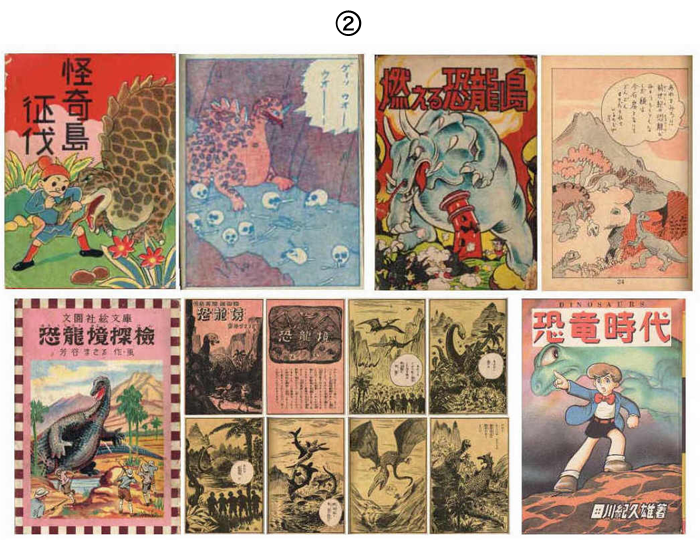
"Kaiki-jima Seibatsu" (Conquest of Mysterious Island) by Kei Sakaki is a mysterious small booklet, like an appendix, with no publisher or publication date. However, the same author published "Kaiki-jima," an adaptation of the movie "King Kong," from Fujitani Shobunkan in January 1934, and both feature the giant ape Gorilla Kong, so there seems to be a connection.
"Moeru Kyoryu-jima" (Burning Dinosaur Island) by Tsuneo Yamada (Manga Shuppansha) might also be an appendix or a rental book. It's about 60 pages long, and the publication date is unknown, but it's probably from the late 1940s to the early 1950s. An atomic rocket plane also appears.
"Kyoryu-kyo Tanken" (Exploration of the Dinosaur Realm) by Masaru Yoshitani (Bunsensha), an illustrated story in a dramatic style published in March 1948, tells of an exploration to a lost world in Kunlun, a legendary land deep in China. The illustrations are powerful.
In the same year, "Jimmy no Daiboken" (Jimmy's Great Adventure) by Kikuo Tagawa appeared.http://blog.goo.ne.jp/mangaziro/e/2dd613e3f09bc3393a3a6cba7190224a
This work was reprinted in 1983 under the revised title "Kyoryu Jidai" (Dinosaur Era).
Source
"Kaiki-jima Seibatsu" by Kei Sakaki, Unknown, Unknown, No page numbers ● "Moeru Kyoryu-jima" by Tsuneo Yamada, Manga Shuppansha, Unknown, 24p ● "Kyoryu-kyo Tanken" by Masaru Yoshitani, Bunsensha, 1948, 1/5/68/77/81/82/92/101p ● "Kyoryu Jidai" by Kikuo Tagawa, Meicho Kankokai, 1983
Then, in December of the same year, 1948, Osamu Tezuka's "Lost World: Prehistoric Edition" was released.
https://ja.wikipedia.org/wiki/Lost_World_(manga)
The original is very difficult to obtain, but it looks something like this:
http://www.eshita-labo.org/culture/2007/01/sf.html
Dinosaurs appear in the space arc. Numerous reprint editions are available, making it easy to read today.
After that, Osamu Tezuka featured dinosaurs in numerous works.
"Kaseki Ningen" (Fossil Man) (I own a reprint from 1952-1982) / "Hi no Tori: Mirai-hen" (Phoenix: Future Arc) (The evolution of life on Earth, which was once destroyed and then restarted, reaches dinosaurs, but then an unexpected ruler appears...) / "Black Jack Vol. 7" (includes "Debeso no Tachi," a story about a boy whose only talent is fossil hunting, who discovers a Gorgosaurus skeleton) / "Lop-kun's Younger Brother Vol. 2" (1980) includes a story about Lop-kun creating robot dinosaurs at an amusement park, and also "Bongo," a work set in Africa written around 1965, surprisingly featuring a Spinosaurus that loves fish. To predict that 50 years ago! Osamu Tezuka is truly amazing. / "Manga Seibutsugaku" (Manga Biology) (a learning manga-style work compiled in 1984)
Currently, these are all we have in our home, but "Osamu Tezuka Museum," a reference book published by Kodansha in 1998, is very useful, containing illustrations and explanations of various creatures (including dinosaurs, of course) that appear in his works, and their sources. Among those I still need to buy are: "Tetsuwan Atom: Test Pilot no Maki" (Tyrannosaurus) / "Magma Taishi" (Stegosaurus) / "Burunga Issei" (Triceratops) / "Norman" (Brontosaurus) / "Chiteikoku no Kaijin" (Brachiosaurus) / "Mitsume ga Tooru" (Plesiosaurus) / "Ozma Taichō" (Ichthyosaurus) / "0-Man" (Mammoth) / "Jungle Taitei" (Mammoth), and many more... The journey of collecting is long.
Source
Osamu Tezuka: "Kaseki Ningen" Tezuka Osamu Fan Club Kyoto Archive, 1982 ● "Hi no Tori" Mushi Production, 1968 ● "Black Jack 7" Akita Shoten, 1976 ● "Lost World: Prehistoric Edition" Togensha, 1976 ● "Lop-kun 2" Kodansha, 1980 ● "Lost World" Kodansha, 1982 ● "Manga Seibutsugaku" Kodansha, 1984 ● "Lost World" Kadokawa Shoten, 1994 ● "Lost World: Shika-ban 2" Kodansha, 1995
*At the end of "Shin Takarajima" (which does not feature dinosaurs) in the Osamu Tezuka Manga Complete Works, there's a document called "Boku no Debut Nikki" (My Debut Diary). In the entry for May 16, 1947, it states, "According to the newspaper, fossils of prehistoric Paleolithic humans were discovered in a cave in the Okuchichibu mountains, and the skeleton of a giant dragon, believed to be a Stegosaurus, was found in Yokohama. (As per original text)." I wonder what newspaper this was... it's a mystery. Tokyo Sports hadn't been founded yet... This information came from a friend in the Dinosaur Club, and what a find it is!
Here, even though the dates might be out of order, let's introduce some dinosaur works by other masters of the Showa era.
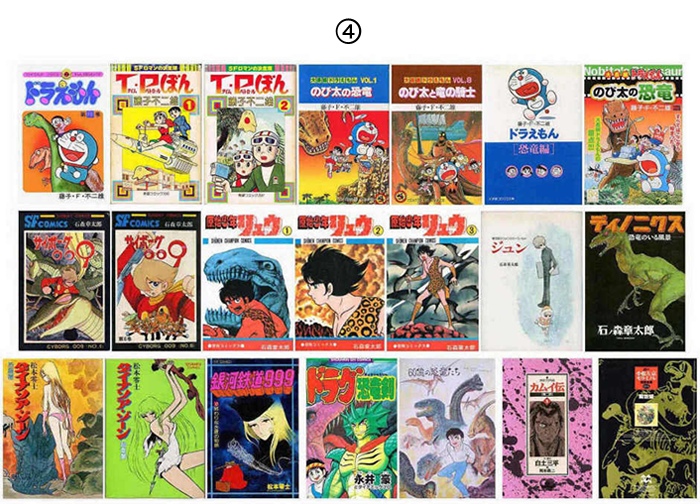
Fujiko F. Fujio
Ken Tsuchiya, a very active science writer today, wrote that his origin was "Nobita's Dinosaur" which he read as a child (incidentally, I read the serialization of "Umi no Oji"). Besides "Nobita's Dinosaur" (long and short versions) and "Nobita to Ryu no Kishi" (Nobita and the Dragon Knights), there are many other Doraemon dinosaur episodes, which are compiled in "Doraemon [Kyoryu-hen]" (Doraemon [Dinosaur Arc]) (1994, CoroCoro Bunko). "T-P (Time Patrol) Bon" (1979) also has an episode where they go to the dinosaur era called "Vacation wa Kyoryu ni Notte" (Vacation Riding on Dinosaurs) and an episode where a Futabasuzukiryu appears on just one page called "Kesarete Tamaruka" (Don't Erase Me). I'm sure there are many more Fujiko dinosaur works, but this is the extent of my knowledge.
Shotaro Ishimori (Ishinomori)
"Cyborg 009 - Underworld Empire Yomi Arc," serialized in Shonen Magazine from 1966, features evolved pterosaurs (?) reminiscent of Pellucidar's Mahars, Pteranodons emitting ultrasonic waves, Plesiosaurs, Eohippus, and even a single panel of Archaeopteryx. I should have included this in Shin Hihokan Vol. 28 [Underground World Feature] but I regrettably forgot. The large-format book "Jun" published by Asahi Sonorama in 1969 is an experimental work, but the chapter titled "Kyoryu" (Dinosaurs) is filled with passionate dinosaur illustrations. "Genshi Shonen Ryu" (Ryu, the Primitive Boy), which was published as a single volume and animated in 1972, boldly declares at the beginning, "Let's say that this [story] has no [time]," and deliberately features Tyrannosaurs, Mosasaurs, Diatrymas, Mammoths, and primitive humans co-starring. "Deinonychus - Kyoryu no Iru Fukei" (Deinonychus - Scenery with Dinosaurs) from 1993 is a compilation of the author's dinosaur works, containing nine short stories, including shortened versions of "Jun" and "Genshi Shonen Ryu." The title "Deinonychus" is an episode from Cyborg 009, and what's interesting is that its first publication in Shonen Jump was in June 1976, just after Desmond's "The Great Dinosaur Era" was released. This means that Ishinomori must also have been shocked by Bakker's illustration of the "running Deinonychus."(Shin Hihokan Vol. 11)
Leiji Matsumoto wrote "Dinosaur Zone" in 1978, featuring a beautiful primitive woman who is as striking as Maetel (the 1981 version has a different cover, but I had to buy it!). "Galaxy Express 999" also has a story called "Cold-Blooded Empire," set on a planet ruled by dinosaurs. Unfortunately, "Kyoryu-so Monogatari" (The Story of the Dinosaur Mansion) does not feature dinosaurs.
When people think of Go Nagai and dinosaurs, many probably imagine the Dinosaur Empire in Getter Robo, but there's also a "jidaigeki" (period drama) called "Drag Kyoryu-ken" (Drag Dinosaur Sword) (1995), set in a world ruled by dinosaur-people, where a dinosaur warrior and his human apprentice journey to avenge a wrong. And what's precious is "60 Oku no Kyoryu-tachi" (6 Billion Dinosaurs) (1995). This is not a commercially sold book but a full-color pamphlet published by the Ishikawa Prefectural Environment Department to promote recycling. I once saw it for sale at Mandarake for 8,000 yen but didn't buy it, and I've regretted it ever since, repeating my usual pattern. A black-and-white version is included in "Go Nagai Sakuhin Zensho" (Complete Works of Go Nagai) (Shin-Kigensha, 2002).
In Sanpei Shirato's "Kamui-den," of all places, a theropod skeleton unexpectedly appears. In the "Sotokawaura" episode of the second part, unrelated to the main plot and not involving Kamui, a theropod fossil unearthed during civil engineering work appears in the dream of Yomyo scholar Kumazawa Banzan (a real person) who was knocked unconscious by a falling rock, advising mankind against its arrogance. Incidentally, the fossil introduces itself as "a dinosaur!" but of course, that's not the point to nitpick. My copy is the Golden Comics edition from Shogakukan published in 1994, but the original publication is unknown.
Who is Minoru Mori??? In fact, it is Sakyo Komatsu himself, later counted as one of the three great masters of Japanese science fiction. He had a period where he aspired to be a manga artist.https://ja.wikipedia.org/wiki/Sakyo_Komatsu
"Bokura no Chikyu" (Our Earth), published by Fuji Shobo in 1950, depicts the history of life through manga, and naturally dinosaurs appear. Unfortunately, the original has not been found, and many of the manuscripts have been lost. The existing parts can be seen in "Maboroshi no Sakyo Komatsu / Minoru Mori Manga Zenshu" (The Phantom Sakyo Komatsu / Minoru Mori Complete Manga Works) (2002, Shogakukan), but while plesiosaurs, pterosaurs, and archaeopteryx are relatively well-preserved, the dinosaur appearance scenes are largely missing, with only about 3 pages remaining.
Source
Fujiko F. Fujio: "Doraemon 16" Shogakukan, 1979 ● "T・P Bon 1" Ushio Shuppan, 1979 ● "T・P Bon 2" Ushio Shuppan, 1979 ● "Nobita's Dinosaur" Shogakukan, 1983 ● "Nobita and the Dragon Knights" Shogakukan, 1988 ● "Doraemon [Dinosaur Arc]" Shogakukan, 1994 ● "Nobita's Dinosaur" Shogakukan, 2014
Shotaro Ishimori (Ishinomori): "Cyborg 009_5" Akita Shoten, 1967 ● "Cyborg 009_6" Akita Shoten, 1968 ● "Genshi Shonen Ryu_1_2_3" Akita Shoten, 1972/1972/1973 ● "Jun" Asahi Sonorama, 1975 ● "Deinonychus" Asahi Sonorama, 1993
Leiji Matsumoto: "Dinosaur Zone" Nihon Bungeisha, 1978 ● "Dinosaur Zone" Nihon Bungeisha, 1981 ● "Galaxy Express 999_10" Shonen Gahosha, 1979
Go Nagai: "Drag Kyoryu-ken" Kobunsha, 1995 ● "60 Oku no Kyoryu-tachi" Ishikawa Prefectural Environment Department, 1995
"Kamui-den Part 2, Vol. 9" Sanpei Shirato, Shogakukan, 1994 ● "Maboroshi no Sakyo Komatsu / Minoru Mori Manga Zenshu Commentary" Minoru Mori, Shogakukan, 2002
[Masters' Dinosaurs] (Image 5)
Source
"Lop-kun 2" Osamu Tezuka, Kodansha, 1980, 175p ● "T・P Bon 2" Fujiko F. Fujio, Ushio Shuppan, 1979, 137p ● "Deinonychus" Shotaro Ishinomori, Asahi Sonorama, 1993, 26p ● "Dinosaur Zone" Leiji Matsumoto, Nihon Bungeisha, 1978, 21p ● "Go Nagai Sakuhin Zensho" Go Nagai, Shin-Kigensha, 2002, 645p ● "Kamui-den Part 2, Vol. 9" Sanpei Shirato, Shogakukan, 1994, 175p ● "Maboroshi no Sakyo Komatsu / Minoru Mori Manga Zenshu Commentary" Minoru Mori, Shogakukan, 2002, 54p
[Other Dinosaur Manga from the 50s-70s](Image 6)
Source
"Kyoryu-jin Donmos" by Shigeru Fujita, Shonen Gahosha, 1955, No page numbers ● "Denjin Arrow" by Daiji Kazumine, Kobunsha, 1965, No page numbers ● "Kaiju Shojo" by Tetsuya Matsushita, Hibari Shobo, 1972, 85/190p ● "Kyoryu Kogeki" by Makoto Takahashi, Enoki Shoten, Unknown ● "Kyoryu Hakase" by Tatsuya Naruto, Nisshokan, 1958 ● "Kyoryu Musume" by Harumi Shiki, Tokyo Manga Shuppansha, Unknown
"Kyoryu-jin Donmos" (Dinosaur-man Donmos) by Shigeru Fujita, an appendix to the October 1955 issue of Shonen Gahō, is a short but complex story about dinosaur-humans evolved from dinosaurs living in Antarctica who travel into space, but their parting gift, a giant dinosaur, attacks Japan. "Denjin Arrow" (Electric Man Arrow) by Daiji Kazumine, an appendix to the February 1965 issue of Shonen, is about a fossilized dinosaur awakening, and there's a page where Arrow explains dinosaurs to children.
Then there's "Kaiju Shojo" (Monster Girl) (1972, Tetsuya Matsushita), a story that defies criticism: Nadeshiko-chan, a girl raised by dinosaurs living in the mountains behind her house, transforms into a dinosaur to avenge her brother (a dinosaur)... The remaining three books are on my "wish list" and haven't been purchased yet. A limited soft vinyl figure of "Kyoryu Musume" was released by Mandarake in August this year, but it's already at a premium price, far out of my reach.
http://sofvi.tokyo/160802_daimansai_made-in-nakano/

Whether it's equally valuable or not, I can't tell, as it doesn't show up in online searches, so it might actually be a rare item. This is a diorama of "Lost World: Prehistoric Edition" that I struggled to find in my closet. Made by Benelic in 1999.(Image 7)
Next time, in "20th Century Dinosaur Manga, Part 2," we'll cover various dinosaur manga, including realistic ones from after the Dinosaur Renaissance, shojo comics, and gag manga.
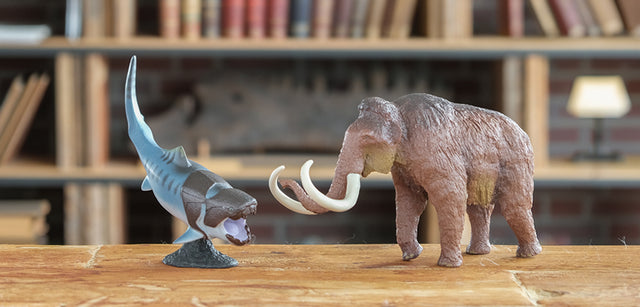
Here's a bonus. I couldn't resist the two words "limited edition" at the "Marine Hunters Exhibition" held at the National Museum of Nature and Science until October 2nd, and spent a whopping 5,000 yen to buy this Carcharodon Megalodon jaw. It's fine that the cartilage part is smooth because it doesn't fossilize, but isn't the 1/12 scale setting practically telling me to display it like this, especially since it's the standard dollhouse scale and there are many figures available!(Image 8)

← Older Post Newer Post →