
New Dinosaur Treasure Museum

Vol. 38 "A History of Iguanodon Reconstruction as Seen Through Figures"

The Sphinx was the one who posed the riddle, "What animal walks on four legs in the morning, two legs at noon, and three legs in the evening?" and ate the travelers who couldn't answer. However, there are surely no dinosaur fans who would be eaten by the Sphinx for being unable to answer the riddle, "What dinosaur walks on four legs in the morning, three legs at noon, two legs in the evening, and four legs at night?"

Iguanodon is truly the king of reconstruction updates in the dinosaur world. Even with feather representations included, Tyrannosaurus rex only ever reached three updates at most. Its former rival, Megalosaurus, has almost never had a full skeletal reconstruction and has become a shadowy existence known only by its lower jaw. Spinosaurus, at least, is on par in terms of transformations: upright -> bipedal -> crocodile face -> aquatic, but it is ultimately a newcomer. Iguanodon, as one of the first dinosaurs ever discovered, is always introduced in dinosaur guidebooks. It appeared in herds as a livestock for sacrifice in Conan Doyle's "The Lost World" (1912), and inspired the title of a work by physicist and essayist Ukichiro Nakaya, who read it ("Iguanodon no Uta," 1952). It's also a major dinosaur, appearing alongside Brontosaurus in the lyrics of "Yatsura no Ashioto no Ballad," the theme song for the TV anime "Hajime Ningen Gyatoruzu." Yet, its popularity in models is currently low. This is likely due to its plain appearance, with no distinctive features other than its thumb spike. Especially now that it's portrayed on four legs, its proud thumb spike is less noticeable, making it hard to identify from a distance. It used to be a regular in dinosaur figure series, but its appearances have significantly decreased in recent years. For example, in Japan, its position has been taken by the native Fukuiraptor of the same family. For the declining Iguanodon and its few fans, this time we're featuring Iguanodon figures by morphological type. Following the example of Shin Godzilla, another large vertebrate that undergoes repeated morphological changes, we'll call them "Forms 1 through 4."

*Actually, our dinosaur models will participate in a special exhibition held from October 21st at the "Kanna Town Dinosaur Center" in Gunma Prefecture, which celebrates its 30th anniversary this year. The theme of the exhibition is the evolution of dinosaur reconstruction, so various styles of models, including nostalgic garage kits from the early Kaiyodo (1980s) such as the giant Araki Tyrannosaurus, will be on display. While selecting models, I noticed that Iguanodon had an unexpectedly rich variety and was interesting, so I decided to collect them. This feature is linked to, or rather, piggybacks on the exhibition. I also borrowed the title a bit.

Special Exhibition "Changing Dinosaur Forms Seen Through Figures"

Form 1
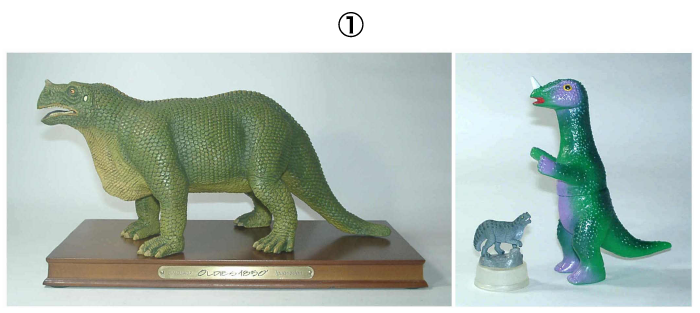
Needless to say, this is the one based on Mantell's skeletal reconstruction, the one with horns that still sits in Crystal Palace Park (Treasure House Vol. 39). Few commercially available models exist. As far as I know, there are items from Favorite's Oldies series and the secret item from Reds' small "Retro Classic Dinosaur Bottle Cap" series (both sculpted by Kazunari Araki), as well as the "Mini Dinosaur Series" from a manufacturer called "Butanohana" that sells mini soft vinyl models of monsters and the like... Don't say, "Hey, it's not on four legs!" because all of this manufacturer's prehistoric animals, including Protoceratops, Edmontonia, and even the dicynodont Placerias (!), are standing upright (the only exception being Eryops). What's more, it maniacally states "Iguanodon (mistake)" on the soles of its feet! (①)
This alone is too lonely, so please also see this: This is one of the 19th-century paleontological lithographs introduced in New Treasure House Vol. 35's Archaeopteryx episode. Unfortunately, no commercially available model exists for its partner, the old Megalosaurus. (②)

n-hihoukan_38-1.png

n-hihoukan_38-2.png

Form 2
Looking back, this period was probably the golden age of Iguanodon. Standing majestically on two legs with its tail as a third point of support, chest puffed out, its dignified posture makes the Godzilla model theory understandable. Indeed, its hands and stance are very much like Godzilla's. To say it's a body type easy for actors to wear might be a bit blunt. My favorite is Brian's color illustration from 1950. Under the moonlight (?), its serene pose even feels divine. And above all, it looks strong. In fact, at that time, it was depicted jabbing its thumb into the throat of a Tyrannosaurus rex, like Abdullah the Butcher's weapon attack.

*While Tyrannosaurus vs. Iguanodon is a bit off in time (only about 50 million years), they were often depicted in battle. There was a scene like that in the TV show "Dinosaur Expedition Team Born Free," and although I haven't been there myself, it seems they're still fighting at the Komuroyama Dinosaur Park in Izu.
In the past, Tyrannosaurus rex was the only large carnivorous dinosaur of the Cretaceous period. It was a simpler time when Iguanodon and Tyrannosaurus, both Cretaceous dinosaurs, could coexist on a single page of a picture book. Terms like "Maastrichtian" would never be uttered by amateurs.

The second form of Iguanodon also showed off minor tricks, such as eating leaves by entwining them with a long, giraffe-like tongue. There was no shortage of topics, such as the mass suicide by jumping at Bernissart. It was also the first large dinosaur to run at full speed with its tail held high (as early as 1913! Heilmann's illustration).
Of course, there are many models too.

n-hihoukan_38-3.png

(③) Kaiyodo garage kit. (Please also see Treasure House Vol. 62)

n-hihoukan_38-4.png

(④) 1972 Bandai plastic model. It's a rare item (Treasure House Vol. 59 and New Treasure House Vol. 8), but I decided to finally build it for this occasion. That said, I built the relatively common American version, and the original domestic version is safely preserved. It's been a really long time since I built a plastic model. It was probably over 10 years since I opened a Mr. Cement (plastic model adhesive) lid. It was a moment when my plastic modeler's soul was revived along with the nostalgic scent.

n-hihoukan_38-5.png

(⑤) Toys from the 70s-80s. From left: standard Hong Kong rubber figure / Clover / Daikyo? / Marushin / unknown / and a mystery Kenko Chocolate toy. (See Treasure House Vol. 36 & 37)

n-hihoukan_38-6.png

(⑥) Overseas items. From left: MARX (1950s) / STARLUX / KLEINWELKA / unknown (bought in the 1990s) / SHREDDIES (See New Treasure House Vol. 8)

Form 3
Since the dinosaur renaissance in the 1970s, bipedal dinosaurs no longer dragged their tails. This, of course, includes Iguanodon. However, it's quite difficult to make models stand on just two legs without a base, so some still rely on their tails for support. The distinguishing feature from Form 2 is the presence or absence of cheek pouches. In the 1980s, all herbivorous dinosaurs, even sauropods, had cheek pouches. But am I the only one who regrets that these cheek pouches made Iguanodon lose its vigor and turn into a docile, ordinary herbivorous dinosaur...?

n-hihoukan_38-7.png

(⑦) Kaiyodo garage kit. Is the one on the far right actually Form 2?

n-hihoukan_38-8.png

(⑧) Front row from left: U.K.R.D (90s) / British Museum of Natural History (1980) / Carnegie Safari (1990) / probably related to Disney's Animal Kingdom. The larger ones in the back are from the Thunderbeast series, early 90s.

Form 4
In 1985, a quadrupedal Iguanodon figure was sold at the "Special Exhibition: Iguanodon" held at the National Museum of Nature and Science. Two types were sold side-by-side, including a Form 2 figure (⑨). At this exhibition, the relatively smaller Iguanodon mantelli was reconstructed as bipedal, while the larger Iguanodon bernissartensis was reconstructed as quadrupedal.

n-hihoukan_38-9.png

n-hihoukan_38-10.png

(⑩) The two on the front left are from its home country, Britain. One is from the British Museum of Natural History's "Dinosaur Collection" series, and the other is a figure from the BBC TV series "Walking with Dinosaurs."
Next to them is a "Bullyland" product from Germany. The one in the back is a work by sansyo88, which appeared in New Dinosaur Treasure House Vol. 21: Special Feature on One-of-a-Kind Items, and was also acquired on Yahoo! Auctions. There are also various others, such as Favorite's desktop model series (out of print), Safari's revamped version, and candy toys, but it's probably inevitable that they all have similar proportions given the demand for scientific accuracy in modern figures. As I wrote at the beginning, without the ability to display its spike and with an unremarkable face, it has become an even plainer dinosaur than Edmontosaurus.

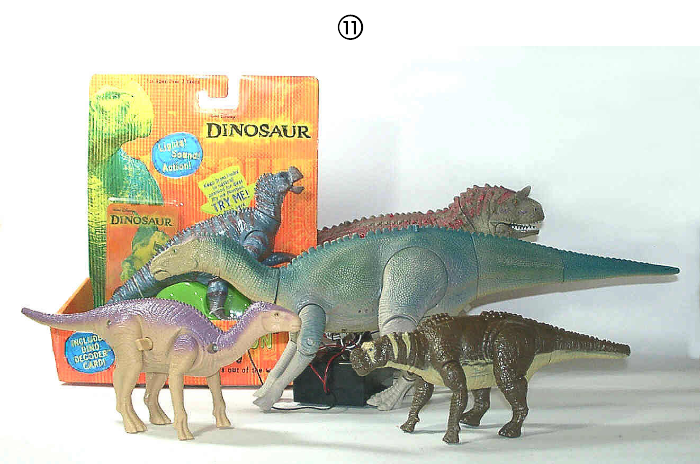
The only time this fourth form of Iguanodon truly flourished was in its starring film, Disney's "Dinosaur," released in 2000. If you could tolerate the talking dinosaurs and Disneyfied faces, the CG dinosaurs were very well-made and enjoyable. So many goods were sold that I bought quite a collection, but perhaps because of the Disney faces, they weren't displayed on shelves. This time, I had to dig some of them out of a closet piled high with merchandise. (⑪) The larger ones are connected to the Carnotaurus in the back with a wire, and it seems they're supposed to interact somehow, but I can't figure out how to operate them. A shame. Looking at them again, the quality of the figures is better than those from Jurassic World.

n-hihoukan_38-11.png

n-hihoukan_38-12.png

(⑫) Iguanodon skeletal figures are pitifully scarce (only skulls were released by Favorite). The one on the left is a fluorescent kit, the same as what's currently sold as an excavation kit. The one on the right is probably from the 80s, a prize from a lottery. It looks perfectly like an Iguanodon, but unfortunately, the pelvis is omitted. So, when I was young, I made the pubic and ischial bones out of plastic sheets and put it in the then-popular running pose, which is the one in the center. The rest are "Honehone Zaurus" out of desperation, and a wooden skeleton from the 100-yen shop Daiso that, to me, looks undeniably like a Velociraptor, which briefly caused excitement among friends a while ago. Enthusiasts can't help but be drawn to these kinds of things. I never thought I'd be showcasing them at the Treasure House. There should also be items from Furuta's candy toy "Choco Egg" series, but I unfortunately couldn't find them.

*The Dinosaur Toy Museum also features Iguanodon figures. It has a rich collection of "Dinosaur" merchandise and candy toys.

Emboldened by building the Iguanodon plastic model, I finally completed the ultra-limited resin kit "Brian Tyranno," sculpted by Shinobu Matsumura, which had been left assembled for about two years. (⑬)
It doesn't look like a Tyrannosaurus at all (its head is small, and it has three fingers...), but it's undeniably cool!

n-hihoukan_38-13.png


Older Post Newer Post