
Vol. 51 Fall Art Season Dinosaur Art Exhibition Tour
Just when I thought I could finally relax after the summer dinosaur storm, artistic dinosaurs somehow arrived with the autumn breeze this year, and my wallet is getting lighter and lighter, with no way to guard against it. Despite my grumbling, I cheerfully visited three dinosaur art exhibitions.
First up was the exhibition "Dinosaur Design" by Ryoko Sugisaki, a newspaper dinosaur artist, which I've seen several times now. This time, it was held at Tsutaya Books in Daikanyama.
As expected of a bookstore located in Daikanyama, Tsutaya Books is an exceptionally stylish place. It has a spacious and relaxed interior with quiet, genre-specific rooms that mix Japanese and Western books (perhaps inspired by old foreign bookstores?), as well as a cafe and an antique goods corner. It seems like a great spot to spend a leisurely afternoon reading, but for someone like me, who isn't used to such an atmosphere, it makes me a little nervous. The newspaper dinosaurs were displayed in a room dedicated to biology and earth science books, surrounded by dinosaur books.
![]()

My first encounter with newspaper dinosaurs was about four years ago, at a small gallery in Nishi-Ogikubo. The exquisite delicacy of their feather representations, claws, and teeth immediately turned me into an alien. I desperately wanted one, but the Archaeopteryx with its magnificent flight feathers was too expensive for my reach or my purse. After much deliberation with my finances, I managed to acquire a small Pterodaustro (Image 1). But even though it's a small piece, each brush-like tooth on its distinctive lower jaw is individually planted.
*This part of the text is greatly influenced by the book "Bird Skeletal Specimen Encyclopedia" by Bird Kawakami (Bun-ichi Sogo Shuppan) that I recently read. Although it mostly features rows of similar skeletal specimen photos (especially the 35 consecutive Passeriformes), Kawakami's characteristic small, entertaining anecdotes shine through, allowing you to learn about subtle skeletal differences while having fun. However, to my chagrin, I only understood about half of the anecdotes. When I tried to look them up later, the glossary at the end of the book meticulously explained terms like "paleognathae" and "schizorhinal," alongside "Kal-El = Superman's real name" and "Number 1 for technique, Number 2 for power = catchphrases for Kamen Rider 1 and 2." It's a highly recommended book.
And so, having become a complete fan of newspaper dinosaurs, I desperately wanted another one. However, even when I found a piece I liked at an affordable price, it was often already sold when I looked closely, so my wish wasn't easily granted. This time, I went on the second day of the exhibition, well-prepared, and managed to get a new piece.
![]()

This is the head of a Spinosaurus. The depiction of the teeth is incredible, clearly indicating it was a fish-eater. The title of the work is "Timetable." The fine print of the timetable creates a nice scale pattern. The feathered T-rex and Triceratops heads from the same series are featured on the postcard (Image 2).
![]()

Next, I went to the photo exhibition "Nocturnal Still Life Observation: Dinosaurs Howling at the Starry Sky" by photographer Akinobu Yamashita. It featured mysterious, dreamlike photographs of dinosaur statues found in parks across the country at night, taken using a phosphorescent photography technique. Fortunately, they weren't selling the photos, so I only ended up spending money on two mini photo books (Image 3).
*For information on dinosaurs in parks nationwide, there is a booklet edited by the curator of the "Dinosaur Toy Museum" (the Dinosaur Club also cooperated in the research). (New Secret Treasure House Vol. 26)
Finally, there was the "Nihonga Dinosaur Exhibition" held in Shibuya.
It was a group exhibition themed around dinosaurs, featuring graduates and current students of the Nihonga (Japanese-style painting) major at the University of the Arts. Japanese painting and dinosaurs... I was incredibly curious about how it would turn out, and it actually matched perfectly. The texture of the mineral pigments used in Nihonga was ideal for depicting dinosaur skin and fossils. In particular, the fossils looked just like real fossils. After all, the raw material is "rock."
![]()

All the works were unique and wonderful, but I tend to be drawn to realistic ones. So, I bought Masaki Shirakura's "Fossil Diagram," which was incredibly realistic and affordably priced (Image 4).
It's so beautifully fossilized that you'd genuinely believe it was from Liaoning Province if someone told you it was.
This concludes my autumn art tour, but I have one more art-related topic.
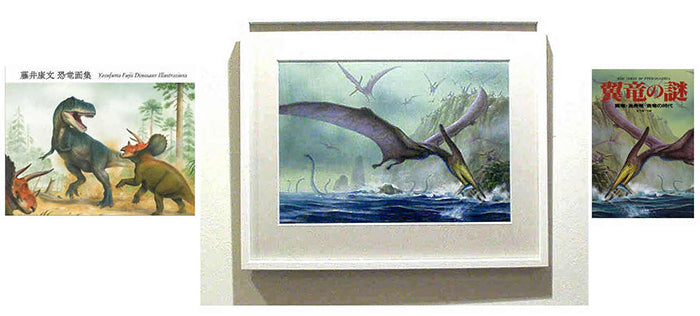
This autumn, the "Dinosaur Art Book" by Yasufumi Fujii, a leading figure in paleontology restoration art, was published.
Fujii-san has been active since the 1980s, and any dinosaur fan must have encountered his dinosaurs in encyclopedias or Newton magazines. He is an undeniable "master" who has continuously depicted the history of dinosaur restoration, from "Godzilla-standing" dinosaurs to feathered dinosaurs, all in hand-drawn illustrations. Not only the main prehistoric creatures, but also every single tree and leaf are carefully drawn, and the backgrounds often exude a poetic atmosphere, which is lovely. I highly recommend picking up the book and experiencing the amazing quality of hand-drawn art, which is different from CG.
![]()

Happily, Fujii-san joined the Dinosaur Club a few years ago. Thanks to that, one of his original drawings now hangs on my wall! It's a Pteranodon, also included in the "Dinosaur Art Book," and it was featured on the cover of the late Ryuichi Kaneko's book "The Mystery of Pterosaurs" (Futami Shobo, 1995) (it's printed reversed in the book). It's a family treasure (Image 5).
Let me introduce another work by Fujii-san. While many of his works are featured in my collection books, I intentionally chose this early piece (yes, I'm showing off a rare item…).
![]()

This is the "Dinosaur Era Chronology" supplement from the June 1989 issue of the youth science magazine "Coper 21" (see New Secret Treasure House Vol. 46) (Image 6).
Illustrated dinosaurs drawn to a 1/60 scale, representing the transitional period of the Renaissance, are arranged in chronological order. In the Cretaceous period, Tyrannosaurus and Parasaurolophus are depicted in a "Godzilla stance," but there are also horizontally posed Deinonychus, Stenonychosaurus, and Baryonyx. Saltasaurus also appears, despite its old posture. The reverse side features Triassic and Jurassic dinosaurs, including a gigantic Ultrasaurus (now an invalid name, but at the time it was considered a super-gigantic Brachiosaurus, and life-size models were displayed at the plaza south of Shinjuku Station and at the Yokohama Expo, creating a buzz). Alongside it, there's an Apatosaurus with a Diplodocus-like face...
The latter half of the discussion concerns the subtle relationship between Apatosaurus and Brontosaurus.
I finally read the book "The Rise and Fall of the Dinosaurs" (Misuzu Shobo), published in the summer, this autumn. The author, Steve Brusatte, is a leading dinosaur scholar and a talented writer. The book is incredibly interesting, as he swiftly narrates the development and extinction of dinosaurs while explaining the progress of dinosaur studies from the Dinosaur Renaissance to the present, along with personal anecdotes of his new species discoveries and amusing stories with fellow paleontologists. I read it in one sitting. However, something surprising happened...
The name Brontosaurus kept appearing, while Apatosaurus was only briefly mentioned as one of the other sauropods. Of course, I knew about the "Brontosaurus restoration" movement of the past few years, which sought to separate Brontosaurus from its synonymy with Apatosaurus and establish it as a distinct genus. I was also hoping for the revival of a name I grew up with, but I thought it wasn't yet a decided fact. However, Brusatte-san made no explanation whatsoever, repeatedly using the name Brontosaurus as an established fact. I thought this was the stubbornness of the revivalists, and surely the translator's afterword would address it, but it was lightly brushed over. To make matters worse, Jiro Tomari, a historian of science who reviewed the book in the University of Tokyo Press magazine "UP," complained about minor points like "there's no mention of dinosaur DNA at all," but didn't seem to mind Brontosaurus and made absolutely no mention of it.
This made me wonder if the common perception had already shifted to Brontosaurus while I was sleeping on it, so I hastily flipped through the latest educational encyclopedia, "Kodansha's Moving Encyclopedia: MOVE mini Dinosaurs," which also includes Bajadasaurus and Halszkaraptor. I was relieved to find Apatosaurus. By the way, in "The Dinosaur Textbook" (Sogen-sha), a rather advanced book published in February this year, both Apatosaurus and Brontosaurus are listed, but Apatosaurus comes first, as if avoiding a conclusion.
Apatosaurus replaced Brontosaurus in figures and books in the 1980s. In reality, Apatosaurus had been the official scientific name replacing Brontosaurus since the early 20th century, according to Wikipedia.
The impact of the name "Thunder Lizard" was immense, and the name Apatosaurus does not seem to have been widely adopted by the public. It only began to gain traction in the 70s. In books from the early 80s, both names were mixed. For example, in the groundbreaking "Dinosaurs: A New Look at the Old Dragon" (by J.C. McLoughlin, Iwanami Shoten), published in 1982, which heavily incorporated the Renaissance and even featured feathered dinosaurs, and Hisakuni Hiko's "How Did Dinosaurs Live?" (Akane Shobo), published in the same year, the term Brontosaurus is used. However, in David Lambert's "Dinosaurs" (Heibonsha), published in 1981, it is referred to as "Apatosaurus, also known as Brontosaurus."
*I wanted to check in more detail, but most of the 1980s books have moved to the Gunma Museum of Natural History, so I couldn't look them up. Too bad!
On the other hand, in figures, there is a perfect example illustrating this handover.
![]()

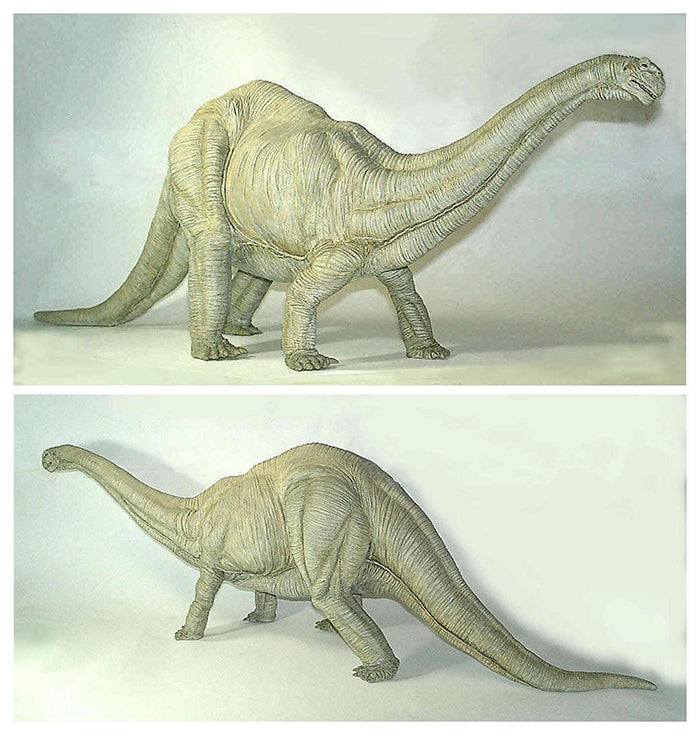
This is a garage kit from Kaiyodo. The photo (Image 7) is likely of the 1/35 Brontosaurus, sculpted by Kazunari Araki, released in 1984. It's a huge, weighty resin kit. Two years later, in 1986, Kaiyodo's magazine "Artpla Dai San Go" featured a photo of Araki's Apatosaurus VS Ceratosaurus (Secret Treasure House Vol. 62) alongside the aforementioned Brontosaurus, each with explanations:
"The photo shown here is of the 'round-faced' Brontosaurus, long known as such, but it has recently been discovered that the fossil evidence for this face belongs to another dinosaur." "The actual Brontosaurus, also known as Apatosaurus, is thought to have had a face like this."
Did the skull of the Apatosaurus at the American Museum of Natural History change from Camarasaurus to Diplodocus-type during those two years, 1984-1986?
*Incidentally, Araki's Brontosaurus was later made into a soft vinyl kit, and at that time, it came with Diplodocus-faced parts, making it reversible between Brontosaurus and Apatosaurus. I have one myself, but regrettably, I haven't made it yet and it's buried deep in my closet, impossible to find.
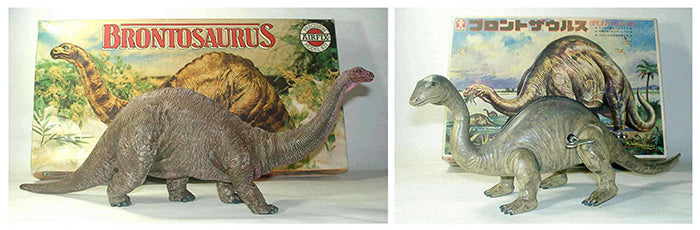
However, there are only a handful of Brontosaurus figures that faithfully reproduce the Camarasaurus-like face. The skeletal models from "ITC," "PALMAR" (Secret Treasure House Vol. 56), and "Gakken" (Secret Treasure House Vol. 60) certainly have such faces, but among the countless figures and toys, only "Alva" (Secret Treasure House Vol. 55), "SINCLAIR" (Secret Treasure House Vol. 35), "MARX", and (Secret Treasure House Vol. 5) immediately come to mind. Most others have a "somehow dinosaur-like" face.
![]()

This time, I impulsively built the "Airfix" (Secret Treasure House Vol. 58) and "Bandai" (Secret Treasure House Vol. 59・New Secret Treasure House Vol. 8・New Secret Treasure House Vol. 38) plastic models, thinking I would never make them if I missed this chance, as you can see (Image 8).
After the 1990s, Brontosaurus gradually disappeared and was replaced by Apatosaurus. However, without the impact of the "thunder" name, and with the appearance of new, much larger titanosaurids, its former glory faded. In old encyclopedias, sauropods always included Brontosaurus, Diplodocus, and Brachiosaurus, but in recent advanced encyclopedias, Apatosaurus is often treated lightly, merely as a member of the Diplodocidae family.
Even if the name Brontosaurus is revived, the encyclopedia's treatment of it probably won't change at this point, which is tear-jerking for us senior dinosaur enthusiasts. However, this sentiment likely won't be understood by the Heisei generation who learned that Apatosaurus was correct, or by children who grew up with feathered dinosaurs and have never even heard of Brontosaurus. For them, it must be nothing but a nuisance.
![]()

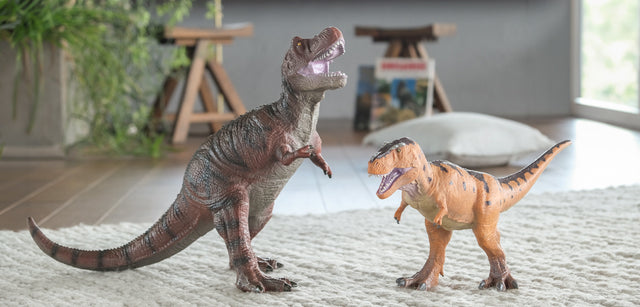
Finally, please take a look at the Brontosaurus from Zallinger's "Age of Reptiles," a famous mural at the Peabody Museum of Natural History, part of Lunar Model's Dinosaur Masterpiece 3D series (Secret Treasure House Vol. 18・New Secret Treasure House Vol. 49), the newly released Brontosaurus from the trend-loving CollectA, and Brontosaurus and Stegosaurus tree ornaments (Image 9).
Merry Christmas!
← Older Post Newer Post →