

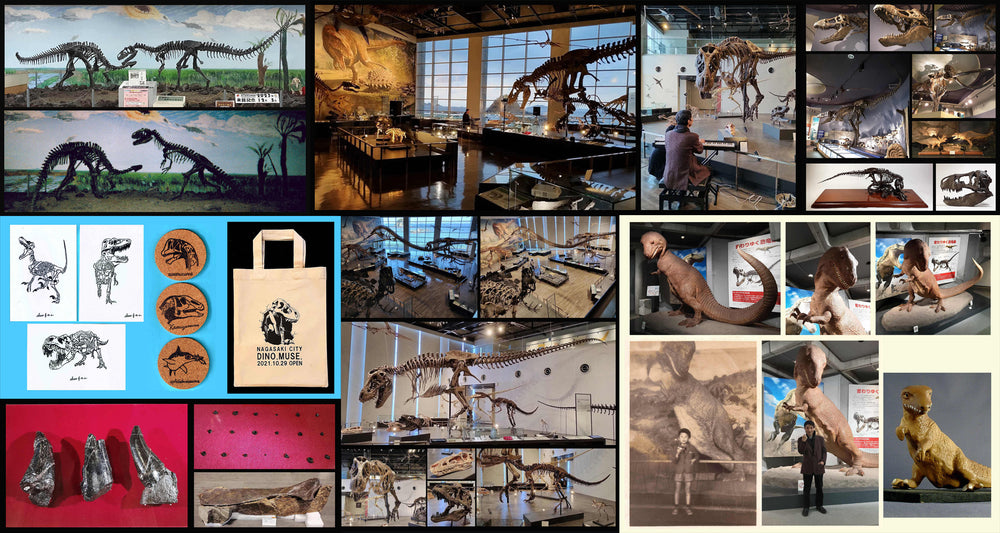
New Dinosaur Treasure Museum

Vol.76 Kyushu Dinosaur Travelogue

At the end of November last year, my main band had a tour (which we call "beta" in industry jargon) for the first time in a long time due to COVID-19. We played five venues from Kumamoto to Kagoshima, and of course, the travel expenses were covered by the organizer. I jumped at the chance and planned to visit the Nagasaki Dinosaur Museum and the Saga Prefectural Museum, which I had always wanted to see. The day before the Kumamoto live performance, I traveled ahead alone to the Nagasaki Dinosaur Museum, and on the morning of the Kumamoto live, I stopped in Saga and arrived in Kumamoto by evening. Such a tight schedule was only possible thanks to the Kyushu Shinkansen. Originally, I even considered arriving in Kumamoto three hours earlier and visiting the Mifune Dinosaur Museum for an hour before the live performance (Mifune is about an hour by bus from Kumamoto city), but that proved to be impossible.

This time, I'll be reporting on the dinosaurs I saw in Nagasaki and Saga, as well as Miyazaki and Kagoshima during my free time on the tour.


November 29: Nagasaki Dinosaur Museum

First thing in the morning, I took a 7:15 AM flight from Haneda to Nagasaki Airport. From the airport to Nagasaki Station, it was just under an hour by limousine bus. Then, I took a local bus with an unusually large number of stops for about an hour. The sea opened up before me, and I caught sight of Hashima (Gunkanjima). The real Gunkanjima truly looked like a battleship, and I was so moved and excited, thinking I was finally arriving. However, the bus continued to drive for more than 10 minutes along the beautiful coastline, stopping frequently as always.

I had heard about it, but the access really was bad... I arrived a little after 2 PM.


For this visit, I was able to get in touch with curator Daisuke Nakatani through a connection at the Dinosaur Club. Mr. Nakatani specializes in marine reptiles, but he also researches Dr. Matajiro Yokoyama. Yes, Nagasaki is the birthplace of Professor Yokoyama, the "father" of the word "dinosaur." I have also been "acquainted" with the professor for many years (New Treasure House Vol. 6 & Vol. 47) and collect his books, so I really wanted to hear his stories.


While exchanging emails with Mr. Nakatani several times, an unexpected plan came up, but I'll tell you about that later. First, let me introduce the museum.


This museum is the newest dinosaur museum in Japan, having opened about two years ago. One side of the dinosaur exhibit room is made of glass, offering a view of the beautiful sea and Gunkanjima floating in it. This sense of openness was something new and refreshing that I hadn't experienced in previous museums. Sometimes, the curtains are drawn to light up the specimens, making them easier to observe. Although it's not particularly large, there are many highlights.

The main attraction, above all, is Trix, the Tyrannosaurus rex. It is a replica of a full skeleton specimen boasting one of the best states of preservation, owned by the Naturalis Biodiversity Center in Leiden, Netherlands. It came to Nagasaki City through the good offices of Leiden, which has been a sister city since Siebold's time. Apparently, it's the only replica displayed in the world. Its low-slung posture is also cool. According to Mr. Nakatani, Naturalis gave detailed instructions regarding the pose. I was strangely impressed that even for a replica, there was such meticulous attention to detail, as if it were their own child.

At the feet of Trix are four specimens that tell the story of the evolution of the tyrannosaur family. From oldest to newest, there are Dilong from the Tyrannosauroid superfamily, and then Xiongguanlong. The oldest Tyrannosauridae currently known is Lythronax from the Campanian stage, 80 million years ago. And then there's Alioramus from the latest Maastrichtian stage in Mongolia, which is said to be closely related to Tarbosaurus. It's unique that familiar Tarbosaurus and Albertosaurus are absent. Well, perhaps it's due to the limited exhibition space.

Image 1

This museum has an impressive collection of tyrannosaurs because three well-preserved teeth, believed to belong to Tyrannosauridae, were discovered in the local Mitsuse Formation (a Campanian-age stratum from 81 million years ago). They are nearly 10 cm long, comparable in size to those of T. rex. To think that such a gigantic tyrannosaurid existed 10 million years before T. rex! If described, its immense size and antiquity, similar to Lythronax, could rewrite tyrannosaur history. Excavations are ongoing, which is exciting. Scapulae and teeth of Hadrosauroidea have also been found in the Mitsuse Formation.

Image 2


To return to the story, what I did at this museum was, surprisingly, appear live on TV.

Mr. Nakatani's unexpected proposal, "If you're coming anyway, why don't you perform at the museum?", made me enthusiastic, thinking it would be a memorable experience. I appeared on a 10-minute segment called "Nanden Chukei" within "Nanden Cafe," an information program broadcast daily at 5 PM on the local cable TV station "Nagasaki Cable Media." The idea was to play the electric piano while looking at Trix. The angle of Trix's skull was just right, so when I sat at the piano, our "eyes met." It was something I did as a joke, thinking it would appeal to viewers, but as we stared at each other, I was seized by a strange sensation, as if there were really eyeballs deep within those empty orbits. It was an interesting experience that I'd want to brag about to my dinosaur friends.

Image 3

The rehearsal scene. Such a sight is quite rare, I'd say.


Actually, this program is distributed on YouTube. From the opening scene showing the surprisingly evolved, latest tyrannosaur robot, the scene shifts to a suspicious person playing the piano...

I think you'll enjoy it. Please take a look.


Now, since I visited the museum, browsing for merchandise was a must. Although I secretly hoped for a Trix figure or a Matajiro Yokoyama doll, there were none. However, I bought coasters and postcards featuring works by Show.F.E.S, a local "genius eraser stamp artist boy." He debuted in 2020 at the age of 13, so he's still 16 or 17. His skill is remarkable. Is the tote bag the only Trix merchandise?

Image 4


I heard various valuable stories about Dr. Matajiro Yokoyama, but Mr. Nakatani is scheduled to publish a paper on Dr. Yokoyama soon, so it's off the record until then.


Afterward, Mr. Nakatani and other staff members (including a member of the Dinosaur Club living locally, whom I met for the first time!) held a celebration near my hotel in front of Nagasaki Station. Everyone lived closer to the museum and drove, so I was the only one who drank alcohol, but they indulged me in enjoyable dinosaur conversations. I'm very grateful.


Image 5

I never thought I'd have all the dinosaur figures of the Tyrannosaur family that were at Trix's feet. I arranged them in the same way as in the museum. In the top row, from oldest to newest, starting from the right, is a Dilong by Safari. Xiongguanlong, Lythronax, and Alioramus are by CollectA. A Lythronax by the currently popular PNSO is also available, but unfortunately, I don't have it at home.

The skull of Alioramus on the bottom left is by Yoshiaki Murase, who introduced the skulls of Tyrannosaurus and Nanotyrannus in Treasure House Vol. 64 and Galeamopus in New Treasure House Vol. 54. Alioramus is also available from Mattel's JP series. To its right is the closely related alioramid, Qianzhousaurus, produced by Safari and PNSO. Even just within Tyrannosauridae, it's amazing how the world has become such that these niche dinosaur figures are available.


November 30: Saga Prefectural Museum

I checked out of the hotel at 10 AM and took a local limited express train and a Shinkansen for about an hour to Saga. I was going to see that Tyrannosaurus again.

First, please take a look at this.

New Treasure House Vol. 10 / Vol. 17 / Vol. 56 / Vol. 57


And so, it was a long-awaited two-shot with the Tyrannosaurus from the National Museum of Nature and Science after 63 years. Thank you to the curator who went out of their way to take the photo.

Image 6


I spent about an hour in front of the T. rex, reflecting on my life (?)... but there were no other dinosaurs to see in this museum, so I headed to Kumamoto, the location of that day's work, by Shinkansen. From the next day, I would stay three nights in Miyazaki, with live performances in Miyazaki, Miyakonojo, and Hyuga. I would have plenty of free time during the day.


December 2: Miyazaki Prefectural Comprehensive Museum

I've had opportunities to perform in Miyazaki several times before, so this is my third visit to this museum. The natural history exhibit focuses on Miyazaki's nature with dioramas, taxidermied animals, and full skeletons of living creatures like striped dolphins and pygmy sperm whales. Fossils are limited to a few Devonian corals. However, the dinosaur skeleton exhibit is quite impressive. Full skeleton replicas of Saichania, Protoceratops, and a rare white Eoraptor are crammed into the space. The Naumann elephant from Hokkaido, positioned high up, also makes an impact, but the main attraction is still the full Tyrannosaurus skeleton.

Image 7

The T. rex here is MOR555 Wankel Rex, which is rarely seen in Japan. The original was exhibited at the Museum of the Rockies in Montana (hence MOR), but it is now on loan to the Smithsonian, where it is said to be gnawing on a Triceratops, as shown in the model below. This full body and skull model of Wankel Rex is from my collection, and it's a product of Amphi LLC, which produces skeletal models using 3D printers.


December 5: Kagoshima Prefectural Museum

The last live performance of the tour ended the day before, and it was the day to return to Tokyo. I couldn't waste the two hours between checking out and boarding the bus to the airport. So, I headed to the Kagoshima Prefectural Museum. This museum is within walking distance of the hotel, right next to Saigo Takamori's statue.

Here, the second oldest full dinosaur skeleton in Japan is exhibited. It is a historical Allosaurus and Camptosaurus, donated by Yukichi Ogawa, who also donated the Allosaurus full skeleton to the National Museum of Nature and Science in 1962, which was the first dinosaur fossil exhibit in Japan. These have been on display since 1966. More than half of them are said to be composed of actual fossils.

I saw them probably over 30 years ago, also during a performance tour. I found a photo from that time, so I'll put it alongside. Please forgive the old, extremely dark photo that I couldn't scan well.

Image 8


This is my personal opinion, but I prefer the old display. I wish fossils with such drama would be preserved as monuments in their original state, so that we could reflect on the dinosaur love of our predecessors...


This museum also displays another fossil that wasn't there 30 years ago. It's the actual fossil of the elasmosaurid Satsumautsunomiyaryu, discovered in 2004 by Satoshi Utsunomiya, a famous salaryman fossil hunter, on Shishijima Island at the northern tip of Kagoshima Prefecture, which is now drawing attention as a fossil island. I was happily surprised as I hadn't known it could be seen here. The turtle-like restoration model created by Goro Furuta of Kaiyodo is quite unique. While it may lack scientific basis, it leaves a strong impression.

Image 9

*The details of the Satsumautsunomiyaryu excavation can be read in Satoshi Utsunomiya's book, "Discovery of a Plesiosaur! - Tips for Fossil Hunting from a Legendary Salaryman Fossil Hunter" (Tsukiji Shokan, 2007).


This Kyushu tour was fulfilling in terms of dinosaurs, but there are many museums I still want to visit in Kyushu, such as the Mifune Dinosaur Museum in Kumamoto (which I had to forgo this time), the Goshoura Dinosaur Island Museum in Amakusa (reopening in March this year), and the Kitakyushu Museum of Natural History & Human History (which I haven't visited since its renovation). Furthermore, a full-scale dinosaur museum is scheduled to open next year on Koshikijima Island, another dinosaur fossil producing island in Kagoshima Prefecture, alongside Shishijima Island.

Dinosaurs in Kyushu are hot right now!


Bonus

I just had to make something like this.

Image 10


There are many things I regret. I completely failed to make the canopy of the 1/100 Zero fighter (Doyusha), which seemed to be the right size, open. And looking at the photo, I over-weathered the Zero... I had the impression from the movie that it was battered, so I ended up overdoing it. The diorama was a makeshift one using felt because I didn't have much time. I'll remake it along with the Zero after watching the video... but I feel like I said the same thing when I made the "so-called" Anguirus (New Treasure House Vol. 73).


Older Post Newer Post