
Vol. 20: A History of Spinosaurus
The other day, shocking news broke: "Spinosaurus was aquatic!" The Asahi Shimbun, a newspaper we subscribe to despite its many problems, treated this major news – which could fundamentally overturn our previous image of the Spinosaurus – with less prominence than the previous day's "Sumatran tiger cub born" story. While I'm on the subject of outrage, I'd like to add that it didn't report a single word about the discovery of the sauropod Dreadnoughtus (a name that delights battleship enthusiasts, as it's named after the ship that gave us the term "dreadnought"). How many times have I felt pathetic when people ask me, "I hear they found an amazing dinosaur?" Well, enough with the gripes. This time, let's look back at the history of Spinosaurus figures, a very current dinosaur.
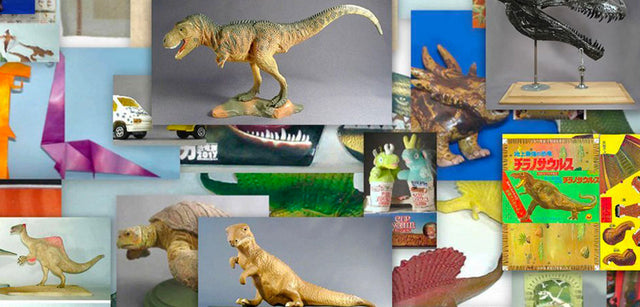
Until the 1970s, like other theropods, Spinosaurus looked like this (Photo 1).

The skeletal diagram on the left was standard at the time, but looking at it again, I'm surprised by its long body and small hind limbs. According to the legendary dinosaur specialty magazine "Dino Press Vol.4" (2001), the length of the vertebral centra of Spinosaurus' dorsal vertebrae is longer than that of Tyrannosaurus, so perhaps this is why it was reconstructed this way? But with this, it seems it could only waddle.
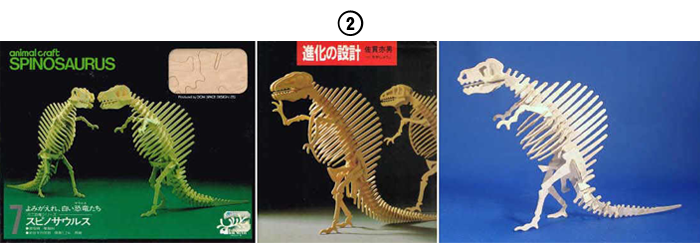
During this period, Spinosaurus was not well-known and rarely modeled. It was the age of Dimetrodon when it came to "sail-backed" dinosaurs. Among the few models, the most impressive is from the "Domspace Design" unpainted wooden dinosaur series released in the 1970s (Photo 2).

On the left are the stock items from the mini dinosaur series (though they are still 30cm long) that I had at home. Next to it is a larger version that was featured on a book cover, which I now deeply regret not buying. Its forelimb fingers have been corrected to three, and something resembling gastralia is also depicted. On the right is the reduced and simplified paper confectionery toy "Meiji Fusen Gum Dinosaur Encyclopedia" from the 90s (see Secret Museum Vol. 16). Other models include the "Tsukuda Hobby 1/30 Dinosaur Series" soft vinyl model, which, though released in the 80s and somewhat outdated, is quite well-made (Photo 3), and the French "Starlux" model (Photo 4), which is rare for the 70s in depicting a quadrupedal posture.

In the 80s, when a new wave of dinosaur reconstruction arrived, Spinosaurus began to look like this (Photo 5).

The left image is from "Encyclopedia of Dinosaurs" (1985), which introduced the latest dinosaur science at the time. Isn't bipedal locomotion a bit difficult in this posture? This book groups dinosaurs with long neural spines, such as Acrocanthosaurus, Altispinax, and Metriacanthosaurus, together as Spinosaurids, albeit with a question mark.
The right image is an illustration from "Dinosaurs: The Evolution and Morphology of Dinosaurs" (1981). The explanation typically describes it as quadrupedal. Araki's work, which graced the cover of the historic "Hobby Japan Dinosaur Special Issue" (April 1984) (Secret Museum Vol. 61), may have been inspired by this illustration.
During this period (80s-90s), figures were quite diverse, and the number of quadrupedal types also increased.

(Photo 6) Kaiyodo's 1/35 garage kit, which I introduced previously (Secret Museum Vol. 62).

(Photo 7) The two on the left are made by "Safari." The one on the right is of unknown origin. The larger one is about 20cm.

(Photo 8) These are also about the same size. The two on the left are "Bullyland," and the one on the right is "Schleich." Both are German manufacturers.

(Photo 9) These were sold as souvenirs at "UNESCO Village Great Dinosaur Hall" (1993-2006). Produced by KOKORO, famous for their dinosaur robots, they are very well made despite their small size (about 10cm).
Spinosaurus's crocodile-like face became recognized after the related Suchomimus was reported in 1998, and it is likely that "Jurassic Park III" in 2001 brought it to public attention. In fact, for "Jurassic Park II: The Lost World" (1997), a Spino action figure was released by "Kenner," even though it didn't appear in the movie. At that time, it still had a typical theropod face. (Photo 10)

In "Jurassic Park III," Spino fights and defeats T. rex. (I avenged it in Secret Museum Vol. 33!) Referring to this, Dr. Paul Sereno commented on a site related to this new theory that "JP III was wrong." However, we shouldn't forget that there are scenes that perfectly visualize the new theory, such as Spino scattering a school of skipjack tuna and attacking a boat with only its sail visible above the water.

(Photo 11) "Jurassic Park III Figures."
The action figures are made by "Hasbro." The two small types in the foreground and the paper skeleton are confectionery toys.
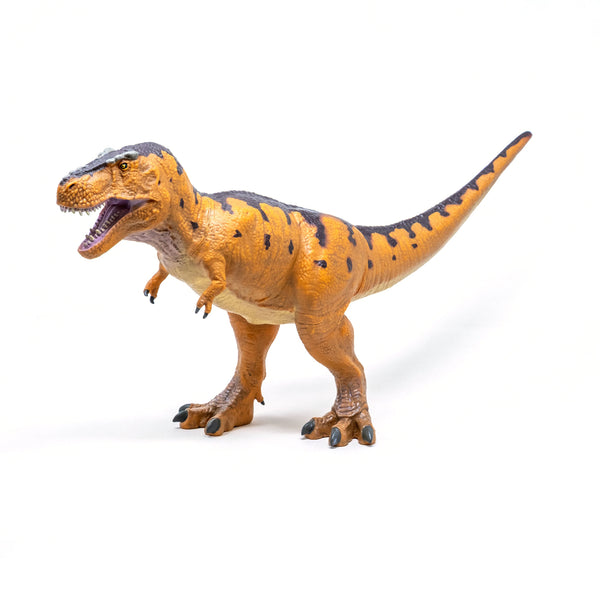
Since then, the JP III type has become the mainstream Spinosaurus figure and remains so today. While you can view Favorite's products on this website, let me briefly introduce some others.

(Photo 12) Top row from left: Great Dinosaur Age (Happinet) / Dinosaur King (Sega) / Dino Models (Furuta) / New/Old Three-Dimensional Encyclopedia (Colorata) / Dinosaur Hunter Collection (Epoch Co.) / CC Zaurus (Suntory) / Dino World (Kabaya) / Dinosaur King (Lawson exclusive) / Original Color Great Dinosaur Encyclopedia (Gachapon at Dinosaur Expo 2011 venue).

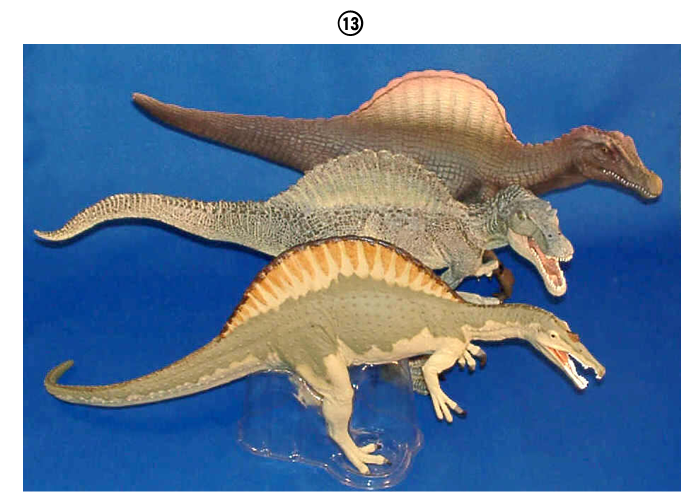
(Photo 13) From front: "Safari" / "Papo" / "Schleich." All are imposing, almost 40cm long. (*The Schleich models currently on sale have been revamped and are a bit smaller and plainer.)
In addition, there are large and small models from "CollectA," which recently became available in Japan, expensive and unattainable giant "Sideshow" models, 100-yen store items, excavation kits, and of course "Honehone Zaurus." If you search, you'll probably find countless more, but it's unavoidable that they all tend to have similar styles (as do other recent dinosaur models). Among them, this model from Safari from a little while ago (Photo 14), even compared to the new theory, is quite "cool." The smaller one is from a super mini animal series, 4cm long, which I recently bought at Tokyu Hands for 90 yen. Amusingly, they have the same shape.


(Photo 15) I couldn't help but concoct this. It's a Spino skeleton from a "Jurassic Egg" that I bought for about 1500 yen, cut, glued, and shaved, with the pubis, ischium, and hind limbs replaced with those of a Fukuiraptor from a gachapon "Dinosaur Skeleton Museum." I didn't have time to paint it, but I think you can see the parts I've modified.
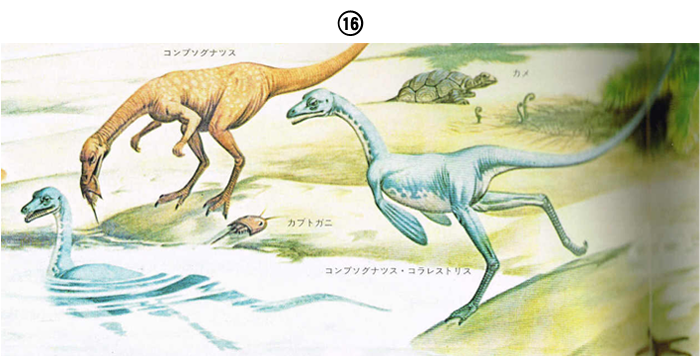
Aquatic dinosaurs have appeared several times before. Not to mention the aquatic Brachiosaurus, which became synonymous with retro dinosaurs, and the snorkel Parasaurolophus, the aforementioned book "Dinosaurs: The Evolution and Morphology of Dinosaurs" even includes this rarity (Photo 16).

This is Compsognathus corallestris, found in France in 1972, and the explanation states that its fingers were fused and transformed into oar-like structures.
Furthermore, in the early 90s, Ryuichi Kaneko introduced theories that Protoceratops (swimming with a flattened tail), oviraptorids (eating shellfish as their main food), and even ankylosaurs were semi-aquatic. So, what kind of conclusion will we reach this time? I'm also curious about its relationship with the giant crocodile, Sarcosuchus.
As of this writing, it hasn't been released yet, but by the time this is uploaded, the October issue of "National Geographic Japan" with a feature on Spinosaurus (and on the cover) will be on bookstore shelves. It should detail the aquatic theory. I'm really looking forward to it!
← Older Post Newer Post →