

Vol.56 The Summer Without Dinosaurs
In the end, I didn't encounter any dinosaurs outside my house all summer. There were no dinosaur exhibitions, mineral fairs, or natural history festivals, all of which were summer regulars. And taking advantage of the fact that the only exhibition held in the Kanto region, the Gunma Museum of Natural History's "Heroes Who Challenged the Sky" exhibition, runs until December, I ended up thinking impure thoughts about using GoTo Travel to visit during the autumn foliage season.
*The poster has been updated.
http://www.gmnh.pref.gunma.jp/wp-content/uploads/10b6f19a66dfe83c5620d26b4c8b2189.pdf
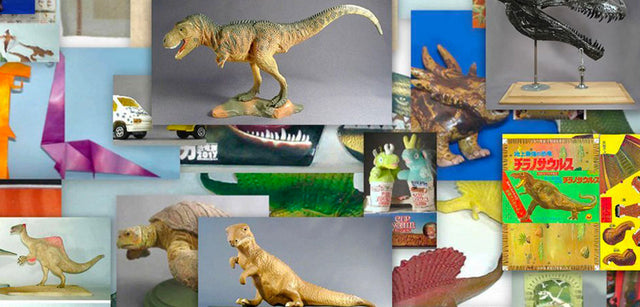
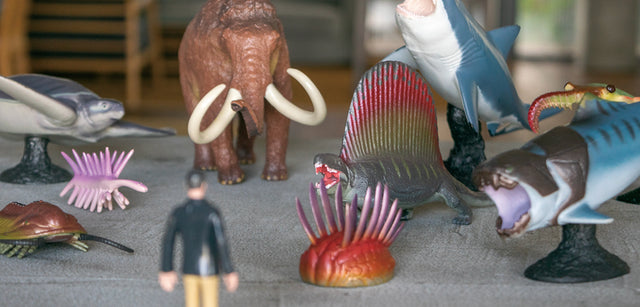
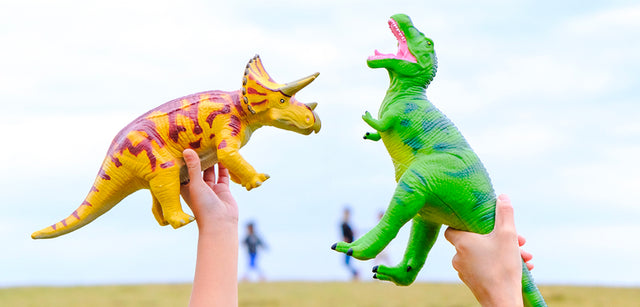
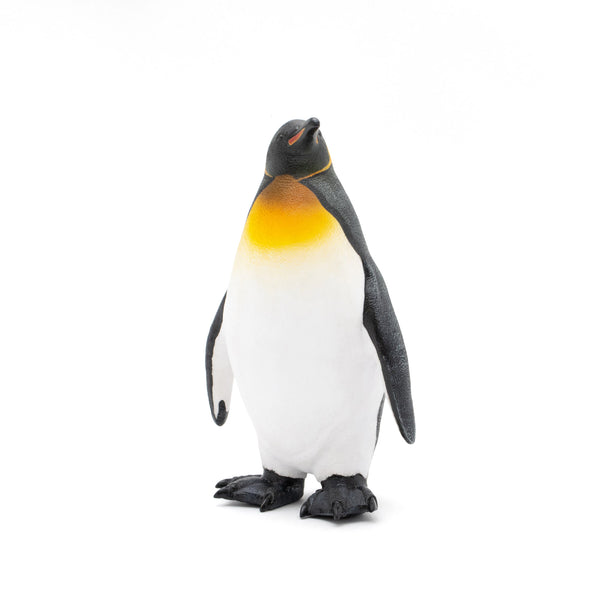
The dinosaur figures released this summer were also disappointing, with only the Ania Jurassic World series available.
*From the end of September, McDonald's Happy Meal came with Jurassic World figures, but these were also underwhelming, and I wasn't motivated to collect the complete set.
I skipped "Nobita's New Dinosaur" because I didn't like the tear-jerking aspect. The new dinosaur figures also have big, sparkling eyes, so they're not for my collection.
Thanks to this, I avoided the summer spending spree that I lament every year around this time, but my income was also low, so as a result, I'm facing a financially difficult autumn, as usual. Normally, the "treasure house" at this time of year would be filled with the spoils of summer dinosaur events, but this year it's sadly empty.
However, for some reason, the dinosaur book world is thriving, with about 40 books published from June to August, which is almost on par with previous years. And unlike last year, there's no restriction to dinosaur exhibitions, so there's a wide variety. If I were to look back at this summer's dinosaurs, it would have to be these!
This Summer's Dinosaur Books

Please see the cover images (Image 1). Of course, I don't own all of them; some images were found online for my lifelong project of creating a "List of Japanese Dinosaur Books." Let me introduce a few books that caught my attention (including those I didn't buy).
●"Kodansha's Moving Encyclopedia MOVE - Ancient Creatures" (1st book from the left in the 1st row, hereinafter referred to as 1-1).
MOVE, which just released "Dinosaur 2" in February this year, covering the latest dinosaurs from Kamuysaurus to Halszkaraptor. This book seems to push the Radiodonta, represented by Anomalocaris, with many of them lined up, and perhaps because of this, the Paleozoic era has the most pages. It's all in color and, as always, has rich content.
●"Tyrannosaurus' Hungry Day" and "Triceratops' Ordinary Day" (1-4 / 1-5, written by Fumiko Takeshita, illustrated by Mamoru Suzuki, Kaiseisha) are picture books that depict a single day in the lives of a T. rex and a Triceratops. The idea is that the two meet at the end. It's an interesting concept, but the books are meaningless unless you buy both. I was hoping they would combine them into one, and then I found "Dinosaur Rival Encyclopedia" (1-6, Gakken Plus), which also features T. rex and Triceratops. If you read it from the front, it's "The Book of Tyrannosaurus." If you read it from the back, it's "The Book of Triceratops," and the two meet on the center page. It felt like the book read my mind.
●"The Great Encyclopedia of Biological Evolution" (2-1, Kawade Shobo Shinsha) and "Visual Dinosaur Encyclopedia" (2-2, Nikkei National Geographic) are both revised editions of books published about 10 years ago. After a quick browse, I passed on them because, despite their high price, there didn't seem to be any significant revisions.
*The name of Dr. Ikuo Obata, who passed away several years ago, is still used as a supervisor for "The Great Encyclopedia of Biological Evolution."
●"Popeye - Our Museum" (2-4, Magazine House) featured various museums recreated in a magazine. The dinosaur section, spanning 16 pages, was enjoyable with its rich content, including photos of skeletons, a corner introducing researchers from around the world with caricatures, and displays of figures and merchandise.
●"Dinosaur Bone Coloring Book" (3-7, Yoshinori Okada, KADOKAWA) is a unique coloring book where you add flesh to thinly drawn dinosaur skeletons and color them. However, since it's something you play with by coloring, I held off on buying it. There are plenty of other things to color.
●"Dinosaur Science" (4-1, Shin Manabe, Gakken Plus) is an enriching book with a gentle narrative style that even beginners can understand. It's a work that showcases Professor Manabe's true expertise.
●"More Reasons Why They Went Extinct" (4-2, Takashi Maruyama, Diamond Inc.) / "Awesome and Crazy Dinosaur Encyclopedia" (4-3, Kanzen). "Reasons Why" no longer features dinosaurs. Have they run out of ideas? As for "Crazy," the strangely deformed illustrations are crazier than the content!
●"Unravel the Mystery! Dinosaurs of the World" (5-2 / 3, Shiobunsha) seems to be a monthly magazine, but I've never seen a physical copy. It doesn't appear to be available in bookstores. Only 32 pages, but ¥2500! That's expensive!
●"BIRDER August Issue - The Secret of Beaks" (5-4, Bunichi Sogo Shuppan) features an interesting article by Kyoichi Kobayashi titled "When Did Beaks Evolve? Beaked Dinosaurs, Toothed Birds."
●"Struggling, Struggling, Paleontologist!!" (6-1, Yuri Kimura, Bookman Inc.) The author is a passionate young researcher who cheerfully recounts her journey to becoming a paleontologist in an unpretentious style, making you want to root for her. The reunion-like discussion with fellow Jurassic Park generation researchers at the end of the book is also very enjoyable, making it a great summer read. The author herself has a video introducing the book, so please check it out.
https://www.youtube.com/watch?v=AwXhQWRBgvk
*The two books of Doyle's "The Lost World" (6-2/3) that were somehow published one after another this summer will be discussed later.
●"Dinosaur Encyclopedia" (6-5, Gregory Paul, Kyoritsu Shuppan) Gregory Paul is a charismatic figure who, in the 90s, profoundly influenced dinosaur reconstructions of the Renaissance period with his "Carnivorous Dinosaur Encyclopedia" and "Dinosaur Skeleton Atlas." With a new book by him (though it's from 2016), I couldn't *not* buy it, even if it was a bit expensive. Perhaps some old fans are shedding tears over the nostalgic black-and-white skeleton diagrams?
And then, at the cusp of summer and autumn, on August 31st and September 1st, these books hit the shelves:
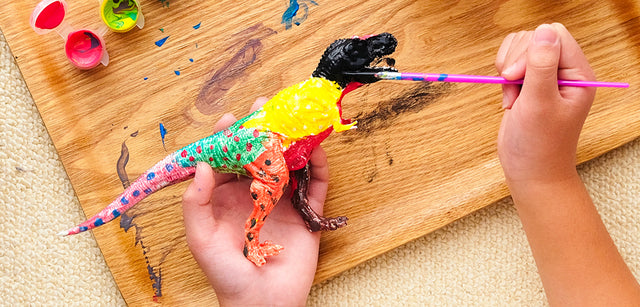
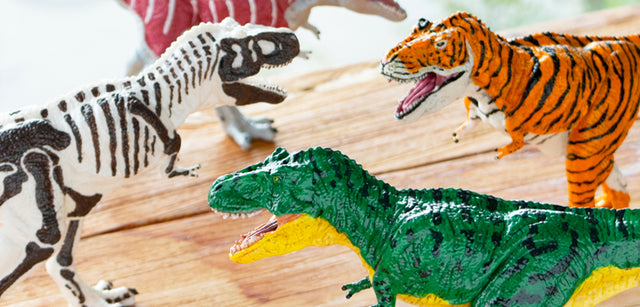
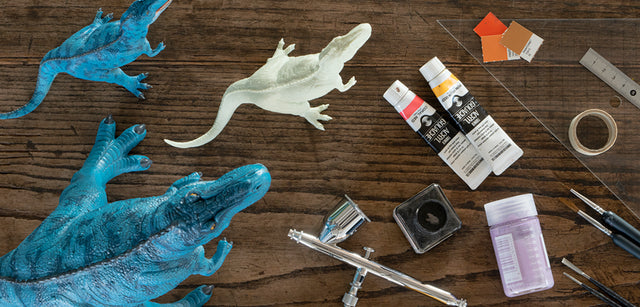
●"Shogaku 8-nensei October/November Issue" and "Shogaku 1-nensei October Issue" (6-6/7, Shogakukan). Both came with dinosaur skeleton plastic model kits. These models were surprisingly well-made, which stirred my excitement, and I ended up painting them. (Image 2)
These two books, in fact, featured plastic models alongside their dinosaur articles, even covering the manufacturing process of plastic models at a Bandai factory. The "How Plastic Models Are Made" articles, which are quite common these days, taught me a lot too. It's completely different from the old days when craftsmen meticulously carved out prototypes.
*What surprised me about making the latest plastic models was that you could cleanly snap the parts off the runner (frame) by hand. Until now, I had always thought that plastic model parts had to be cut with nippers or a cutter and then filed into shape.
As you can see, the two dinosaur plastic models have excellent proportions. The T-rex even has gastralia and a furcula, and the Triceratops' forelegs correctly point its toes outward. This shows the seriousness of Bandai and Shogakukan. The only regret is that the space between the ribs is not hollowed out in either. Was there some reason for this? I painted the gaps black (called "sumi-ire") to disguise it, but the ribs still feel too thick. Ideally, I would cut them out and thin them down.
These two books also have extensive dinosaur articles. In particular, the 8th grader's issue is packed with content, including dinosaur quizzes, the evolution of restoration drawings, recipes for dinosaur fossil sweets, a Doraemon dinosaur manga, and a manga depicting "Marsh and Cope's Great Fossil Excavation Battle." All this for just 1100 yen (tax included) is an incredible deal.
Now, about the remaining two copies of "The Lost World." I have other books I want to introduce besides the new releases, so I'll start a new section.
Back to the Lost World
*This section is a continuation of "New Dinosaur Treasure House Vol. 30: The Lost World." Since this alone may not be sufficient, I would appreciate it if you could read Vol. 30 first.
For four years after the special feature on Arthur Conan Doyle's "The Lost World" in the New Treasure House Vol. 30 in June 2016, no new translations of "The Lost World" were published. However, this summer, two new translations suddenly appeared for some reason.
●"The Lost World - A World of Dinosaurs"
(Edited and translated by Taku Ashibe, Gakken Plus)
A juvenile book from the series "World Masterpieces to Read by Age 10." Although the story leading up to their arrival at Maple White Land is largely abridged, all subsequent episodes are included (even my favorite conversation about "Allosaurus or Megalosaurus"). The dinosaurs that appear, while their appearance is modernized, remain faithful to the original in terms of species, from Iguanodon to Toxodon. The book also includes a bird's-eye view of the plateau and explanations of the featured dinosaurs at the beginning, even touching upon the gap between the dinosaur images of that time and modern ones. A very carefully crafted and excellent book.
●"The Lost World"
(Translated by Naoya Nakahara, Sogensha SF Bunko)
This is a new translation, using illustrations from the original Strand Magazine. It's only natural to want to compare it with the 2016 Kobunsha Classical New Translation Library edition, which has a similar approach.
While it's natural for translations to differ in phrasing, the Kobunsha edition seems to use more circuitous language, perhaps to preserve the classic feel of the original. For example, in the passage where Professor Challenger explains Megalosaurus, the Sogensha edition says, "A ferocious species, the most feared in the ancient Earth—and the most popular in modern museums." On the other hand, the Kobunsha edition says, "The most terrible wild animal that brought disaster to the Earth and bestowed blessings upon museums." Furthermore, it goes so far as to write "異龍" (i-ryu) and "斑竜" (han-ryu) and provide furigana for Allosaurus and Megalosaurus, respectively.
Many of the illustrations are the same, but the Sogensha edition has more. The Kobunsha edition states the origin of each illustration, indicating that some are from sources other than the Strand Magazine. The origin of the illustrations in the Sogensha edition is unknown.
Illustrations of pterosaurs in the swamp and the famous scene of Stegosaurus by the lake are only in the Sogensha edition. Conversely, the theropod attacking the Indian village is only in the Kobunsha edition. The pterosaur flying inside the hall at the end uses different illustrations in the Sogensha and Kobunsha editions (the Kobunsha edition specifies "Sunday Magazine").
Conclusion: You should get both books.
Now, let me introduce two rare "Lost World" books I've acquired in the past four years.

●"SF Dinosaur Great Adventure" (6th grade science/science material, Gakushu Kenkyusha, 1981)
This is a 33-page manga that came as a supplement to the December issue of "6th Grade Science." Since it's educational material, about 5 pages are dedicated to a learning manga explaining dinosaurs and fossils, leaving only 28 pages for the main story. What's more, the beginning and end feature a conversation between Conan Doyle and Sherlock Holmes. The bizarre premise is that Doyle reads "The Lost World" to Holmes, who has come to visit. It's a super-fast digest of effectively 26 pages, but it admirably depicts all the important scenes. By the way, Doyle also plays the role of the teacher in the educational manga, and Holmes is the student. (Image 3)
●"Tales of the Prehistoric World" (Edited by Kiichiro Otsuchi, Kinransha, 1929)
And this is my biggest purchase of the summer. I finally bought it. Four years ago, when I arranged the translated editions of "The Lost World" chronologically, this was the third one from the top, following "Strange Footprints" and "The Fallen World," making it the third translated edition in Japan. It's the very book I lamented not being able to afford at 70,000 yen on a used bookstore website. The price had somehow dropped significantly to 40,000 yen, but that's still not an amount one can casually spend. I had it in my favorites for about two years, and how many times did I look at it and almost click "buy," but held back... I decided to go for it now, thinking it was the only chance since I had some leftover dinosaur funds this summer (or so I convinced myself).
![]()

![]()

Once it arrived home, as expected for something with such a high price tag, its condition was exceptionally good. There was hardly any sign of it ever being read, making it hard to believe it's a book from 90 years ago. Both the slipcase and cover (Image 4), as well as the illustrations (Image 5), are vibrant, which made me very happy. The illustrations are the work of Motosaburo Kosaka, who also designed the book. I thought they were wonderfully pop, and while researching, I stumbled upon this page: Hirobo's page for Conan Doyle enthusiasts. It was incredibly informative, providing everything from information on the first Japanese translation of "The Lost World" and more.
http://blog.livedoor.jp/bsi2211/archives/51360020.html
*The cover image here is from the revised edition published in 1931, and the illustrations on the slipcase and cover have changed.
*I couldn't find any information about Motosaburo Kosaka.
You can read this book in the National Diet Library Digital Collection. https://dl.ndl.go.jp/info:ndljp/pid/1719754
As Hirobo's explanation states, the story is abridged (for example, the scene with the Megalosaurus simply says "(The two) began to argue," sadly omitting my favorite conversation about species names) but largely follows the original. However, for some reason, Challenger is called "Doctor" (whereas Summerlee is a professor, the opposite of the usual), and his boisterous character is toned down. Please look at the bottom part of the illustration. His appearance, described in the story as identical to the ape-man king, is that of a fashionable gentleman (Malone also looks like Ringo Starr). What could be the reason for this? In the scene just before the illustration, Challenger actually welcomes Malone into the room, saying, "Please come in. We still have more to discuss." He's not the type of person who would use polite language.
Incidentally, in the Kobunsha edition, it's "Please come here," and in the Sogensha edition, it's "Come here! I'm not finished talking yet."
Speaking of old books, let me also introduce some dinosaur sightings from magazines published from the Taisho to Showa periods that I've recently acquired.

"Rigakukai" (The Scientific World) in (Image 6) is a magazine I've encountered for the first time.
The upper part is from the November 1922 (Taisho 11) issue. The cover and leading pages feature an illustration of an Ichthyosaurus and a fossil photo. There's also a 2-page article about Ichthyosaurs and Plesiosaurs titled "Giants of the Prehistoric World."
The bottom left is the May 1924 issue. The illustration adorning the opening page is titled "Giant Animals Excavated in Mongolia," but aren't they from America, except for the egg fossil in the bottom right?! However, the main text includes a 2-page article titled "Where Exactly is the Cradle of Humanity?", introducing the results of the Roy Chapman Andrews expedition to the Gobi Desert, which took place the previous year.
*The March issue of "Scientific Knowledge" in the same year also featured the Andrews expedition. (New Treasure House Vol. 6)
The bottom right is just the cover of the February 1937 (Showa 12) issue, titled "Prehistoric Mysteries - Triceratops," but the miscellaneous news section at the end of the magazine contains an explanation of the cover. And next to it, there was a news article about the discovery of a new species of Australopithecus.

(Image 7) On the left is the cover of the February 1925 issue of "Kagaku Gahō" (Science Graphic), which appeared on the cover of Shin Hihōkan Vol. 7 with Nessie (a cool futuristic bullet train!) and the opening illustration depicting a "monstrous animal that once ruled the world." The accompanying explanation reads: "[A large reptile named Carnegie Diplodocus. 1丈3尺 high. More than 5丈 long.]"
On the right, much later, is the March 1953 issue of "Kagaku Yomiuri" (Science Yomiuri). The dinosaur on this cover is none other than my childhood friend, the Tyrannosaurus that resided in the dinosaur hall of the National Museum of Nature and Science when I was young, and which has appeared twice in Shin Hihōkan (Vol. 10 and Vol. 17). Such a large-format color photograph is, I believe, very rare. I was stunned when I read the "Explanation of the Cover" section. It stated that it was installed at the National Museum of Nature and Science in January of that year, and January 1953 is the month I was born. This means we are almost twins. Thinking this, and looking at the two-shot photo in Vol. 10 again, I can't help but feel a little spiritual, wondering if my life was decided even before I was born.
Next up is the report on the "Discovery of the Proganochelys Eraser." It's a rather mundane story, but still.
Previously, in Shin Hihōkan Vol. 12, when I featured turtles, I lamented that I only had ancient turtle figures of Archelon, Meiolania, and Sinemys-Gamera, and expressed my desire for Proganochelys, Anomalocaris, and Odontochelys (I later acquired a handmade Odontochelys on Yahoo Auctions). I never imagined that a Proganochelys would be sleeping in a corner of my room, and for 40 years at that!
Recently, I found a mixed lot of dinosaur erasers on Yahoo Auctions, and I liked the昭和-era dagashiya (old-fashioned candy store) bag design, so I somehow won the bid for about 1000 yen. I thought the contents looked familiar, and indeed, they were erasers I had bought very early in my dinosaur collecting, probably in the 70s. They had such mediocre sculpts (for example, you couldn't tell an Allo from a T-Rex or an Iguanodon) that they were never displayed and remained in a box in large quantities. It was good to finally learn their origin, but on the back of the bag, I found an unfamiliar name, "Triasochelys," among the standard dinosaurs listed. Since it had "chelys" in its name, I guessed it must be a turtle. And indeed, there was something turtle-like among the erasers. After searching online, I found a few hits, but the descriptions were limited to "an ancestor of turtles from the Triassic period found in Europe," and the illustrations were identical to Proganochelys. Proganochelys is also called Sanjōkigame (Triassic Turtle, for some reason written in katakana), and I also found a description stating that no Triassic turtles other than Proganochelys were known until the 21st century. Furthermore, a decisive check of "The Path of Turtles" by Professor Ren Hirayama did not mention Triasochelys, so the theory that Proganochelys = Triasochelys (which indeed means "Triassic turtle" literally) is happily confirmed. However, was it ever officially called Triaschelys? And why is Sanjōkigame written in katakana? ...There seems to be an anecdote behind this.
At any rate, it's a cause for celebration that rare Proganochelys figures (and several of them!) have been discovered from the 70s stratum of my room! I tried painting them to celebrate, but they are, after all, erasers about 4cm long, so they ended up looking like this. (Image 8)

A somewhat happy story at the end of summer
In the "Soul Supplement" section of the Asahi Shimbun evening edition on August 31st, Mr. Masao Higashi (whom I don't know personally), who edits supernatural and fantasy magazines and compiles anthologies, https://ja.wikipedia.org/wiki/%E6%9D%B1%E9%9B%85%E5%A4%AB
showcased his collection of dinosaur goods, which he has amassed over many years. Some of it can still be viewed in digital form. https://www.asahi.com/articles/DA3S14604772.html
He mentioned that the T-Rex in the center of the photo was bought for him at an amusement park in Yokohama when he was a child. Mr. Higashi is five years my junior, making us roughly the same dinosaur generation. If so, this is undoubtedly a souvenir from Yokohama Dreamland. (Shin Hihōkan Vol. 10 Photo 9)
It's a copy of a US Marx toy, but a rare Japanese-made copy. Only a few members of the Dinosaur Club own one. (I, unfortunately, lost mine.)
I never expected to see it here.
Unexpectedly, knowing that there's another collector who shares memories of the Dreamland dinosaurs allowed me to end the summer with a rather happy feeling.
Mr. Higashi has also worked on dinosaur-related books. Of course, I own them.
![]()

●Gensō Bungaku (Fantasy Literature) No. 8, Special Feature: "Lost World Literary Museum" (Gensō Bungakukai Publishing Bureau, 1984)
This is an informative book, ranging from historical analyses of dinosaur literature to introductions of dinosaur novels.
●Book Guide Magazine No. 2, Special Feature: "A Full Course on Dinosaur Books for Adults" (Gensō Bungakukai Publishing Bureau, 1990)
This includes a guide to dinosaur novels and art books, as well as an introduction to the latest scientific books for learning about the dinosaur renaissance, written by Ryuichi Kaneko.
●"Dinosaur Literature Compendium" (Edited by Masao Higashi, Kawade Bunko, 1998) This collection contains 16 pieces of Japanese dinosaur literature, from novels to essays. It includes the rare "Monster of the Lake" from 1907 and "The Iguanodon's Song" (Shin Hihōkan Vol. 30), in which children are read Doyle's Lost World. It's a must-have. (Image 9)
My connection with Mr. Higashi doesn't stop there; his "Cthulhu Mythos Encyclopedia" and "Cthulhu Kaikiroku" (Records of Cthulhu's Strangeness) are also on my bookshelf. If Kaneko-san were still alive, he could have introduced us...
← Older Post Newer Post →
