
New Dinosaur Treasure Museum

Vol.88 3D Printed Skeletal Replica Encyclopedia

Last year, at the end of the year, the semi-annual Mineral Show in Ikebukuro came around again, and once again, I splurged. However, unlike in the past, it's rare to find real fossil bargains at affordable prices these days. Instead, over the past few years, I've found myself drawn to inexpensive, scaled-down replicas produced with 3D printers, which have been increasing in number.

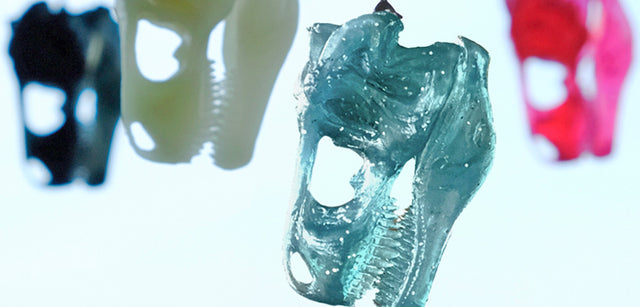
Before I knew it, my shelves at home were overflowing with 3D-printed dinosaur skeletons. This time, I've put together a summary of them.

The first 3D printer replica I acquired was a 1/6 scale Stan skull from Black Hills. I believe it was at the Shinjuku Mineral Fair in 2007, and Black Hills had a booth there at the time. I initially bought the educational version with separate skull parts (Treasure House Vol.43), but I couldn't resist the realism and ended up buying the finished product as well.

Image 1

The 3D-printed Stan next to a 1/10 scale Stan previously sold by Black Hills. The difference is clear. Until then, scaled-down skeletons were made by hand, which gave them character but lacked accuracy. Having a 1/6 Stan that was an exact replica of the life-size version in front of me was shocking. I was thrilled, thinking what an amazing era we had entered. However, for some reason, for over 10 years after that, 3D-printed replicas did not seem to be widely available on the market, as far as I knew.

I recall in 2017, when the "British Museum of Natural History Exhibition" was held at the National Museum of Nature and Science, I was excited to hear that 3D-printed replicas of Mantell's Iguanodon teeth from the British Museum of Natural History would be sold, but I unfortunately missed out on buying one. The full story is in New Treasure House Vol.35.

*A full-size 3D-printed "Cape Lion Skull" also from the British Museum of Natural History was left unsold, but I hesitated to buy it because, although an extinct species, it was a modern animal. Looking back now, I should have bought it... I would have bought a cave lion without hesitation.

Image 2

The 1/8 scale skull of Tyrannosaurus "Tufts-Love Rex" by the American manufacturer "Triebold Paleontology," which I purchased at the 2020 Mineral Show, was my first 3D-printed replica in a long time. (New Treasure House Vol.58)

This was part of the "Deep Time Micro-Museum" series, and I was able to collect Nicole the Torosaurus (New Treasure House Vol.62) and Brontosaurus at subsequent Mineral Shows.

In 2021, Amphi LLC, which had previously handled museum exhibition models, began selling scaled-down skeletal models made with 3D printers online. While focusing on modern animals, their lineup also includes prehistoric creatures, and many of these products seem to utilize commercially available 3D data found online. They use high-precision printers, resulting in well-made products at reasonable prices, so I couldn't help but buy some. I've introduced a few in the Treasure House (New Treasure House Vol.61 / Vol.76 / Vol.78), but I've gathered them all here again.

Image 3

Allosaurus from the Osaka Museum of Natural History (New Treasure House Vol.78) / Mosasaurus (repainted) / Ichthyosaurus (original data) / Erlikosaurus / Teratophoneus / Gastornis... I have several others and still want more, such as a coelacanth skeleton.

In 2021, at the "Jimbocho Wunderkammer," an exhibition and sale of natural history goods held at Okuno Karuta Shop in Kanda, "bone gacha" appeared. These were not ancient creatures but skulls of modern animals made from 3D data of museum specimens. They were well-made and came in gacha capsules for 500 yen each. Even now, they are a popular corner at events like the "Natural History Festival." (New Treasure House Vol.62)

In 2022, at Wonder Festival, which I attended for the first time in a while, there were countless garage kits made with 3D printers. Around this time, affordable 3D printers for general modelers seemed to be gaining popularity. There were several dinosaur-related items, but the only replicas based on actual data that I can recall were the magnificent skulls of Dunkleosteus and Smilodon sold by a female student from a beauty vocational school, as introduced in New Treasure House Vol.67.

And that year, the woolly rhino skull sold at the "Fossil Hunters Exhibition" at the National Museum of Nature and Science, which was small but cost 10,000 yen, was also 3D-printed. (New Treasure House Vol.68)

It's still fresh in my memory that in 2024, I obtained a 1/3 scale replica of a Futabasaurus skull through a crowdfunding campaign by the National Museum of Nature and Science. (New Treasure House Vol.77 / 78)

Image 4

These photos are re-posted. Please refer to past issues of the New Treasure House for details.

Street Museum Bone Gacha (the colored hippo on the far right was acquired at last year's Hakufesu) / Wonder Festival Beauty School Replica / Fossil Hunters Exhibition Woolly Rhino / Futabasaurus

The Chinese manufacturer "Kikuseki," available on Amazon and other platforms, has been making high-quality skeletal models for a long time, but around last year, they also started selling 3D-printed skeletons. Although the precision is lower, the price is less than half that of conventional models, ranging from 5,000 to 10,000 yen, so I can't help but buy interesting items when I find them.

Image 5

Ancient whale Ambulocetus / Mosasaurus / Nigersaurus / Hadrosaurus / Dimetrodon

Image 6

Recently, I've seen products from Ral_Shop on Yahoo Auctions. Like Amphi, they use commercially available data, so some types overlap. The printer's precision isn't great, and the layering is noticeable, but at a bargain price of 2700 yen, it's unavoidable. I also have to paint them, but I see it as an enjoyable process... As a result, I'm satisfied with how they turned out. What's more, it's great to find rare dinosaurs.

Sarmientosaurus is one of the few titanosaurs whose skull has been found, and it served as the basis for the head of the Patagotitan in the "Giant Dinosaur Exhibition." (New Treasure House Vol.80)

Herrerasaurus and Eoraptor are in a rare fossilization state.

As for Panoplosaurus, I hardly remember it. I even looked it up on Wiki.

Perhaps due to the printer's limitations, the fine irregularities on the skull's surface weren't reproduced, leaving it smooth, so I had intended to modify it, but I gave up.

Image 7
Wankel Rex

This T-Rex, residing at the Smithsonian, reportedly has free data, and multiple manufacturers are commercializing it. I acquired three, so let me introduce them.

The one on the left is a Smithsonian-authorized replica from the Master Replicas brand, complete with a certificate card. It cost around 13,000 yen on Amazon. The one in the center is a product from Amphi LLC, costing around 5,000 yen. And the large one is from Ral_Shop on Yahoo Auctions; despite being over 20cm tall, it was a bargain at 3,000 yen. Well, it has its flaws, but from a distance, it's fine. However, lining up three of them, they are naturally all identical in every detail, which isn't very interesting. The conclusion is that one good replica of the same individual is enough. If I had a powerful 3D printer, would I be able to create my own Wankel Rex on par with the Black Hills Stan?

Now, for the last of the 3D items, these are the replicas that caused me to splurge at the mineral show I mentioned at the beginning. For the past few years, there has been a booth called Eldonia from France, and the owner, François, is a friendly person who even serves wine. I always look forward to this booth because they have quite unusual items every year. The Dinictis biting a human head, which I introduced in New Treasure House Vol.52, was purchased here.

The convenient small-sized replicas appeared in the summer of 2024 (New Treasure House Vol.78) and have been multiplying ever since. At a price range of around 5,000 to just over 10,000 yen, which is not too difficult to decide on, and with good quality and paintwork, plus an attractive variety, I can no longer resist.

Image 8

From top left:

Basilosaurus-like Dorudon / Mosasaurus-like Prognathodon / Moroccan Azhdarchid Arambourgiania / Microraptor / Triassic amphibian Metoposaurus (New Treasure House Vol.82) / Ankylosaurid

Middle row: Late Cretaceous terrestrial crocodile, Kaprosuchus

Bottom row (these are the spoils from the mineral show at the end of last year): Elasmosaurid / juvenile Triceratops / Spinosaurid?

And the biggest catch and the source of the problem this time is the magnificent complete skeleton on the right. It's a new species of dromaeosaurid that was described just last year and named Shri (Shri rapax).

In fact, François was one of the co-authors of this descriptive paper.

This replica is about 25cm tall, and I believe it's about 1/3 the size of the life-size replica (600,000 yen!) that was on display. It's very well made and costs around 20,000 yen, but it was highly praised by the dinosaur club members gathered there, who said it was sharper and better than the life-size one, and everyone bought it eagerly. However, the story took an unexpected turn...

For that part of the story, please read the Mineral Show Report by Mr. U, a carnivorous enthusiast and fellow club member.

So, this skull was a modified version of Velociraptor data. If they were going to do that, I wish they'd made it more similar. By the way, the life-size version has a detachable head (amusingly, it was installed upside down for general visitors), which is fairly honest considering the descriptive paper didn't include the skull.

The photo pasted in the upper right is of the missing original skull, which was included in the descriptive paper (signed by François) given as a bonus. I plan to use this photo to create my own skull and replace it someday.

3D printers are very convenient and ideal for making miniature replicas, but is it really good for all miniature skeletons in the world to be 3D printed? Miniature models from 3D data, precisely because of their accuracy, can sometimes feel unnatural depending on the scale. I've heard somewhere that master model makers of plastic models, taking into account how humans view real objects, intentionally deviate from blueprints.

We must not let the cool skeletal models painstakingly crafted by skilled sculptors go extinct!

With that wish, I will unveil three exquisitely handcrafted skeletons.

Wooden skull by Taburin.

The life-size Heterodontosaurus was something I requested. I am truly grateful to Taburin for readily making a dinosaur with such a troublesome dentition. The dental arrangement is as magnificent as I expected.

I got Irritator on Mercari. It looks strange, but the upper front part of the Irritator's skull has not been found, so it is sometimes restored linearly like this. It's unique and truly interesting. Taburin must have thought so too.

The Ichthyosaurus bust, also obtained on Mercari, is also original. It only has one fin, but the fact that each finger bone is individually crafted is astonishing! The teeth are also detailed, and the surface texture is superb. The product description explicitly stated that it was "not made with a 3D printer." I don't know the artist, but they must be a die-hard modeler who laments the golden age of 3D printers. Keep up the good work!

I've introduced man-made bones so far, but that doesn't mean I didn't buy real ones from the end of last year to the New Year. Finally, please take a look at this.

Image 10

The only real fossil I bought at the mineral show is a positive/negative fossil of Barasaurus (Barasaurus besairiei), a Permian reptile from Madagascar. Barasaurus is a minor reptile not even listed on Wikipedia, belonging to the Procolophonidae. Procolophonidae are anapsids, one of the reptile classifications (anapsids, synapsids, diapsids) illustrated at the beginning of Showa-era dinosaur encyclopedias.

Currently, synapsids are no longer classified as reptiles, and anapsids are called parareptiles and distinguished from diapsids, which are true reptiles. Anapsids are mostly extinct since the Paleozoic era. (Although turtles were once considered the only surviving anapsids, this has been refuted.)

This fossil is missing its tail but is about 20cm long in total. This is my first time welcoming an anapsid into my home. With this, I have inadvertently collected diapsids (New Treasure House Vol.63), amphibians (New Treasure House Vol.66), and anapsids from Madagascar dating from the Permian to Triassic periods, all of which are positive/negative fossils. This makes me happy somehow.

And then there's a modern theropod, specifically a raptor (in Latin, it means "thief," but in English, "raptor" refers to a bird of prey).

It's the Eurasian Sparrowhawk, the smallest bird of prey in Japan. I found it at the natural history shop "Study Room" inside Ueno Station, and I fell in love with its coolness at first sight, impulsively buying it for 40,000 yen without hesitation. Unlike a typical skeletal specimen, it has wings and tail feathers, making it look like the Berlin specimen of Archaeopteryx. Although small, under 25cm in length, it is a bird of prey, powerful, and somehow has the scent of a non-avian theropod.

It's wonderful.
I could gaze at it forever.


Older Post Newer Post