



Paleontology Ramblings

Are mammoths mammoth-sized?

— 絶滅ゾウとマンモスから大きさを考える —
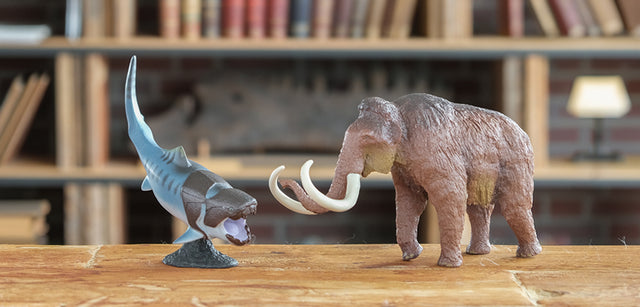
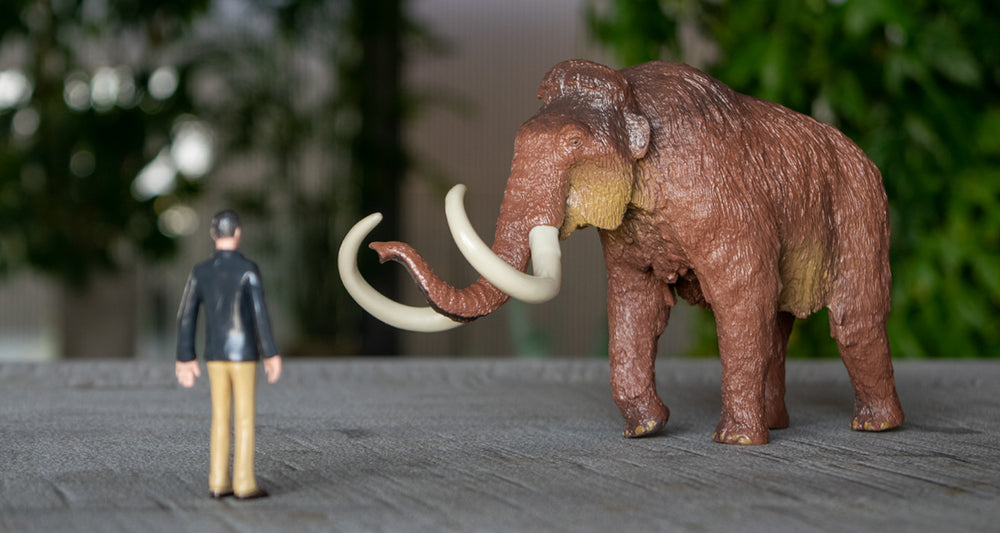
Woolly Mammoth Soft Model

Mammoths aren't always big

Among prehistoric creatures other than dinosaurs, mammoths are probably one of the most well-known. After all, there's even the phrase "mammoth-sized" to describe something huge. However, the Woolly Mammoth (Mammuthus primigenius), the species of mammoth with long hair and large tusks that has become the general image of a mammoth, wasn't particularly large. In terms of body size, it was not much different from the African and Asian elephants alive today.


So, does that mean the expression "mammoth-sized" is wrong? Not exactly. Some species of the same genus Mammuthus, such as the Steppe Mammoth (Mammuthus trogontherii) and the Columbian Mammoth (Mammuthus columbi), were particularly large, not only among elephants in general but also among all terrestrial mammals. Other terrestrial mammals that might have been larger than these mammoths include elephants such as the Straight-tusked Elephant (Palaeoloxodon recki), and the rhinoceros relative Paraceratherium. While it seems that Columbian Mammoths and Steppe Mammoths cannot be definitively called the largest terrestrial mammals in history, there's no doubt that they were close in size.

Shokako (Songhua River) Mammoth (one of the world's largest Steppe Mammoths, Ibaraki Nature Museum)
Songhua River Mammoth
(One of the world's largest Steppe Mammoths, Ibaraki Nature Museum)
Columbian Mammoth full skeleton (Page Museum, USA)
Columbian Mammoth Full Skeleton
(Page Museum, USA)

Nevertheless, the Woolly Mammoth is still fascinating.

While the Woolly Mammoth may not stand out in terms of body size, the presence of its long, dramatically curved tusks is impressive compared to other elephant species. What makes the Woolly Mammoth particularly unique, not just among fossil elephants but among all prehistoric creatures, is the discovery of frozen remains in the Siberian permafrost. These "ice mummies" provide detailed information about their flesh, fur, color, and other fine details as they were when alive—information that can usually only be imagined for other prehistoric creatures.

Woolly Mammoth Soft Model Woolly Mammoth Soft Model

When I created the mammoth as a prototype for Favorite, Inc., I had to re-learn a lot as a prehistoric creature model artist due to the abundance of data, which differed from typical paleontological restorations, and the unique way of interpreting that data. It was also an enjoyable experience that showed me the breadth of restoration work. However, there are still many unknown aspects, and that, too, is part of the mammoth's charm and intrigue.

Mammoths in Japan and Other Elephants

When it comes to fossil elephants found in Japan, many people probably think of Naumann's Elephant (Palaeoloxodon naumanni), don't they?
Indeed, fossils have been discovered in various locations across Japan, including Lake Nojiri, and partial fossils and full skeletons are exhibited in many museums, so it might be fair to call it Japan's representative fossil elephant. Some members of the genus Mammuthus also inhabited Japan. In addition to the Woolly Mammoth, fossils of a species called Proto-mammoth (Mammuthus protomammonteus) have been discovered, which is believed to be an ancestor of the Woolly Mammoth, as its name suggests.

Naumann's Elephant (Gifu Prefectural Museum)


Furthermore, various elephant relatives inhabited Japan. From the genus Stegodon, there were the Mie Elephant (Stegodon miensis) and the Akebono Elephant (Stegodon aurorae), known for becoming smaller due to island dwarfism after migrating to Japan. In addition, fossils of Stegolophodon and Gomphotherium, which had four tusks (two on the upper jaw and two on the lower), have also been found. Many elephant relatives migrated to Japan from the continent, and some species adapted to the new environment.

Akebono Elephant (Saitama Prefectural Museum of Natural History)


Before, I didn't know much about the differences between Naumann's Elephant and mammoths, nor that a diverse range of elephant relatives lived in Japan. When I saw elephant fossils and skeletons in museums, my impression was simply, "Oh, an elephant." Later, as I started attending paleontological conferences and had more opportunities to hear about fossil elephants from researchers, I began to understand their fascination. Now, I enjoy seeing the various fossil elephant exhibits in museums. When it comes to large fossil vertebrates discovered in Japan, with many reconstructed skeletons on display, elephants are indeed representative. For this reason, each museum's exhibit should have some unique characteristics. If there's a facility near you that exhibits fossil elephants, I encourage you to take another look.

References
  • "Kaseki wa Kataru" (Fossils Speak) by Keiichi Takahashi, Yasaka Shobo, 2008
  • "Nihon no Koseibutsu" (Prehistoric Creatures of Japan) by Ken Tsuchiya, Kasakura Publishing, 2019
  • "Shinpan Zetsumetsu Honyūrui Zukan" (New Edition Illustrated Guide to Extinct Mammals) by Yukimitsu Tomida, Maruzen Inc., 2011
  • Special Exhibition "Mammoth YUKA" Catalogue, Yomiuri Shimbun, 2013
  • "Taiko no Honyūrui Ten" (Exhibition of Ancient Mammals) Catalogue, Yomiuri Shimbun, 2014

Also, I would like to thank Mr. Katsunori Watanabe (Tottori Prefectural Museum) for his cooperation in writing this essay.


Newer Post

RELATED PRODUCTS

関連商品