


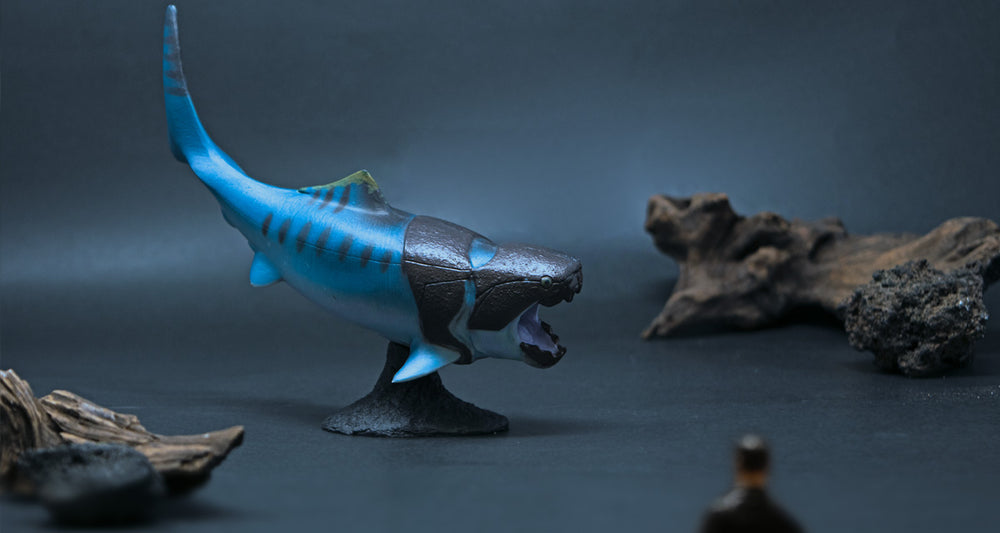
The largest predatory fish of the Paleozoic Era, with powerful jaws.
A Popular Ancient Creature, Then and Now
When I talk to children who attend the dinosaur workshops I instruct, the Dunkleosteus is often mentioned as a favorite ancient creature other than dinosaurs. I'm always surprised that children can smoothly say the somewhat difficult word "Dunkleosteus," which shows me its popularity. Its distinctive head and its existence as the largest and most powerful predatory fish of the Paleozoic era must leave a strong impression on children. Indeed, that head, especially the powerful jaw, leaves a great impression not only on children but also on adults. When I was a child, I often saw it in books as Dinichthys, and I think it was already one of the well-known ancient creatures back then. It was much later that I learned that the species Dinichthys terrelli had been reclassified into the genus Dunkleosteus. Since I was so familiar with Dinichthys, it was quite a struggle to re-learn the name.
Cleveland: The Holy Land of Dunkleosteus
When you think of Dunkleosteus, you think of Cleveland, but I only learned this when I attended the Society of Vertebrate Paleontology meeting in Cleveland, USA, in 2008. The description of the Dunkleosteus exhibit at the Cleveland Museum of Natural History stated, "The original Dunkleosteus specimens displayed around the world are housed in this museum." Come to think of it, the cover illustration of that year's SVP abstract book was a Dunkleosteus. Moreover, the name Dunkleosteus itself is dedicated to David Dunkle, a researcher at the Cleveland Museum of Natural History, and it has also been chosen as the "state fossil" of Ohio, where Cleveland is located. It is truly a specimen and an ancient creature that Cleveland can be proud of to the world. The exhibit at the National Museum of Nature and Science in Tokyo is also a replica of the Cleveland Museum of Natural History specimen.
The Full Body Remains a Mystery
While fossils of its armored head and chest remain, there is almost no information about the body behind that, as it has not been preserved in the fossil record, except for parts like the pectoral fins. Therefore, when attempting to reconstruct Dunkleosteus, Coccosteus, another placoderm with a similar appearance, is often referenced.
Coccosteus at the Tohoku University Museum of Natural History
Coccosteus is small, about 20-40 cm long, but complete fossils have been found. One reconstruction method assumes that the closely related Dunkleosteus had a similar appearance. On the other hand, there are also reconstructions of Dunkleosteus that resemble medium to large sharks, which are similar in size. A major difference between Coccosteus-type and shark-type reconstructions is the shape of the caudal fin. If it were like Coccosteus, it would have a horizontally elongated caudal fin, but if sharks are used as a reference, it would be depicted as crescent-shaped with fins extending both upwards and downwards.
Reconstruction model at the North American Museum of Ancient Life
Reconstruction model at the American Museum of Natural History
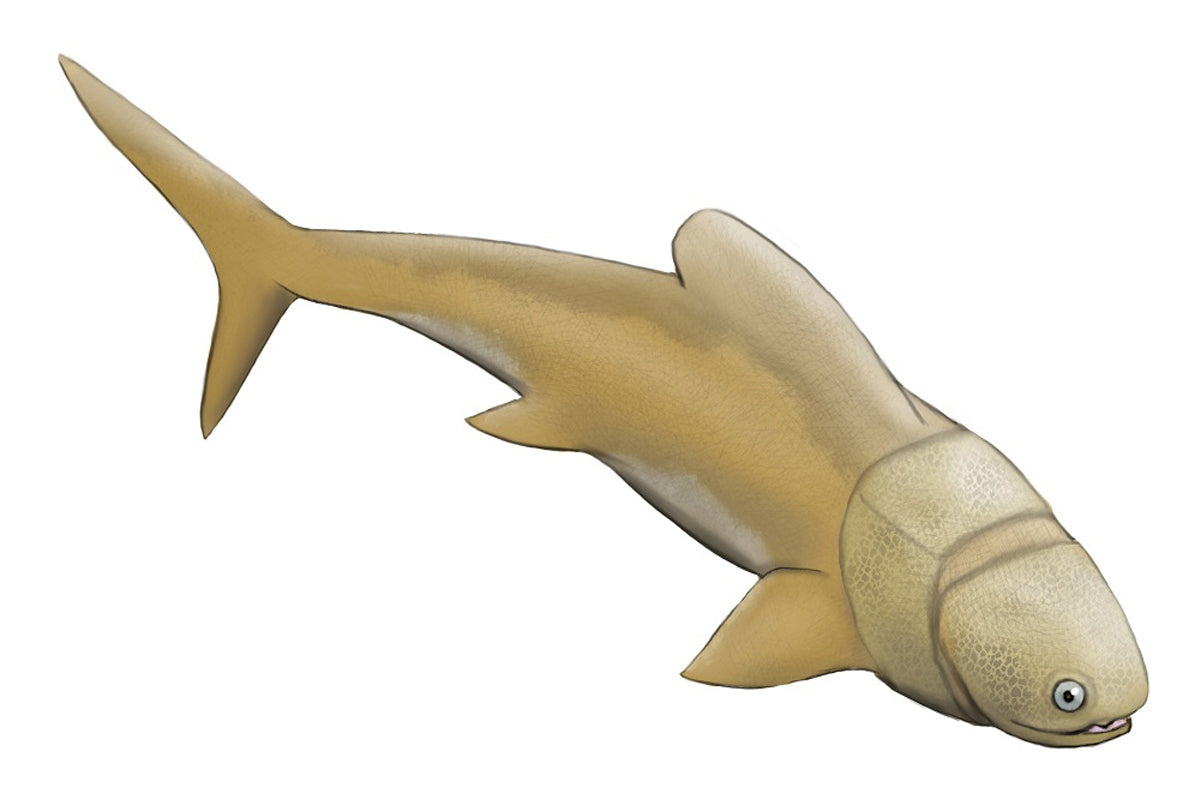
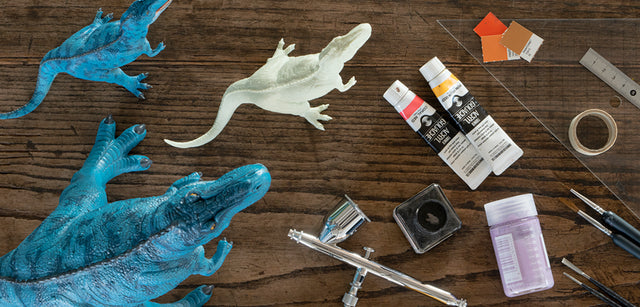
When creating the prototype for the Favorite Dunkleosteus, both options were considered, and the crescent-shaped caudal fin reconstruction was adopted. In addition to the caudal fin shape, various views and new research are being published regarding the reconstruction of Dunkleosteus and placoderms. Some international researchers and paleoartists became acquaintances by showing them the Favorite Dunkleosteus and exchanging opinions during the Society of Vertebrate Paleontology meetings. It seems many people are interested in the reconstruction of this ancient creature. A new species of placoderm, Amazichthys, discovered in 2022, is smaller than Dunkleosteus at 87 cm in length, but its full body has been preserved, and its caudal fin appears to have been crescent-shaped.
Amazichthys, Illustration by Hirokazu Tokugawa
If Amazichthys is used as a reference, the caudal fin of Dunkleosteus would also be assumed to be crescent-shaped, but that is still just one possibility. The best outcome would be to find a fossil of Dunkleosteus itself where its full body is clearly visible. It is an ancient creature whose future discoveries and research are highly anticipated.
References
- "Illustrated Dictionary of Vertebrate Fossils" by Tokio Shikama, Asakura Shoten, 1979
- "Fishes of the Paleozoic Era" by J.A. Moy-Thomas, R.S. Miles, Koseisha Koseikaku, 1981
- "The Rise of Fishes," Second Edition, by John A. Long, Johns Hopkins, 2011
- "Creatures of the Devonian Period" by Ken Tsuchiya, Gijutsu Hyoron Sha, 2014
← Older Post Newer Post →