

Paleontology Ramblings

Large Permian carnivorous animal with a sail on its back

— ディメトロドン —

Not a dinosaur!

Dimetrodon is a primitive synapsid, phylogenetically including mammals, and is not a dinosaur.
Among the prehistoric creatures often mistaken for dinosaurs, such as pterosaurs, ichthyosaurs, and mosasaurs, Dimetrodon is the animal furthest from dinosaurs in terms of both geological age and phylogeny. Recognizing the difference between dinosaurs and Dimetrodon might be one of the gateways to deeply appreciating the fascinating world of paleontology and evolution.

Gunma Museum of Natural History exhibit, photographed in 2015. Dimetrodon footprints (top left) are also on display.
Gunma Museum of Natural History exhibit, photographed in 2015
Dimetrodon footprints (top left) are also on display.

A familiar prehistoric representative in museums?

Dimetrodon is, alongside Tyrannosaurus and Smilodon, one of the most commonly exhibited carnivorous terrestrial prehistoric vertebrates in museums, making it a familiar prehistoric creature, wouldn't you agree?
It also holds an important position in museum exhibits due to its status as a primitive synapsid and a large Permian Period early carnivorous animal. Globally, I speculate that it might even be exhibited more frequently than Tyrannosaurus or Smilodon.

When visiting museums abroad, especially in the United States where Dimetrodon fossils are found, there's a high probability of encountering a Dimetrodon skeletal exhibit. Having already seen Dimetrodon many times in Japan, when I first started visiting overseas museums, I would think, "Dimetrodon again," and didn't pay much attention. However, as my knowledge grew, my perspective changed. First, there are many species within the genus Dimetrodon, differing in body size, sail shape, and skull shape. Also, skeletal exhibits vary in the preservation state of the original fossils, assembly techniques, and presentation. As I encountered them more frequently, Dimetrodon became a prehistoric creature whose various unique characteristics I could compare from exhibit to exhibit, and I began to look forward to seeing "what kind of Dimetrodon will be at the next museum?"

Exhibit at the Museum of Paleontology at the University of Tübingen, Germany, photographed in 2011Exhibit at the Museum of Paleontology at the University of Tübingen, Germany, photographed in 2011
Exhibit at the American Museum of Natural History, photographed in 2011Exhibit at the American Museum of Natural History, photographed in 2011


For many, the image of Dimetrodon with a black skeletal half-body against a white background is familiar, thanks to its frequent appearance in books and the replica at the Osaka Museum of Natural History.
The American Museum of Natural History's vertebrate exhibits are arranged by phylogenetic group, not by geological age. Dinosaurs are divided into Saurischian and Ornithischian halls, with separate halls for mammals, and other reptiles, amphibians, and fish. This Dimetrodon is displayed in the mammal hall, which truly reinforces the idea that it is "not a dinosaur."


Dimetrodon and Edaphosaurus

Edaphosaurus is often introduced alongside Dimetrodon. They lived in the same region and era, were similar in size, and even shared the design of a large sail on their backs. However, while Dimetrodon was carnivorous, Edaphosaurus was herbivorous, a very significant difference in terms of their animal nature. The smaller head and teeth of Edaphosaurus compared to Dimetrodon show a clear difference in their diets. Furthermore, comparing their skeletons reveals interesting subtle differences. Unfortunately, fewer museums display Edaphosaurus compared to Dimetrodon.

Edaphosaurus at the Field Museum, USA, photographed in 2012Edaphosaurus at the Field Museum, USA, photographed in 2012


Diplocaulus, possibly preyed upon by Dimetrodon

Diplocaulus, an amphibian famous for its boomerang-shaped head, has also been found in North America from the Early Permian Period, the same time as Dimetrodon.

Diplocaulus skeletal exhibit at the Sam Noble Museum of Natural History, USA, photographed in 2007Diplocaulus skeletal exhibit at the Sam Noble Museum of Natural History, USA, photographed in 2007


There is also a theory that Dimetrodon preyed on Diplocaulus. The fact that Dimetrodon and Diplocaulus, two distinctive prehistoric creatures with unique designs (aside from dinosaurs), coexisted in the same era and region makes the Early Permian period all the more fascinating. Geologically speaking, the Permian Period precedes the Triassic Period, when dinosaurs emerged. The Permian Period itself hosted a diverse array of captivating animals.
By paying attention to Permian exhibits in museums and elsewhere, you can undoubtedly enjoy the charm of prehistoric creatures that are different from dinosaurs.

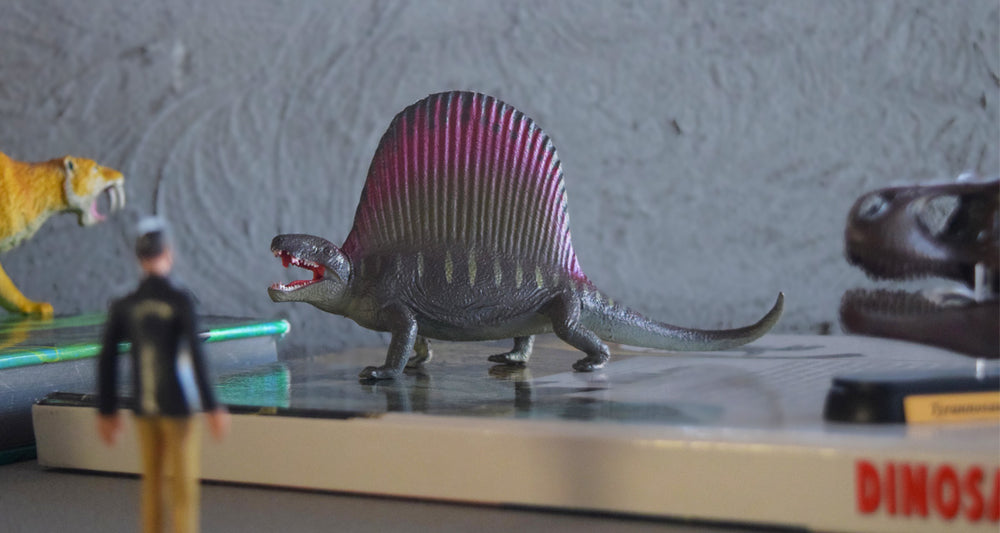
Dimetrodon soft model
References
  • "Pre-Dinosaur Era: The Lost Enchanting Permian World" by Ken Tsuchiya, Bookman Inc., 2022
  • "Ah, My Beloved Prehistoric Creatures" by Ken Tsuchiya, Kasakura Publishing, 2018

Older Post Newer Post

RELATED PRODUCTS

関連商品