


Paleontology Ramblings

The giant shark, still shrouded in mystery

— メガロドン —

Which shark is the Megalodon closest to?

I first learned about Megalodon with its scientific name, Carcharodon megalodon. This would mean Megalodon is a species of the genus Carcharodon, which includes the extant great white shark. This implies that Megalodon and the great white shark are very closely related, and the image of Megalodon derived from this is exactly that of a "giant great white shark."
However, the prevailing theory now suggests it is not part of the genus Carcharodon, with theories proposing it belongs to the genera Otodus or Carcharocles. According to these theories, Megalodon would be a species of shark whose entire genus is extinct, with no extant species in its genus.

Megalodon remains Megalodon, even if the genus changes

The common name "Megalodon" has become widely known as the quintessential extinct shark. Furthermore, "MEG," a name derived from Megalodon, has even become the title of novels and films. Among ancient creatures generally remembered by their genus name, Megalodon is one of the rare examples where the species name has become the familiar common name. And because of this, the common name Megalodon will not change unless the species name Megalodon is changed, even if the genus changes from Carcharodon. Since the species name was the common name, it was not affected by research advancements, and I think that was fortunate for paleontology enthusiasts. It would be very disappointing and sad if the common name Megalodon, which means "big tooth" and aptly describes a large shark, and is familiar to many people, were to disappear.

泳いでいる化石ゾウ類の1種・プラティペロドン(右)を襲うメガロドン(左)ヒューストン自然科学博物館にて2018年撮影 獲物を襲うメガロドン、というシーンに加え、泳いでいるポーズの化石ゾウ類の骨格の珍しさもあり、印象の残る展示です。
Megalodon (left) attacking a Platybelodon (right), a species of fossil elephantid, swimming
Houston Museum of Natural Science, photographed in 2018
This exhibit is impressive not only for the scene of Megalodon attacking its prey, but also for the rarity of a swimming posture in a fossil elephantid skeleton.

Various theories about its size

Like other ancient creatures, Megalodon holds many mysteries, and its size is a particularly noteworthy aspect. While it is certain that it was larger than the great white shark, there are various theories about its size, ranging from 10m to 20m. Even if we take the minimum estimate of about 10m, that's roughly twice the size of an extant great white shark. As for fossil fish, Leedsichthys, with a supposed length of about 16m, is a candidate for a fossil fish larger than Megalodon, but Leedsichthys is believed to have fed on plankton. As a predatory fish, Megalodon still seems to be the largest fish in history.

Megalodon in Japan

Megalodon tooth fossils have also been discovered in Japan. Megalodon teeth believed to be from a single individual have been found in Saitama Prefecture. It is rare to find multiple teeth confirmed to be from the same individual, which could allow for more specific estimations of jaw size and body length. There are many examples of ancient creature fossils discovered in Japan that are globally significant findings, and Megalodon is one of them.
At the Saitama Museum of Natural History, a reconstructed jaw model based on teeth found in Saitama and a life-size 12-meter full-body reconstruction model are on display, allowing visitors to experience the true scale of Megalodon.

メガロドンの復元されたアゴと全身復元模型 埼玉県立自然の博物館にて2014年撮影 メガロドンの復元されたアゴと全身復元模型 埼玉県立自然の博物館にて2014年撮影
Reconstructed jaw and full-body model of Megalodon
Saitama Museum of Natural History, photographed in 2014

The overall form also remains a mystery

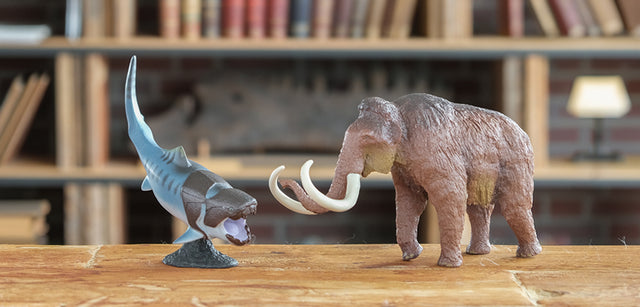
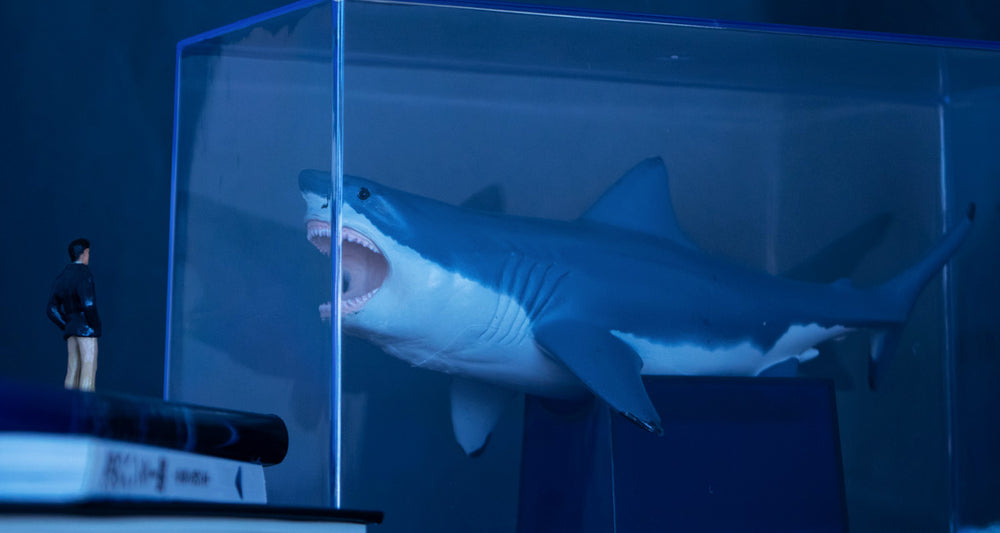
As cartilaginous fish, most shark fossils consist of teeth. It is rare for the torso, such as vertebrae, to remain, and very little information about Megalodon's torso seems to have survived. This means that not only its size but also its appearance is unknown. If we follow the Carcharodon genus theory, its appearance would be inferred based on the great white shark, but if we follow theories of other genera, different appearances become possible. When creating the prototype for Favorite Co., Ltd.'s soft model, while basing it on the great white shark, considerations for the hypothesized jaw shape were incorporated, resulting in a jaw that is more robust than that of a great white shark, giving it a somewhat "brazen" facial expression. While it's enjoyable to hypothesize about its appearance in various ways, we naturally hope for the discovery of fossils that could provide clues to its actual appearance.
Fossils of Cladoselache, a cartilaginous fish from the Devonian period, much older than Megalodon, have been found with intact full-body outlines and fin shapes. This makes me wonder if such fossils of Megalodon might also be discovered, and perhaps even in Japan.

クラドセラケ化石 クリーブランド州立自然史博物館にて2008年撮影
Cladoselache fossil
Cleveland Museum of Natural History, photographed in 2008
References
  • "Shallow Sharkology" by Keiichi Sato and Taketeru Tomita, Sangyo Henshu Center, 2021
  • "500 Million Years of Ocean Life: The Shark Empire Strikes Back" by Ken Tsuchiya, Bungeishunju, 2018

Older Post Newer Post

RELATED PRODUCTS

関連商品