

A star in the paleontology world, with many fans and collectors.
Godzilla and Trilobites
I believe my first strong awareness of the existence of trilobites came from the first Godzilla film, "Godzilla" (1954). There's a scene where trilobites are stuck to a giant footprint, suggesting that the creature that made the print (Godzilla) is a survivor from ancient times. However, while Godzilla in the film is said to be a creature from the Jurassic period, trilobites became extinct before the Jurassic period. In other words, this combination is chronologically incorrect, but if one considers that Godzilla survived until modern times in a unique place where various creatures from different eras also survived, then this combination becomes plausible. While ammonites might be more suitable if simply trying to match the Jurassic period, trilobites are still more appropriate for the depiction of creatures stuck to a footprint. I also imagine that by the time "Godzilla" was released in 1954, the general public had some recognition of trilobites as prehistoric creatures.
Entering the World of Trilobites Through Figure and Illustration Work
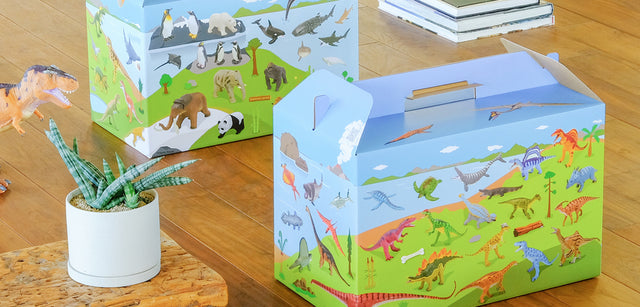
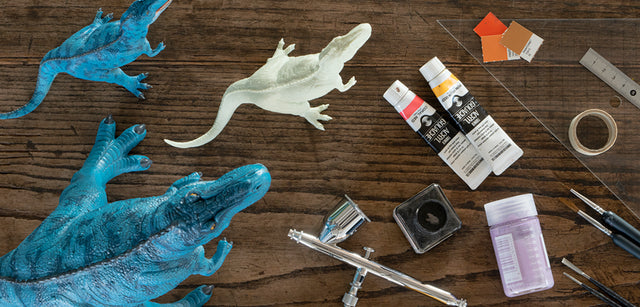
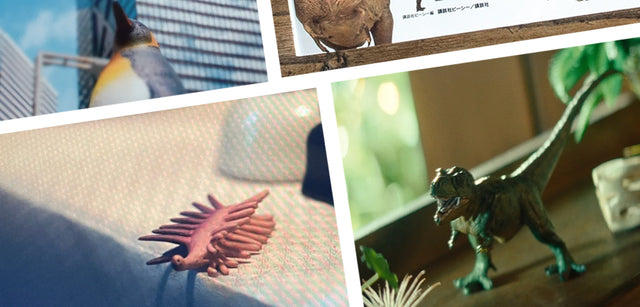
My opportunity to learn in depth about trilobites, about which I had very little knowledge until then, came from working on the prototype for Favorite Co., Ltd.'s prehistoric creature figure and mini-model series, the Olenoides (a genus of trilobite), and creating illustrations for the book "World Dinosaur Map." I worked on these two projects around the same time. For the Olenoides prototype, I had to learn about the structure of a trilobite's body. Since it was a figure prototype, I needed to meticulously sculpt the underside (ventral side) of the body as a three-dimensional object. Then, for "World Dinosaur Map," I drew illustrations of about 70 species of trilobites found worldwide, and through this process, I discovered the diversity of trilobite designs. Initially, I found flashy-looking species interesting, such as those with spines all over their bodies or those with distinctively shaped horns. However, as I drew many trilobites, I began to notice subtle differences even among species with simple forms, which also became fascinating. Furthermore, there are individual differences even within the same species depending on the specimen. The vast variety of types and designs, and the individual differences in each fossil specimen, gave me a glimpse into the depth and charm of the trilobite world, and I understood why there are so many trilobite fans and fossil collectors.
The Houston Museum of Natural Science Collection
It was around the time I started to grasp the appeal of trilobites that I visited the Houston Museum of Natural Science in the US. Initially, I was looking forward to seeing the exhibits of ancient vertebrates, including dinosaurs, but I was surprised by the trilobite exhibit when I got there. It is an exhibit based on Sam Stubbs' personal collection, and even I could appreciate the sheer number of specimens and the magnificence of each one. Furthermore, I was impressed by the exhibition method, which matched the high quality of the collection. If I hadn't worked on trilobite figures and illustrations beforehand, I probably wouldn't have realized the value of this exhibit as much, and I would have regretted it later once I did. I truly had the opportunity to learn about trilobites at a good time.


Nevertheless, my knowledge of trilobites is still quite limited. I'm barely at the very beginning of the introductory level. But that also means there's a huge amount of enjoyment still to come. The world of trilobites, with over 10,000 species described so far, seems daunting if one delves too deep, but I plan to continue paying close attention to trilobite exhibits during my museum visits and examining them more carefully than ever before.
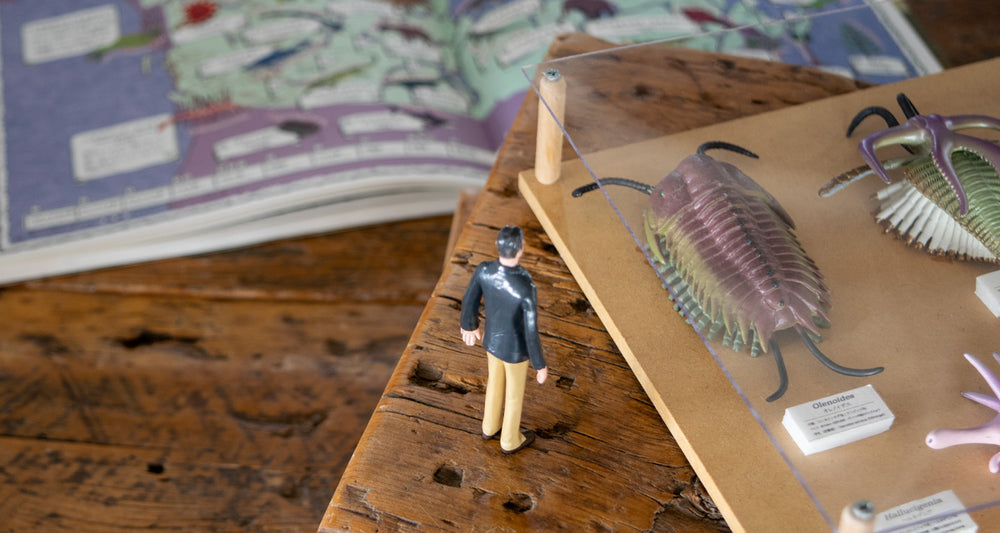
I colored Favorite's Olenoides and placed it in a specimen box. The specimen box was custom-made by Rokko Insectarium, an insect specimen shop in Kobe.
References
- "Trilobite: Eyewitness to Evolution" by Richard Fortey, Hayakawa Publishing, 2002
- "World Dinosaur Map" by Ken Tsuchiya, X-Knowledge, 2016
- "Ammonites and Trilobites" edited by Children's Science Editorial Department, Seibundo Shinkosha, 2012
← Older Post Newer Post →


